In an age defined by AI-enabled personalization, predictive analytics, and automated campaign orchestration, one strategic shift stands out: while technology grows more advanced, the demand for human-centered brand interaction is increasing, not declining. Event investments are expanding, not contracting. For organizations operating in hyper-competitive digital ecosystems, event-driven engagement offers one essential outcome that digital systems rarely deliver at scale: undivided, intentional, and emotionally anchored attention.
As omnichannel architectures widen and automation tools multiply, a strange paradox has emerged. Brands have more ways to communicate than ever before, yet fewer ways to connect meaningfully. Algorithms can optimize frequency and targeting, but they cannot replicate the context-building depth of physical presence, handshake familiarity, eye-level trust, and shared time. Events resolve this gap not by dismissing digital, but by grounding it. They transform abstract pipeline categories into conversations, personas into participants, and interest signals into active relational outcomes.
This shift has clarified one strategic truth: the debate today is not whether to invest in events, but how rigorously to architect them. Organizations with highest event ROI are those treating event programming as a revenue-aligned engine, not an isolated calendar moment. Event planning is now sequencing work: pre-event activation, mid-event behavioral design, and post-event conversion mapping. The event is not an endpoint—it is a conversion structure.
This guide presents the foundational frameworks that differentiate high-impact, audience-centric event programs: thematic positioning, selection of format, promotional runway calibration, attendee experience architecture, inter-departmental alignment, and post-event lifecycle planning that translates presence into pipeline.
Why do events still matter in an omnichannel world?
Strategy first: Audience, objectives, positioning
What event format should you choose: In-person, virtual or hybrid?
How do you drive event registrations and attendance?
How do you design events for attendee engagement?
What are the essential event KPIs?
How do you align teams for event success?
How do you maximize post-event value?
Practical takeaways & checklist
How to measure event marketing ROI
Tools to help with event marketing success
Ready to build your event marketing strategy?
Why do events still matter in an omnichannel world?
Global spend projections are definitive. The events sector is positioned to grow from $1.2 trillion in 2024 to $1.35 trillion in 2025, with projections reaching $2.1 trillion by 2032. This trajectory outpaces traditional advertising, campaign placement, and media channels.
Data reveals behavioral preference. According to ATN Event Staffing:
82% of attendees prefer in-person settings
1% prefer purely virtual engagement
17% remain open to hybrid adjacency
The psychological gap is not subtle. Face-to-face interaction compresses trust-building cycles, accelerates confidence, and reduces message fatigue. Digital immersion is scalable, but presence-based environments remain irreplaceable for negotiation clarity, premium positioning, and executive persuasion.
Virtual experiences retain strategic importance. They remain essential for learning distribution, dispersed territory access, and volume-centered reach. However, hybrid structures must be designed as two distinct experiential layers—not live broadcast duplication. A simultaneous audience is not a single audience.
Freeman’s research indicates that 77% of attendees report elevated trust in a brand following direct, physical engagement. Trust conversion in digital spaces is incremental; event conversion can be immediate. One macro keynote discussion can achieve what six months of drip marketing cannot.
Beyond trust, the contemporary event experience is diversified. Attendees no longer measure event value by tote bags, floor maps, and speaker lists. They expect structure that enables shared learning, curated access, thematic relevance, and community continuation beyond departure. An event is no longer a destination; it is a catalyst network.
The omnichannel dynamic enhances this. A single annual conference can fuel:
six months of social content
quarterly demand generation
sales enablement libraries
on-demand learning portals
74% of Fortune 1000 CMOs plan to expand experiential budgets entering 2025. Rising acquisition costs across digital platforms make event differentiation not just valuable but cost-efficient in strategic cycles.
Strategy first: Audience, objectives, positioning
Many companies reverse the order—venue before value, registration before relevance. Strategic event clarity precedes format definition.
Event marketing strategy aligns:
audience segmentation
desired commercial outcome
format selection
promotion timelines
content tracks
measurement criteria
Audience definition begins not with range but with restriction. Precision outperforms scale. Gather only those who justify experience investment and pipeline intent.
Start at ICP:
roles that authorize purchasing
industry verticals with highest LTV
decision cycles that match solution maturity
annual budget thresholds
adoption barriers and motivational triggers
Segmented attendees require layered programming. Executives require transformation framing; practitioners require tactical articulation. Strategy determines seating charts, agenda pacing, breakout volume, and speaker category.
Objective setting transforms performance outcomes. Vague targets dilute return.
Replace “maximize registrations” with:
“Generate 90 net-new enterprise-level opportunities with validated purchase windows.”
Replace “drive attendance” with:
“Accelerate mid-funnel accounts to active consideration with track-based executive solution mapping.”
SMART structure remains foundational, but event performance now extends toward economic clarity, churn protection, pipeline acceleration, and content repurposing volume.
54% of marketers do not track registration-to-event conversion
53% do not track opportunity creation post-attendance
40% do not calculate cost-per-engagement
This is not a measurement problem; it is a strategy sequencing problem.
What event format should you choose: In-person, virtual or hybrid?
Each format expresses a different revenue intention.
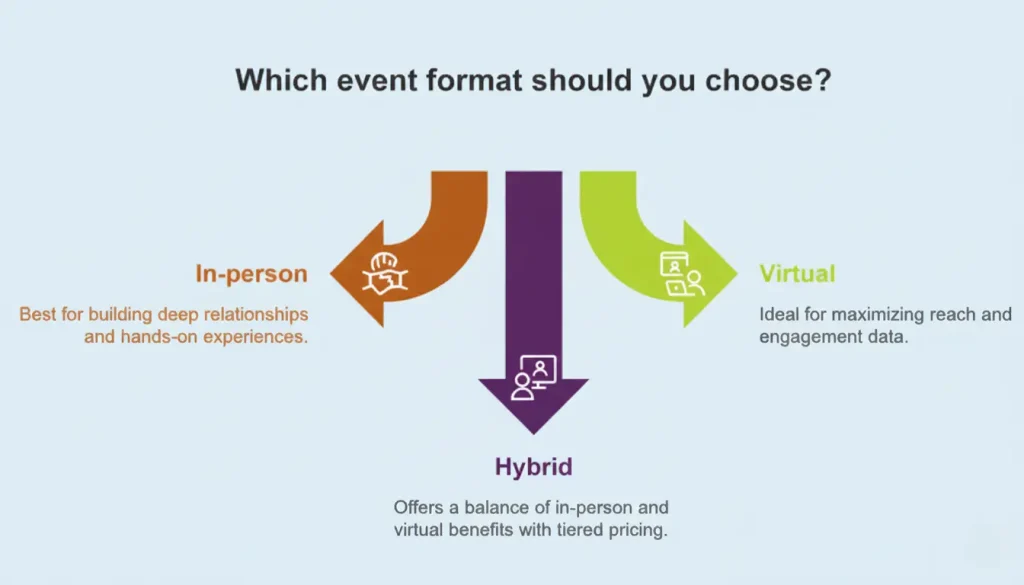
In-person delivers relational compression.
Virtual delivers instructional scale.
Hybrid delivers access segmentation.
Revenue distribution remains:
60% in-person
35% virtual
5% hybrid configuration
Event formats. Source: DMI
In-person formats excel where stakes require articulation. Enterprise sales cycles, technical demonstrations, and strategic negotiations translate best across spatial context.
Virtual formats excel where curriculum outweighs charisma, where repetition matters, and where audience distribution justifies frequency.
Hybrid formats require dual-design, not live relay. This is a two-program investment, not a duplicated lens.
Events achieving consistent ROI treat the calendar not as an annual milestone but as a thematic cycle. A flagship annual event is supported by quarterly webinars, bi-monthly expert panels, and curated regional micro-forums.
How do you drive event registrations and attendance?
Driving attendance remains one of the most deceptively complex functions in event marketing. Unlike digital sign-ups where friction can be abstracted and optimized in real time, event registration requires calibrated sequencing: messaging consistency, brand proof, audience segmentation, value articulation, and rhythm. Registration is not a single CTA, but a momentum line that begins weeks before and intensifies as the date approaches.
Strong registration outcomes always correlate with early runway planning and multi-channel alignment. Launching event announcements 6–8 weeks prior remains a widely validated benchmark because it gives enough time to warm intent, advance curiosity, and reinforce reason. The audiences least responsive to last-minute campaigns are senior decision-makers, which means calendar blocking, travel intent and internal approvals require earlier framing.
Volume is not the true metric; relevance is. Organizations that over-expand target lists see inflated registration counts but weakened attendance conversion, because cold audiences expressing curiosity do not match the experiential or strategic intent of the event. High performing programs pre-filter through ICP tiers, existing pipeline maturity, account status, and role type.
Registration should never open before the narrative is prepared. Speaker confirmations, agenda pillars, thematic framing, and executive alignment must exist before registration is activated, otherwise the messaging lacks irreversibility. If promotional language begins with “coming soon,” its informational dilution weakens conversion potential.
Multi-channel sequencing remains essential:
Email forms the narrative spine because it accommodates personal segmentation and high-resolution personalization. Executives should see outcome-level value propositions; practitioners should see practical application and learning specifics.
Paid channels expand beyond internal databases. LinkedIn targeting against job titles, firmographics, and software intent signals remains the preferred route for B2B contexts.
Social layers sustain excitement. Internal advocates, speaker spotlights, countdown messaging and backstage access cues create a forward pull.
Partner amplification unlocks adjacency. Co-branded invitations with sponsors extend networks through allied trust rather than cold reach.
Registration experience itself performs as a conversion asset. Forms streamlined to core fields — name, title, company, email — consistently outperform multi-question sequences. Details not essential to entry can be captured later in the nurture cycle. Value must be positioned visibly above logistics; attendees should be told why they should care before when and where.
Late-stage lift remains predictable. It is common for 12–20% of registrations to occur in the final 72 hours. Momentum should not taper. Messaging frequency should rise without shifting tone toward urgency that signals scarcity over value. If urgency becomes dominant, consideration becomes defensive rather than enthusiastic.
Attendance conversion sits between 50–60% across most enterprise events. When conversion drops below 40%, messaging often lacked clarity, friction existed in calendar reminders, or pre-event engagement was under-cultivated. Reminder cadence, calendar blocking links, speaker preview notes, and thematic reinforcement narrow this gap.
Screenshot of webinar registration from Slack
How do you design events for attendee engagement?
Event attendance is not equivalent to event engagement. Many organizations reach the door but never reach the mind. Engagement is a design architecture, not a by-product of interesting speakers or curated audiovisual staging.
49% of marketers cite engagement as the core indicator of event success, yet most event programs still treat it as a secondary layer. True engagement is embedded in agenda sequencing, content pacing, speaker framing, and audience interaction mapping.
Content must move beyond performance to participation. Modern attendees no longer accept passive lecture modes as default. They expect knowledge interactivity, thematic peer connection, open dialogue frameworks, and accessible direct input. Keynotes expand imagination; breakouts operationalize it. Panels layer perspectives; workshops anchor learning.
Selecting speakers requires editorial discipline. Recognizable thought leaders gain draw, but high-value programming often comes from practitioner depth with contextual relevance. Avoid speaker placement that prioritizes celebrity over clarity.
Interaction pathways determine energy distribution. Live polling during sessions activates real-time sentiment. Open Q&A with structured moderator facilitation ensures multi-voice representation. Small group discussions following industry breakouts enable trust-based exchange, not just content absorption.
Events that become communities extend beyond their closing hour. Attendee-only channels in Slack, LinkedIn, or private platforms preserve relational continuity. Content recirculation, shared resource access, speaker follow-ups, and curated micro-meetups sustain memory and brand presence.
Personalization deepens engagement. First-time attendees should not receive the same programming intensity as returning veterans. Executive-target cohorts require private leadership forums rather than open breakouts. Segmenting by role maturity, industry vertical, and learning objective ensures the right people sit in the right conversations.
Engagement is the difference between presence and participation. Events are not measured by who arrived, but by who contributed, learned, returned, and built new internal narratives anchored in brand trust.
What are the essential event KPIs?
Measurement remains the least prioritized phase in many event programs. Funds are allocated, planning is executed, engagement is delivered — yet many organizations lack a structured evaluation model to trace event impact into pipeline clarity and commercial attribution.
Event KPIs must mirror the experiential arc:
Top-of-funnel
Registration count contextualized by ICP alignment is a stronger metric than raw intake. Cost-per-registrant tied to audience quality guides future spend allocation.
Middle-of-funnel
Attendance ratio signals value recognition. Industry benchmark remains near 57%. Below 45% indicates pre-event messaging weakness. Engagement per session, chat logs, content recall, question frequency, and dwell-time modeling advance interpretation beyond attendance.
Bottom-of-funnel
Conversion hierarchy matters: lead qualification, opportunity creation, sales acceleration, renewal lift, and cross-sell migration. Qualitative conversion — those becoming advocates, speakers, or repeat participants — remains as commercially consequential as pipeline metrics.
CRM integration is operational, not optional. Without CRM synchronization, lead origin attribution fractures. Event attendance must map to deal stage, projected timing, account owner, and nurture sequence. Otherwise, insight dissolves.
Event performance cannot be viewed as standalone. It must be connected to marketing automation flows, sales sequences, on-demand replay analytics, post-event interaction clustering, and account-intelligence overlays. If the event stands alone, the event fails.
How do you align teams for event success?
Events function at their highest yield when multiple departments operate not in parallel lines, but in cooperative architecture.
Marketing frames message and narrative. Sales qualifies, pre-books conversations, and aligns intent. Product teams validate demonstrational depth. Content teams capture repurposable assets. PR teams amplify positioning. Operations ensures invisibility of tension in movement flows.
Misalignment fractures ROI. When marketing measures engagement but sales measures conversion, the event lacks shared purpose. When content teams capture footage but do not coordinate distribution timelines with campaign teams, content becomes archive rather than activation.
Define handoff logic before the event occurs:
What qualifies an attendee into sales conversation?
Which engagement signals trigger what follow-up?
What timeline honors curiosity without pressurizing it?
A RACI model across event milestones clarifies ownership:
Responsible
Accountable
Consulted
Informed
Pre-event alignment meetings surface collision points. Post-event debriefs capture corrective narratives while memory is precise, not approximate.
Events operate best when treated not as experiential outcomes but organizational systems.
How do you maximize post-event value?
Event success is rarely determined by the moment attendees exit the venue or disconnect from a virtual session. Post-event activity, more than any individual keynote or breakout, dictates whether the event becomes a revenue catalyst or a cost center. Organizations that treat event closure as a completion stage lose compounding return. The actual multiplication of value begins only after the doors close.
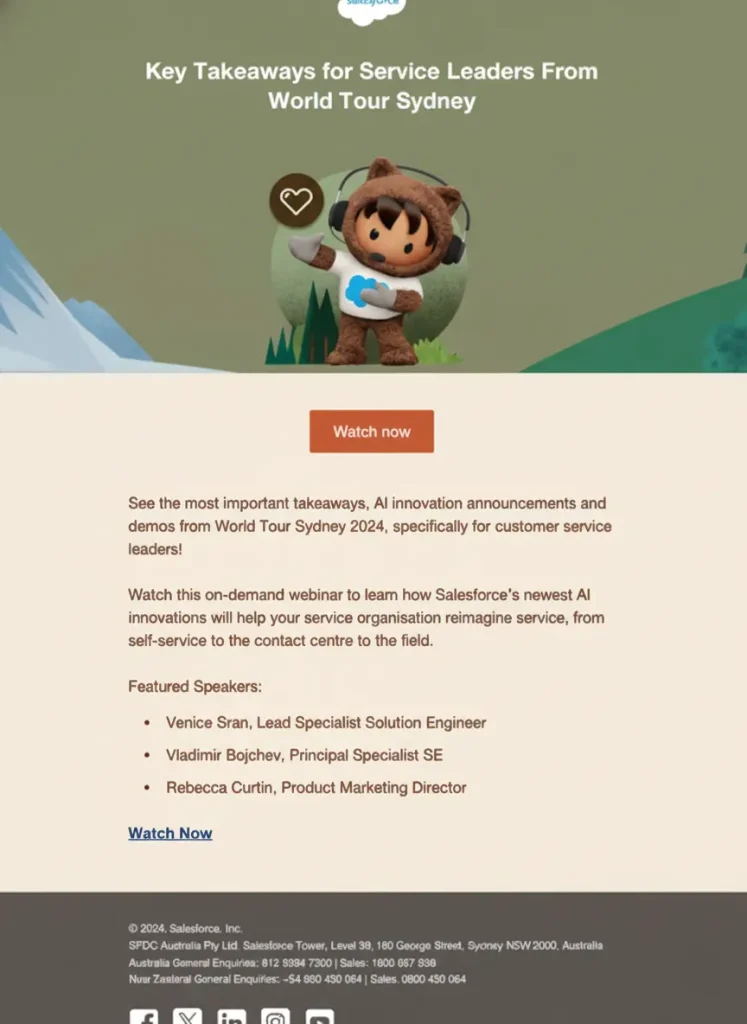
Momentum must be preserved while memory is vivid. Messaging should initiate within 24 hours, not as a transactional thank-you slip, but as a structured continuation of intellectual and commercial relevance. A well-executed follow-up does not simply acknowledge attendance; it contextualizes, redistributes and extends it. Access to session recordings, curated takeaways, speaker insights, and resource libraries converts event presence into long-term consumption.
Segmentation is vital in follow-up tiers. Attendees who visited three or more sessions should receive deeper paths than someone who registered but did not attend. Silent registrants should receive access to on-demand content, not be treated as inactive leads. Buyers in consideration cycles should receive structured demos, not generic education. High-engagement clusters should be flagged to sales teams with full behavioral mapping.
Repurposing is not optional. A singular event can power months of structured content supply. Keynotes into articles. Panels into thematic series. Workshops into gated assets. Q&A threads into industry reports. Community discussion into trend analysis. Without systematic content decomposition, events remain ephemeral, not evergreen.
Salesforce event follow-up. Source: Salesforce
Community extension matters. The most effective programs maintain communication channels in Slack, Teams, private LinkedIn circles, or branded portals. The intent is to transform temporal convergence into ongoing discourse, not to mimic social chatter, but to curate continued learning. Participants should remain connected not because they attended, but because they gained identity inside a shared room.
Post-event measurement must also include behavioral indicators: return interest, replays per attendee, resource downloads, meeting acceptances, and ABM-specific acceleration. Engagement that continues after exit signals conversion probability more accurately than attendance itself.
Post-event strategy is a relay, not a reset. Momentum steepens only when the narrative continues.
Practical takeaways & checklist
Event execution requires rigor, not improvisation. The following timeline reflects strategic orchestration rather than task enumeration. Each phase interacts with the next; none exists independently.
90 days out: Define
ICP specificity
speaker agreements
program architecture
budget and KPI alignment
preliminary partner confirmation
60 days out: Launch
registration
multi-channel promotion
audience segmentation
sales alignment
tech stack synchronization
content capture plan
30 days out: Intensify
agenda visibility
speaker promotion
calendar blockers
community seeding
rehearsal scheduling
on-site operations
Event week: Execute
technical validation
moderation briefing
recording infrastructure
engagement monitoring
partner integration
media handling
Post-event: Convert
segmented nurture sequences
pipeline mapping
meeting handoffs
content deployment
audience summit evaluation
post-event analysis for recurrent scaling
Event architecture becomes predictable only when milestones are documented and internal friction is minimized through timeline standardization.
How to measure event marketing ROI
Events rarely contribute singular influence in modern attribution. They function alongside digital flows, nurture sequences, ABM frameworks, and executive briefings. Therefore, attribution must evolve beyond single-touch simplification to multi-touch calculation. A lead nurtured through webinars, newsletters, and sales consultations but accelerated to decision through a live event remains an event-influenced outcome, not an isolated origin.
Metrics that dominate revenue conversation must include:
pipeline velocity shifts
contract expansion likelihood
retention stabilization
advocacy creation
content lifecycle duration
audience acquisition cost relative to account value
ROI cannot be calculated only through immediate deals. A high-consideration enterprise account influenced by event proximity may convert six months later. The event remains causative, regardless of delay.
Event value must be measured in both directional and durable impact. Engagement scored, consumption patterns sustained, content assets activated, and reputation strengthened. Events can shrink acquisition cycles, elevate category authority, and build leadership credibility in a way digital sequences alone cannot.
Budget justification must include not only cost-per-registration but cost-per-engaged-attendee, cost-per-qualified-conversation, and cost-per-converted-account. Without these distinctions, event reporting becomes shallow and unpersuasive.
Tools to help with event marketing success
Event management platforms such as Bizzabo, Cvent and Splash centralize registration, ticketing, check-in, and badge operations. Their infrastructure integrates attendee data and automates primary administrative sequences. Virtual and hybrid platforms including ON24, Zoom, and BigMarker power digital breakout environments, session analytics and behavioral depth.
Email and marketing automation frameworks including Marketo, Pardot, and HubSpot synchronize communication and score engagement. CRM alignment becomes critical not for list segmentation alone, but for sustaining commercial traceability. Slack, Brella, and Slido facilitate conversation continuity, peer match, live polling and speaker exchange. Integrative data now matters as much as production value.
Event marketing technology is no longer a stack; it is an ecosystem. Each platform performs a single function, but values compounds through interconnection. Fragmented tooling produces fragmented insights.
Ready to build your event marketing strategy?
Event marketing remains one of the few environments where presence and perception align. When executed with precision, events do not simply deliver programming; they deliver trust. A digital world saturated with algorithmic placement and automated personalization cannot replicate shared physical space, collective learning, or relational acceleration.
Brands outperform competitors not by scaling messaging, but by creating significance. Effective event programs are not improvisational stagecraft but designed systems of commercial and experiential intelligence. Audience alignment, format discipline, narrative coherence, KPI measurement, and community extension transform events from annual milestones into strategic infrastructure.
Start with strategy. Proceed with orchestration. Measure with discipline.
In a climate of content saturation, events remain the one setting where attention, not automation, becomes the primary driver of business impact.
FAQs
Why are events still more effective than purely digital engagement?
Events condense trust and connection into concentrated timeframes that digital channels spread across months.
How soon should organizations launch event promotion?
Six to eight weeks prior remains optimal, allowing calendar planning and value affirmation cycles to form.
What percentage of registered attendees typically convert to presence?
Benchmarks approximate 57%, with high-performing programs exceeding 70%.
Why is segmentation essential after the event concludes?
Different engagement levels require differentiated follow-through. High-interaction participants need advanced pathways, not generic outreach.Can hybrid events replace in-person entirely?
Hybrid environments extend access but cannot replicate physical relational density. They remain formats of inclusion, not replacement.