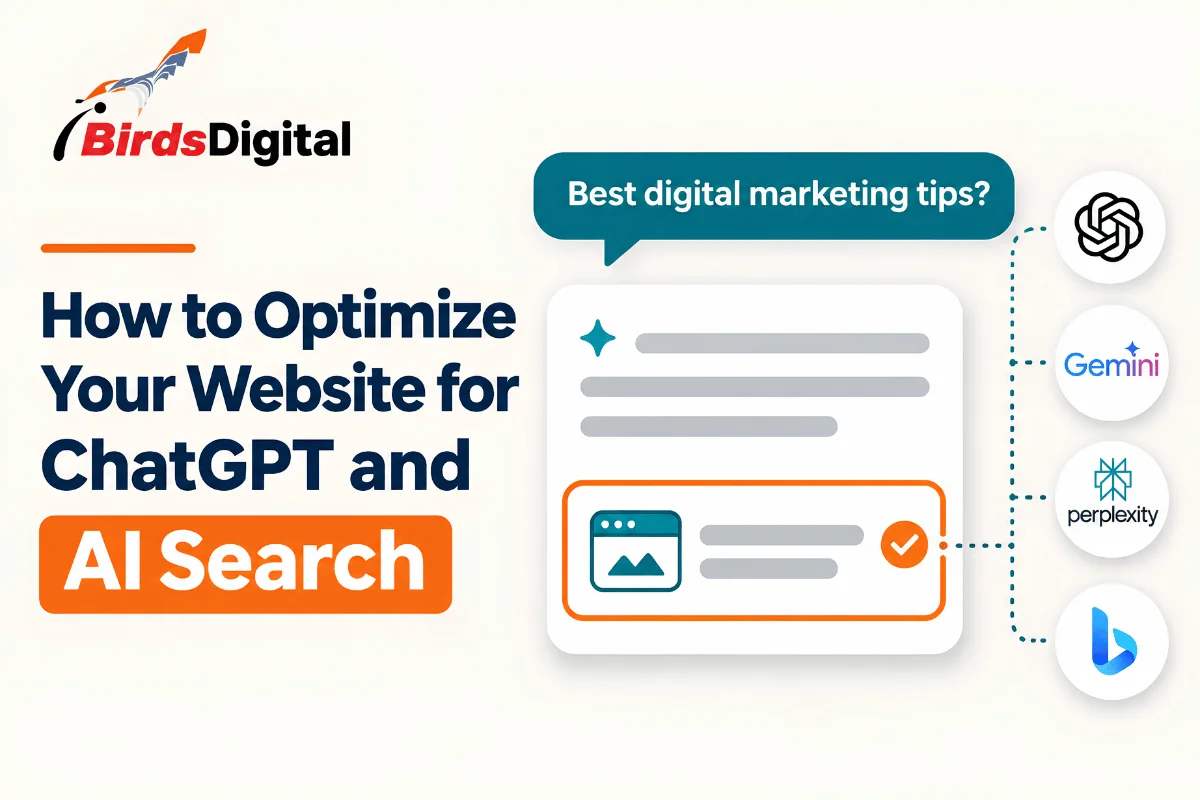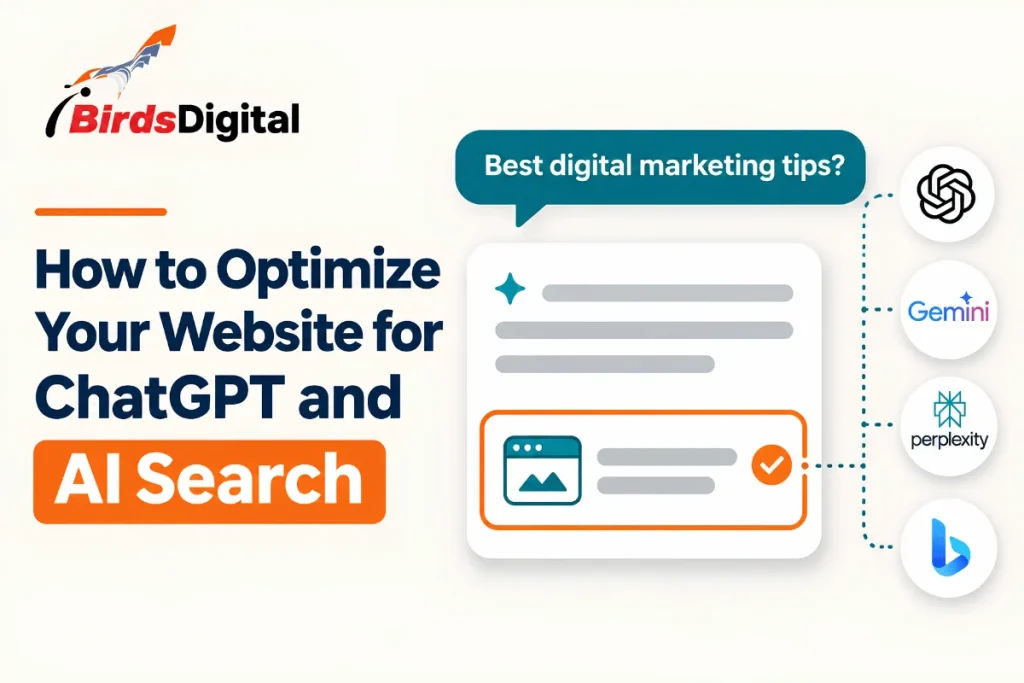

Search behaviour is changing. People are no longer relying only on traditional search engines to find information, products, and services. They are also asking AI-powered platforms such as ChatGPT, Google AI Overviews, Gemini, Microsoft Copilot, and Perplexity for direct answers, comparisons, and recommendations.
This shift creates a new opportunity for businesses. Your website needs to be useful for visitors, but it should also be structured so search engines and AI systems can understand your content.
This is where Generative Engine Optimization (GEO) and Answer Engine Optimization (AEO) become important. Both approaches build on traditional SEO by focusing on helpful information, clear answers, brand authority, and visibility across AI-powered search experiences.
If you want to Optimize Website for ChatGPT, you need a strategy that combines useful content, strong technical SEO, clear website structure, and a trustworthy online presence.
What Is AI Search Optimization?
AI search optimization is the process of improving website content and structure so AI-powered search platforms can understand, interpret, and potentially reference your information when generating answers.
Traditional search engines generally display a list of relevant websites. AI search tools can interpret questions, gather information from different sources, and generate conversational answers.
For example, a user might search for “SEO services” or ask an AI assistant, “How can a small business improve its website rankings?”
The second question requires useful explanations, relevant details, and clear information. Websites that provide these things have a better opportunity to be understood and considered as sources.
However, no optimization method guarantees that an AI platform will mention or recommend a particular website.
Why Should Businesses Optimize for ChatGPT and AI Search?
AI-powered search is creating additional ways for customers to discover businesses. People may use these tools to compare services, research products, understand problems, and find recommendations.
For businesses, this means their online presence should communicate five things clearly:
- What the business offers.
- Which customers it serves.
- What problems its products or services solve.
- Why its information or experience is trustworthy.
- Where users can find accurate and useful details.
When you Optimize Website for ChatGPT, you make your website easier to understand for both people and search systems.
AI visibility also depends on factors outside your website, including brand mentions, third-party information, reviews, and the availability of reliable sources. Therefore, AI search optimization should be part of a wider digital marketing strategy rather than a replacement for traditional SEO.
How to Optimize Website for ChatGPT: 10 Practical Strategies
1. Create Clear and Direct Answers
AI platforms often respond to specific questions. Your website content should make it easy to identify the answer without requiring visitors to read several unrelated paragraphs.
Start important sections with a direct explanation, then add supporting details, examples, and practical information.
For example, instead of beginning a section with a long introduction about website performance, answer the question directly:
“Website speed optimization improves how quickly a website loads by reducing unnecessary scripts, compressing images, and improving server performance.”
You can then explain each technique in more detail.
This approach helps visitors understand the subject quickly and gives search systems clearly structured information to interpret.
2. Use Question-Based Headings
People use conversational questions when searching through AI assistants. Your headings should reflect the questions your potential customers actually ask.
For example:
- What Is Search Engine Optimization?
- How Does AI Search Work?
- Why Is Website Speed Important?
- How Can Small Businesses Improve Online Visibility?
- What Should You Include in a Website SEO Strategy?
Question-based headings make your content easier to navigate and help organize information around specific search intents.
Include your focus keyword naturally in a relevant heading. For example, a section titled “How to Optimize Website for ChatGPT With Better Content” directly supports the main topic.
Avoid repeating the same keyword in every heading. Each heading should describe the information that follows it.
3. Publish Helpful and Detailed Content
Content quality remains important for traditional SEO and AI search visibility.
Avoid publishing articles that only repeat basic information already available across hundreds of websites. Instead, provide useful explanations, practical steps, examples, comparisons, and original insights.
For stronger content:
- Explain complex topics in simple language.
- Include relevant examples from real business situations.
- Answer common customer questions.
- Explain the advantages and limitations of different approaches.
- Update outdated information when necessary.
- Support important claims with reliable sources.
For example, a blog about digital marketing should explain how businesses can use SEO, content marketing, paid advertising, and analytics rather than simply listing these services.
A useful content strategy also helps establish your website as a reliable resource within its subject area.
4. Build Topic Authority With Related Content
Publishing one article about a topic is not always enough to demonstrate expertise. Your website should cover related subjects in a meaningful and organized way.
For example, a digital marketing website can create connected content around:
- Search engine optimization.
- Generative Engine Optimization.
- Answer Engine Optimization.
- Website performance.
- Technical SEO.
- Content marketing.
- Keyword research.
- Website analytics.
Connect relevant articles through contextual internal links. This helps visitors discover related information and gives search engines a clearer understanding of how your website content is connected.
You can also explore how SEO, GEO, and AEO work together to understand the wider approach to modern search visibility.
A well-planned content structure makes it easier to build subject coverage instead of publishing unrelated articles.
5. Improve Website Structure and Readability
A website should have a logical structure that helps visitors and search systems understand its information.
Organize your content using descriptive headings, short paragraphs, meaningful page titles, and relevant navigation links.
For blog articles, use one main H1 heading followed by H2 and H3 headings to organize the sections.
You should also:
- Use descriptive URLs.
- Create clear category and service pages.
- Add relevant internal links.
- Avoid unnecessary duplicate pages.
- Make important information easy to access.
- Use descriptive image filenames and alt text.
A well-organized website improves navigation and makes important information easier to discover.
Your WordPress website development approach should also consider content structure, usability, mobile responsiveness, and technical performance.
6. Use Relevant Structured Data
Structured data helps search engines understand specific information about a webpage.
Depending on the content, suitable Schema.org markup may include:
- Organization schema for business information.
- LocalBusiness schema for eligible local businesses.
- Article schema for blog posts.
- Product schema for product pages.
- BreadcrumbList schema for website navigation.
- Person schema for relevant author information.
For example, Article schema can identify the headline, author, publication date, and other article details.
Use structured data that accurately represents the visible content on your page. Test your markup using Google’s Rich Results Test.
Remember that structured data does not guarantee an AI mention, search ranking, or rich result. Its purpose is to provide clearer information about your content.
7. Check AI Crawler Access
AI platforms use different systems to discover information and access websites. Website owners should understand which crawlers are relevant to their visibility goals.
OpenAI documents crawlers such as:
- OAI-SearchBot: Used for search-related discovery and visibility in ChatGPT search.
- GPTBot: Used to crawl content that may be used for model training.
- ChatGPT-User: Used when ChatGPT users request information from websites.
These crawlers have different purposes. Allowing one does not automatically mean you have allowed every other crawler.
Review your robots.txt file and server settings to check whether relevant crawlers are being blocked. Also check whether your hosting provider, firewall, or security plugin is restricting access.
You can refer to the official OpenAI crawler documentation for current crawler information and guidance.
Do not change crawler permissions without understanding their purpose and how those settings affect your website.
8. Create Strong Brand and Business Information
AI search systems may use information from multiple sources when understanding a business.
Your website should clearly explain who you are, what you offer, where you operate, and how customers can contact you.
Create or improve important pages such as:
- About Us.
- Contact Us.
- Services.
- Team or author profiles.
- Customer reviews and testimonials.
- Case studies and business examples.
Keep your business name, address, contact details, and service descriptions consistent across relevant online platforms.
You should also develop a trustworthy online presence through genuine customer reviews, relevant business listings, useful industry contributions, and accurate third-party mentions.
Brand authority takes time to build. Avoid artificial mentions or misleading claims simply to increase visibility.
9. Keep Your Content Accurate and Updated
Outdated information can reduce the usefulness of a webpage. This is especially important for subjects that change frequently, such as software, digital marketing, technology, and online search.
Review older articles and check whether their facts, examples, links, screenshots, and recommendations are still relevant.
When updating content:
- Correct outdated information.
- Replace broken links.
- Add new and useful examples.
- Remove unnecessary or inaccurate sections.
- Update screenshots where the interface has changed.
- Make publication and modification dates accurate.
Do not change a publication date just to make an article appear fresh. Update it when meaningful changes have actually been made.
A regular content review process helps maintain the quality of your website and provides visitors with more reliable information.
10. Improve Technical SEO and Website Performance
Even useful content needs a technically accessible website.
Slow loading pages, broken links, mobile usability problems, and poor navigation can create a frustrating experience for visitors.
Focus on important technical areas such as:
- Mobile-friendly website design.
- Fast page loading.
- Image compression and modern image formats.
- HTTPS security.
- XML sitemap availability.
- Correct canonical tags.
- Crawlable internal links.
- Proper indexing settings.
- Clean redirects and broken-link management.
Website performance is particularly important for user experience. You can follow these website speed optimization techniques to improve loading performance.
A regular SEO audit can also help identify technical issues that may affect search visibility.
How to Check Your Website’s AI Search Visibility
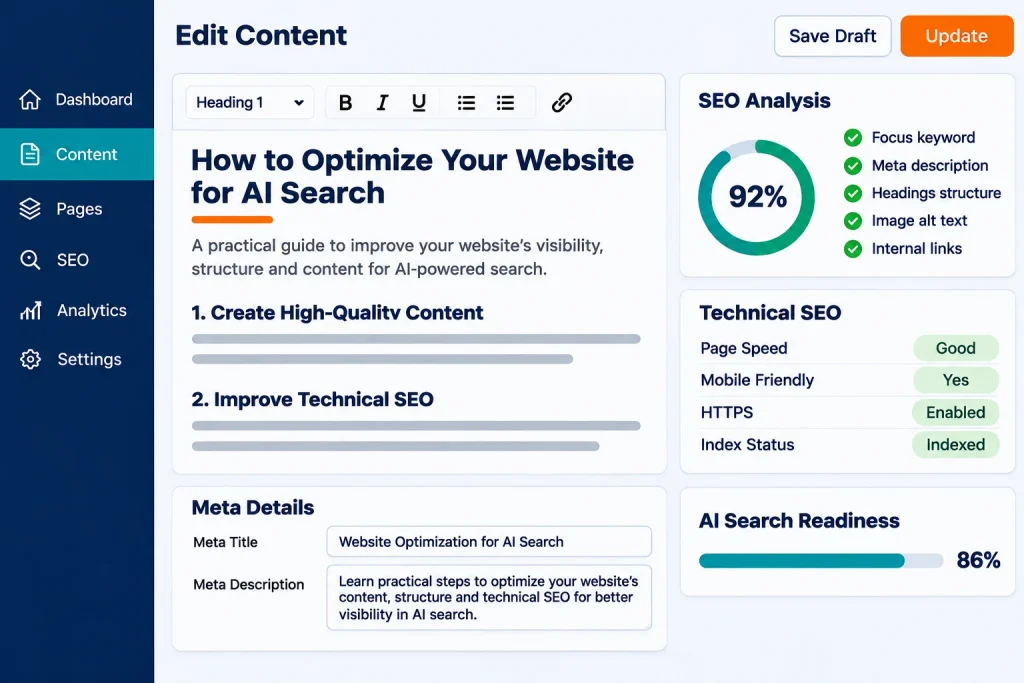
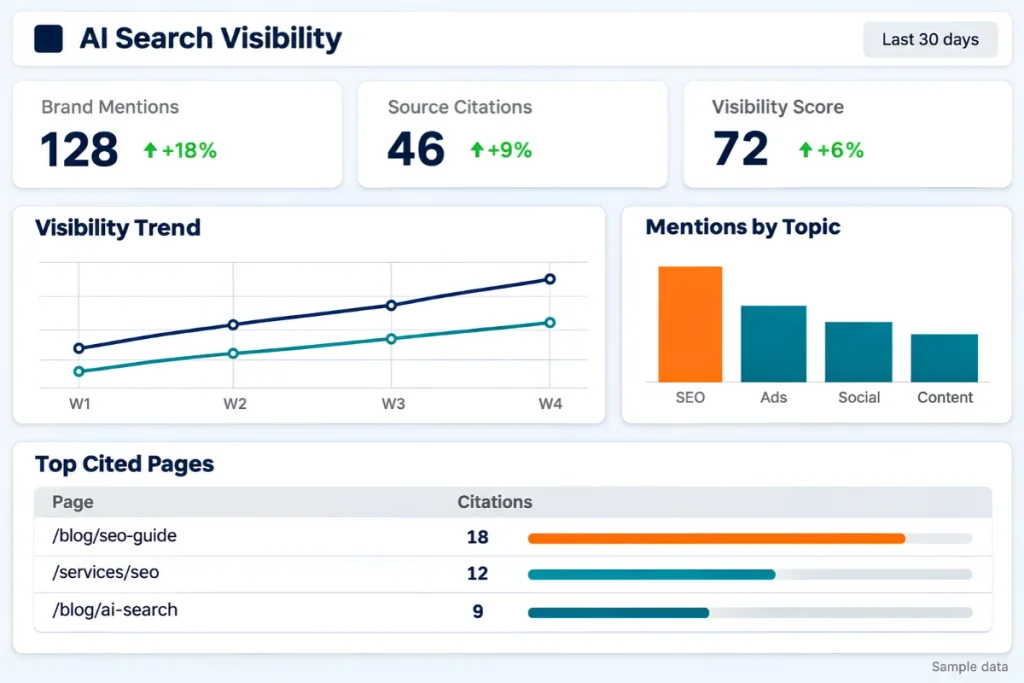
After implementing your optimization strategy, you should review whether your content is appearing in relevant AI-powered search experiences.
There is no single measurement that provides a complete picture of AI visibility. Use a combination of manual checks and website analytics.
1. Test Relevant Questions
Search for questions that your potential customers might ask. Try different wording and compare whether your website or brand appears in the responses.
2. Review Source References
When an AI platform provides source links, check whether your website is included. Review which pages are referenced and whether the information is accurate.
3. Monitor Brand Mentions
Look for mentions of your business across relevant websites, directories, industry publications, and review platforms.
4. Review Website Analytics
Monitor organic traffic, referral traffic, landing pages, and engagement patterns. Where available, identify visits coming from AI platforms.
5. Track Results Over Time
Repeat your checks using similar questions. Keep a record of the prompts, platforms, dates, and results so you can identify changes.
AI-generated responses can vary depending on the question, location, platform, and available sources. One search result should not be treated as a permanent ranking position.
Traditional SEO vs AI Search Optimization
Traditional SEO and AI search optimization have different presentation styles, but they share many important foundations.
| Traditional SEO | AI Search Optimization |
|---|---|
| Focuses on visibility in search results | Focuses on visibility in AI-generated answers |
| Targets keywords and search intent | Targets questions, context, and intent |
| Uses pages and backlinks to support authority | Also benefits from clear brand information and reliable sources |
| Uses technical SEO and content optimization | Uses technical SEO, structured content, and clear information |
| Measures rankings, clicks, and organic traffic | Also monitors mentions, citations, and AI referral traffic |
Businesses should not abandon traditional SEO to focus only on AI search.
The better approach is to build a strong SEO foundation and make content easier for AI-powered systems to understand and reference.
Common Mistakes to Avoid When Optimizing for AI Search
Some businesses focus too much on AI search trends and overlook the fundamentals of website quality.
Avoid these common mistakes:
Keyword stuffing: Repeating phrases unnaturally can make content difficult to read. Use keywords where they genuinely fit.
Publishing generic AI content: Content that offers no original value or practical information may struggle to stand out.
Ignoring technical SEO: Useful content cannot perform properly if important pages are inaccessible, blocked, or incorrectly indexed.
Using misleading structured data: Schema markup should accurately describe the visible page content.
Creating artificial brand mentions: Focus on genuine business information, customer experiences, and relevant industry contributions.
Expecting instant results: Search visibility and brand authority take consistent work. No technique guarantees placement in an AI-generated answer.
Frequently Asked Questions
1. How do I optimize my website for ChatGPT?
To optimize your website for ChatGPT, publish useful and accurate content, answer relevant questions clearly, improve website structure, use appropriate structured data, and maintain strong technical SEO. You should also make sure relevant crawlers can access the pages you want to be discoverable.
2. Does traditional SEO help with AI search visibility?
Yes. Traditional SEO practices such as helpful content, crawlability, internal linking, mobile usability, and website performance provide a strong foundation. AI search optimization builds on these practices with additional attention to conversational questions, clear answers, and brand information.
3. What is the difference between GEO and AEO?
Generative Engine Optimization (GEO) focuses on improving content visibility in generative AI experiences. Answer Engine Optimization (AEO) focuses on making information useful and easy to interpret for systems that provide direct answers. Both approaches overlap and complement traditional SEO.
4. Is llms.txt necessary for ChatGPT optimization?
No. An llms.txt file is an optional proposal intended to help AI systems understand website content. It is not a guaranteed ranking factor or a requirement for ChatGPT visibility. Prioritize accessible pages, useful content, and sound technical SEO first.
5. How long does AI search optimization take?
There is no fixed timeline. Results depend on your website’s current condition, content quality, technical accessibility, competition, and how AI platforms discover information. Review your performance regularly rather than expecting immediate mentions.
6. Can a small business appear in ChatGPT answers?
Yes, a small business can potentially appear in AI-generated answers when its information is relevant and discoverable. Maintain accurate business details, publish useful service-related content, build genuine customer reviews, and develop a consistent online presence. However, appearance in an answer is never guaranteed.
Final Thoughts
AI-powered search is changing how people discover information and businesses online. Companies that want to remain visible should pay attention to content quality, website structure, technical SEO, and brand credibility.
To Optimize Website for ChatGPT, start with the basics: answer customer questions clearly, publish genuinely helpful information, organize related content, maintain accurate business details, and make your website technically accessible.
These improvements can support both traditional search visibility and AI search readiness.
At iBirds Digital, we focus on practical digital marketing and SEO strategies that help businesses strengthen their online presence and connect with the right audience. A consistent approach to SEO, content, and website optimization can help prepare your business for the changing search landscape.