
Ranking a website on Google is not just about targeting individual keywords. Businesses also need to demonstrate that their websites provide useful, reliable, and relevant information about the subjects they cover.
Imagine a digital marketing website that publishes one article about SEO and then moves to unrelated topics. Another website regularly publishes helpful content about keyword research, technical SEO, link building, website optimization, content strategy, and search engine updates. The second website provides a much broader view of the subject.
This is the basic idea behind topical authority in SEO. Instead of focusing only on individual keywords, you build a connected collection of useful content around the topics that matter to your audience.
A well-planned content strategy can improve website organization, support internal linking, address different search intents, and help search engines understand your areas of expertise.
In this guide, we will explain what topical authority means, why it matters, and how to build it through a practical SEO strategy.
What Is Topical Authority in SEO?
Topical authority in SEO refers to the level of knowledge, relevance, and credibility a website demonstrates about a particular subject through its content and overall online presence.
For example, a website that focuses on digital marketing might cover:
- Search engine optimization.
- Keyword research.
- Technical SEO.
- Content marketing.
- Local SEO.
- Link building.
- Website performance.
- SEO analytics.
When these topics are covered in useful detail and connected through relevant internal links, the website creates a stronger content structure around digital marketing.
Topical authority is not simply about publishing as many articles as possible. It is about covering the right subjects in a way that genuinely helps readers.
Google does not publicly identify topical authority as a standalone ranking factor. However, its guidance emphasizes helpful, reliable, people-first content and the importance of demonstrating experience and expertise.
Topical Authority vs. Domain Authority
Topical authority and domain authority are related SEO concepts, but they describe different things.
| Topical Authority | Domain Authority |
|---|---|
| Focuses on expertise in a specific subject | Estimates a website’s overall link-based authority |
| Built through relevant and comprehensive content | Influenced by backlinks and the wider link profile |
| Helps organize a website around a particular niche | Provides an estimate of a site’s competitive strength |
| Can be developed around individual subject areas | Generally evaluates the domain as a whole |
Domain Authority is a third-party SEO metric, not a Google ranking score. Different SEO tools use their own methods to estimate domain strength.
A website can build strong topical coverage in a focused niche even when its overall domain metrics are not particularly high. However, content quality, competition, technical performance, backlinks, and other SEO factors still matter.
Why Is Topical Authority Important for SEO?
A website with well-organized, relevant content can provide a better experience for visitors and make its subject coverage easier to understand.
Here are some important benefits of building topical authority.
1. Better Coverage of Search Intent
People search for information at different stages of their decision-making process. Some want basic explanations, while others are comparing solutions or looking for a service provider.
Covering these different needs helps your website become more useful to its audience.
2. Stronger Internal Linking
Related articles can link to one another naturally. This helps visitors discover additional information and gives search engines more context about the relationships between pages.
A well-planned internal linking strategy also helps users navigate between general guides and detailed articles.
3. More Opportunities for Organic Traffic
Each useful article can target a different relevant search query. A connected collection of content can create opportunities to reach people searching for related questions and solutions.
However, publishing more pages does not automatically guarantee higher traffic. Content must satisfy search intent and provide real value.
4. Improved Content Organization
Topic clusters help organize website content into clear subject areas. Visitors can find information more easily, while website owners can identify missing topics and content gaps.
5. Support for AI Search Visibility
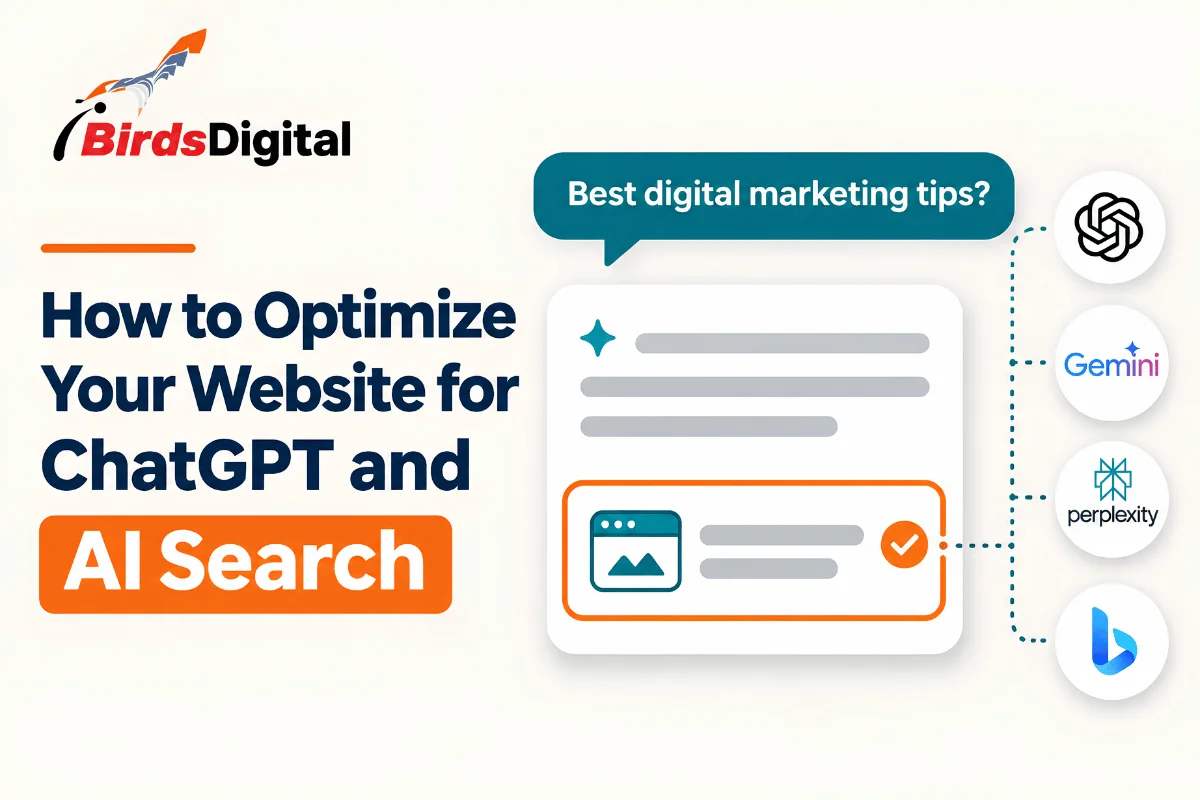
AI-powered search experiences also need understandable and relevant information. Comprehensive content, clear explanations, reliable sources, and consistent business information can support discoverability across different search experiences.
For a deeper understanding, read our guide on SEO, GEO, and AEO.
How to Build Topical Authority in SEO: 7 Practical Strategies
Building topical authority requires planning, research, useful content, and consistent improvements. Follow these seven strategies to develop a stronger content foundation.
1. Choose a Clear Niche and Core Topic
Start by deciding which main subject your website should be known for.
Your core topic should be closely related to your business, services, products, and audience. Avoid selecting subjects simply because they have high search volume.
For example, a digital marketing agency might choose SEO as one of its main content areas.
That topic can be divided into smaller categories:
- On-page SEO.
- Off-page SEO.
- Technical SEO.
- Local SEO.
- Keyword research.
- SEO content writing.
- SEO reporting and analytics.
Each category provides opportunities to publish useful supporting content.
Before choosing a topic, consider your audience’s needs, your team’s knowledge, your services, and whether you can create meaningful content around the subject over time.
A focused content strategy is usually more manageable than publishing unrelated articles across many industries.
2. Conduct Topic-Based Keyword Research
Once you have selected your core topic, research what your audience wants to learn.
Do not limit your research to one primary keyword. Find related questions, problems, comparisons, and long-tail searches that belong to the same subject.
Useful research methods include:
Google Autocomplete: Enter your main keyword into Google and review the suggestions.
People Also Ask: Explore related questions that reveal what users want to understand.
Related Searches: Check the searches shown near the bottom of Google results for additional content ideas.
Competitor Analysis: Review competitor blogs, category pages, and content structures to identify subjects they cover that your website has not addressed.
Keyword Research Tools: Use tools such as Google Keyword Planner, Ahrefs, Semrush, or other SEO platforms to discover relevant keywords and estimate search demand.
For example, if your core topic is website SEO, your research may identify these content ideas:
| Subtopic | Example Keyword |
|---|---|
| SEO basics | What is SEO? |
| Keyword research | How to find keywords for SEO |
| Technical SEO | Technical SEO checklist |
| On-page SEO | On-page SEO best practices |
| Link building | How to build quality backlinks |
| SEO reporting | How to measure SEO performance |
Group keywords by search intent instead of creating a separate article for every similar keyword. Several closely related queries may be better addressed by one comprehensive page.
3. Create Topic Clusters and Pillar Pages
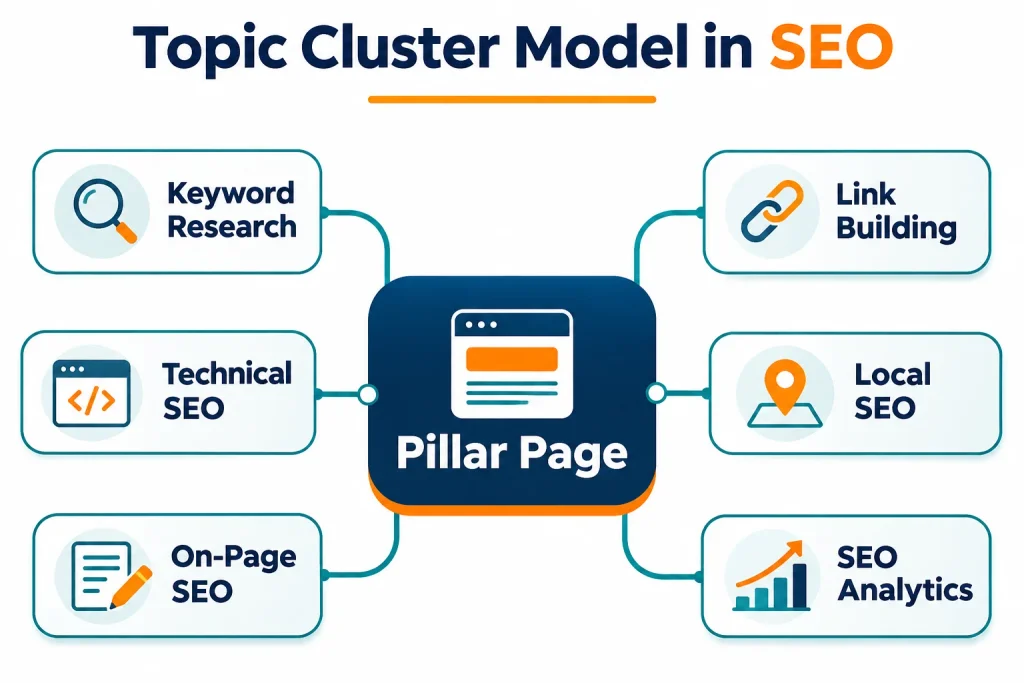
Topic clusters are groups of related webpages organized around one main subject.
A typical topic cluster has two main parts:
Pillar page: A broad guide that introduces and explains the main topic.
Supporting articles: More specific pages that explore individual subtopics in greater detail.
For example, a digital marketing website could build the following SEO topic cluster:
<escape>SEO (Main Pillar Page)
├── What Is SEO?
├── Keyword Research Guide
├── On-Page SEO Best Practices
├── Technical SEO Checklist
├── Off-Page SEO Strategies
├── Local SEO Guide
├── SEO Audit Guide
└── How to Measure SEO Performance</escape>
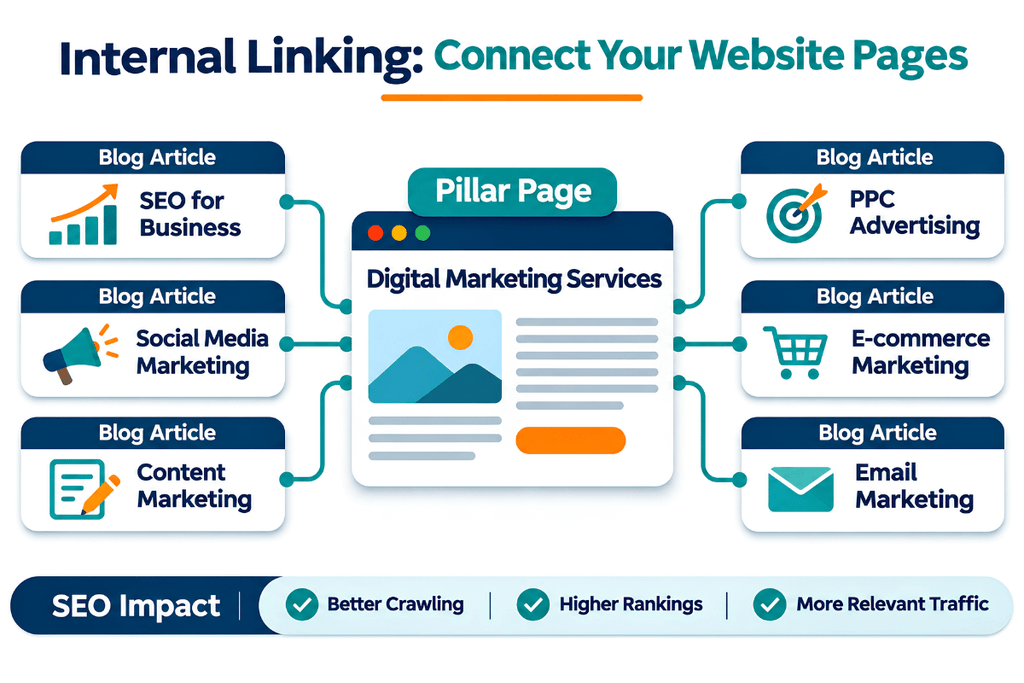
The pillar page should link to relevant supporting articles. Supporting articles should link back to the pillar page where useful, and related articles can link to each other when the connection is relevant.
This creates a logical structure instead of leaving individual blog posts disconnected.
You can also explore our guide to SEO audits and business growth when planning your supporting content.
4. Cover Different Stages of the Customer Journey
A strong content strategy should help users at different stages of their decision-making process.
Not everyone visiting your website is ready to purchase a service. Some visitors are learning about a problem, while others are comparing solutions.
You can organize content around three stages:
Top of the Funnel (ToFu): Awareness
At this stage, people want basic information and explanations.
Example topics:
- What Is SEO?
- Why Is Website Speed Important?
- How Does Keyword Research Work?
Middle of the Funnel (MoFu): Consideration
Visitors are exploring different methods, tools, and solutions.
Example topics:
- Best SEO Tools for Small Businesses.
- SEO vs. PPC: Which Is Better?
- How to Choose an SEO Strategy.
Bottom of the Funnel (BoFu): Decision
Visitors are closer to selecting a service or solution.
Example topics:
- SEO Services for Small Businesses.
- How to Choose an SEO Agency.
- SEO Service Pricing and Deliverables.
Covering different stages helps your website answer a wider range of relevant questions while connecting educational content with your business services.
5. Publish Helpful, Original, and Reliable Content
Content quality is one of the most important parts of building topical authority.
Publishing multiple articles with similar information does not necessarily make a website more authoritative. Each page should provide a clear purpose and offer something useful to its intended audience.
Follow these practices when creating content:
- Explain topics in clear and simple language.
- Include practical examples and useful steps.
- Add original insights or relevant experience.
- Support factual claims with reliable sources.
- Avoid repeating information just to increase word count.
- Update articles when important details change.
- Add relevant images, tables, and diagrams where they improve understanding.
For example, an article about technical SEO should not only define the subject. It should explain crawlability, indexing, XML sitemaps, canonical tags, redirects, and other relevant concepts.
Include author information where appropriate and make it clear who is responsible for the content. For experience-based topics, real examples and case studies can make an article more useful and credible.
Google’s guidance on creating helpful, reliable, people-first content is a useful reference when planning your content strategy.
6. Build a Strong Internal Linking Structure
Internal links connect different pages within your website. They are important for navigation and help search engines discover related content.
However, adding links randomly is not a good strategy. Each link should help readers access information that is relevant to the paragraph they are reading.
For example, an article about website SEO can naturally link to:
- A detailed guide about keyword research.
- A supporting article about technical SEO.
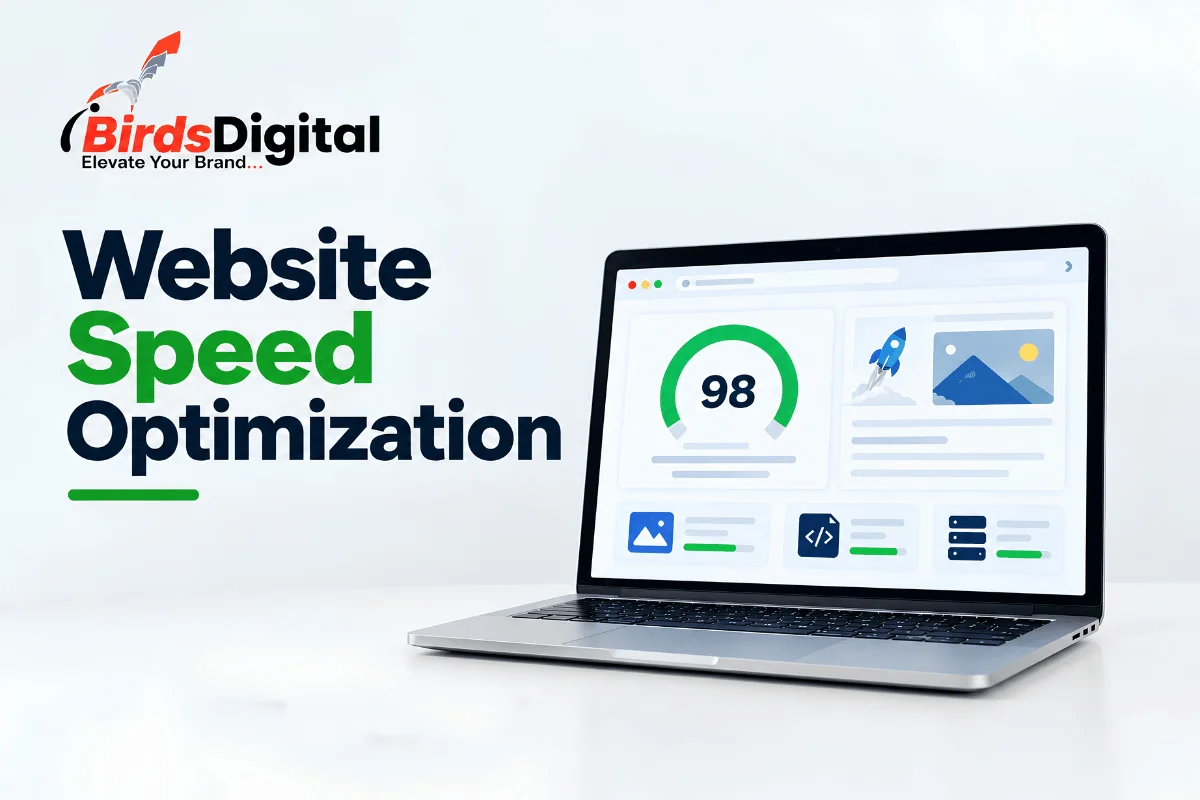
- A guide about website speed optimization.
- A page explaining professional SEO services.
Use descriptive anchor text that explains what the destination page covers.
For example, instead of using “click here,” use an anchor such as website speed optimization techniques.
A good internal linking structure should connect supporting articles to relevant pillar pages, link related articles where appropriate, and help visitors move naturally through your website.
Review older articles regularly to find opportunities to add links to newly published content.
7. Earn Relevant Backlinks and Build Brand Credibility
Internal links help organize your own website, while backlinks connect your content with other websites.
A relevant backlink from a trustworthy website can help search engines discover your content and provide additional context about its credibility.
Focus on earning links through useful and genuine contributions rather than collecting links from unrelated websites.
Some practical approaches include:
Guest Posting: Contribute informative articles to relevant websites in your industry.
Digital PR: Share useful research, insights, or business information that may interest publishers and industry websites.
Original Resources: Create guides, reports, statistics, and practical resources that other websites may want to reference.
Unlinked Brand Mentions: Monitor relevant mentions of your business and look for appropriate opportunities to turn them into links.
Industry Contributions: Participate in relevant discussions and share useful information through professional communities.
Prioritize relevance and quality over the number of backlinks. Avoid paid link schemes and low-quality link-building practices.
How to Measure Topical Authority
There is no single universally accepted Google metric that measures topical authority. Instead, evaluate several SEO and content performance indicators together.
1. Keyword Coverage
Check how many relevant subtopics your website covers compared with the topical map you created.
Identify missing subjects and decide which ones deserve new content.
2. Organic Traffic
Use Google Analytics 4 and Google Search Console to monitor organic traffic, clicks, impressions, and the pages attracting visitors.
Review performance by topic cluster rather than looking only at the entire domain.
You can also learn how to use GA4 for website performance to understand your website’s traffic and engagement.
3. Keyword Rankings
Track the ranking positions of your pillar pages and supporting articles.
Look for improvements across related keywords instead of focusing only on one primary keyword.
4. Internal Link Coverage
Review whether your important pages receive relevant internal links and whether supporting articles connect to their main pillar pages.
5. Backlink Quality
Monitor the number and relevance of external websites linking to your important content.
Tools such as Google Search Console, Ahrefs, and Semrush can help you review different aspects of backlink performance.
6. Content Performance
Identify pages that receive impressions but have low clicks, pages with declining traffic, and topics that are not meeting their intended search purpose.
Use this information to improve existing articles, update outdated information, or create missing supporting content.
Common Mistakes to Avoid When Building Topical Authority
Some websites publish a large number of articles but fail to develop a meaningful content structure. Avoid these common mistakes:
Publishing Unrelated Topics: Covering too many unrelated subjects can make it difficult to develop a focused content strategy.
Targeting Similar Keywords With Separate Pages: Creating multiple pages for nearly identical search intent can lead to unnecessary overlap and keyword cannibalization.
Ignoring Internal Links: Supporting articles should not remain disconnected from the rest of your website.
Focusing Only on Search Volume: Low-volume questions can still be valuable when they match your audience’s needs.
Publishing Thin Content: Articles should answer their intended questions with enough detail and useful information.
Ignoring Existing Content: Improving and updating relevant articles can be more useful than constantly publishing new ones.
Building Irrelevant Backlinks: Links from unrelated or low-quality websites do not provide the same value as relevant, trustworthy references.
Frequently Asked Questions
1. What is topical authority in SEO?
Topical authority in SEO refers to how comprehensively and reliably a website covers a particular subject. It is developed through useful content, relevant subtopics, good website organization, and connections between related pages.
2. Is topical authority a Google ranking factor?
Google does not publicly identify topical authority as a standalone ranking factor. However, its search guidance emphasizes helpful content, relevance, experience, and expertise. Building comprehensive content around a subject can support these goals.
3. How long does it take to build topical authority?
There is no fixed timeline. It depends on your website’s existing content, competition, publishing consistency, topic complexity, and the quality of your work. Building meaningful subject coverage is a long-term process.
4. What is a topical map in SEO?
A topical map is a structured plan that organizes a main subject into categories, subtopics, and related questions. It helps identify content gaps and plan pillar pages and supporting articles.
5. What is the difference between a pillar page and a topic cluster?
A pillar page is a central resource covering a broad subject. A topic cluster is the larger group of related pages, including the pillar page and its supporting articles, connected through relevant internal links.
6. Does topical authority help with AI search?
Comprehensive, relevant, and clearly structured content can support discoverability in AI-powered search experiences. However, topical authority does not guarantee that ChatGPT, Google AI Overviews, or other platforms will cite a website.
Final Thoughts
Building topical authority is not about publishing hundreds of articles or targeting every keyword in your industry. It is about developing a focused content strategy that covers the subjects your audience genuinely cares about.
Start with a clear niche, research related topics, create useful pillar pages, and connect supporting articles through relevant internal links. Continue improving your content and monitor how your topic clusters perform over time.
When your website consistently provides helpful information and a well-organized experience, you create a stronger foundation for long-term SEO growth.
At iBirds Digital, we believe effective SEO starts with understanding your audience and building a strategy around their needs. A combination of quality content, technical improvements, and thoughtful internal linking can help businesses strengthen their online presence.