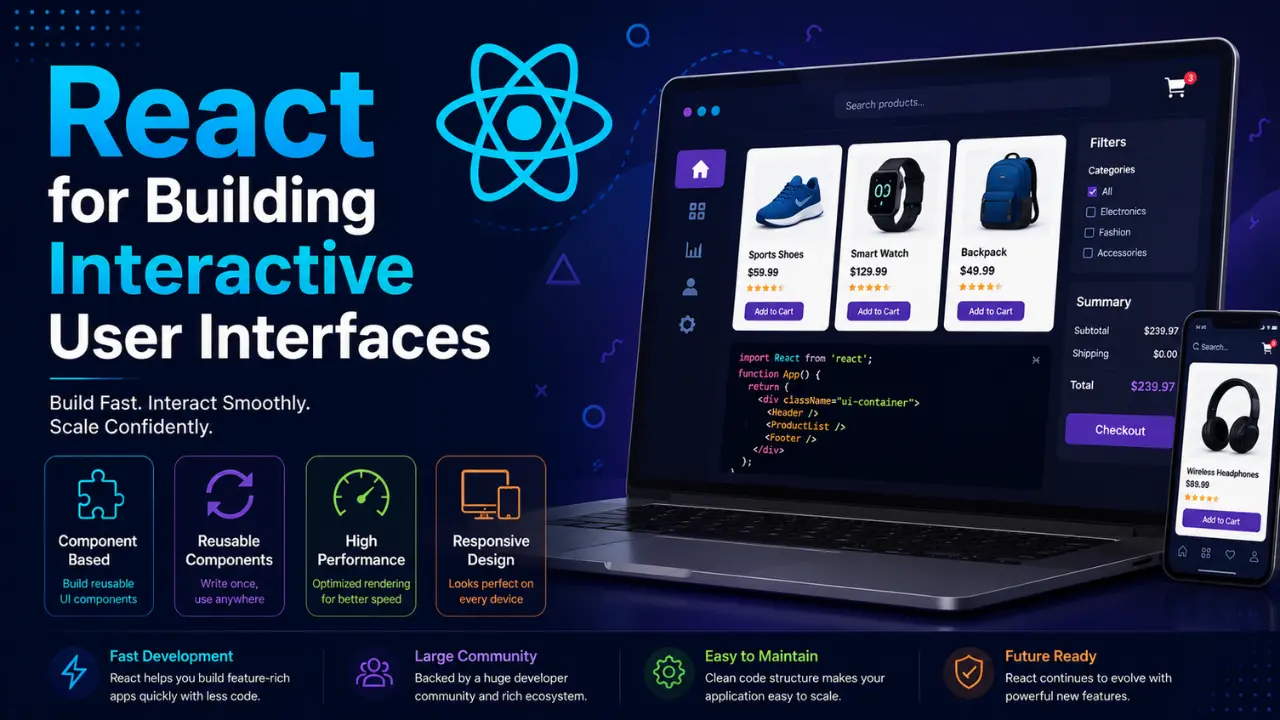
Modern websites and web applications need more than attractive layouts. Users expect fast interactions, smooth navigation, responsive pages, and interfaces that update without unnecessary reloads. This is where React can be a strong choice for building interactive user interfaces.
React is an open-source JavaScript library created for building user interfaces through reusable components. It is widely used for applications where the interface changes based on user actions, data, or application state.
For businesses planning a modern website or web application, choosing the right development approach can affect performance, maintainability, scalability, and future updates. React can help development teams build complex interfaces by breaking them into smaller and reusable components.
In 2026, React has also moved beyond the older idea of being used only for client-side interfaces. React 19.2 is the latest stable version, with features such as Activity, useEffectEvent, cacheSignal, Performance Tracks, and partial pre-rendering. The React team also recommends using a full-stack framework for new applications when the project needs features such as routing, data fetching, server rendering, or other production requirements.
For businesses looking for professional website development, iBirds Digital provides web development services focused on responsive, user-friendly, and business-oriented websites.
But why React?
You may be wondering why React is still a popular choice for building interactive user interfaces when developers have many JavaScript technologies available.
One major reason is its component-based approach. Instead of treating a complete webpage as one large piece of code, React allows developers to divide an interface into smaller components. A button, navigation menu, product card, search box, checkout section, or complete page can be developed as separate components.
This approach makes large applications easier to organize and maintain.
React also uses a declarative programming model. Developers describe what the interface should look like for a particular state, while React handles the process of updating the UI when that state changes. This makes interactive UI development easier to reason about compared with manually changing different parts of the page.
React is also designed for gradual adoption. A complete website does not have to be rewritten in React. React can be added to an existing project and used for specific interactive parts of a page.
For larger applications, React can be combined with frameworks such as Next.js or React Router. React’s official documentation currently recommends starting new full applications with a framework rather than relying on the old Create React App approach, which has been deprecated.
These capabilities make React useful for:
- Interactive business websites
- Single-page applications
- SaaS platforms
- eCommerce interfaces
- Dashboards and admin panels
- Customer portals
- Data-driven web applications
- Content-rich applications with interactive features
Please read on to understand the main benefits of React and why its component-based and declarative approach remains useful for modern web development.
Benefits of React seen by many Web Development Companies
Simple
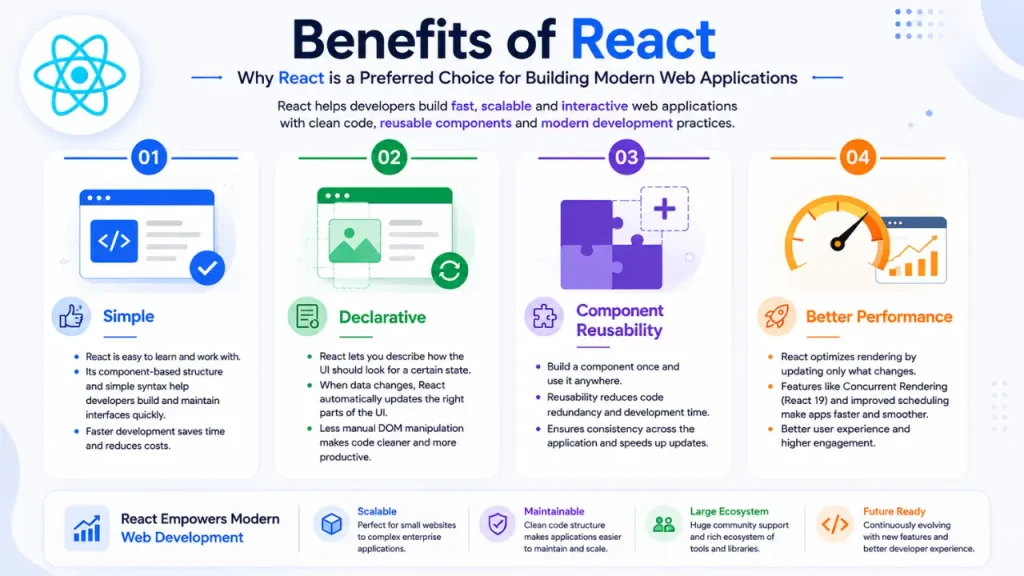
React can make complex interfaces easier to organize because developers can divide a large interface into smaller components.
For example, an eCommerce product page may contain a product image gallery, product information, price section, reviews, size selector, quantity control, and shopping cart button. Each part can be developed and maintained as a component.
This component-based approach helps developers work on individual parts without treating the entire interface as one large block of code.
React also uses familiar JavaScript concepts, which makes it easier for JavaScript developers to understand and work with. Its official documentation focuses on practical concepts such as components, props, state, events, conditions, and lists.
For businesses that need a scalable website, choosing an experienced web development company in India can help ensure that the technology is selected according to the project’s actual requirements.
Declarative
One of React’s important concepts is declarative UI development.
In a traditional approach, developers may need to manually find an element, change its content, update its classes, and manage several related UI changes when data changes.
With React, developers describe the desired interface based on the current data and state. React then manages the rendering process.
For example, if a shopping cart changes from two products to three products, the application can render the cart according to its new state rather than requiring developers to manually update every affected DOM element.
This model becomes especially useful when an application contains many changing values and interactive elements.
React’s rules also encourage components and Hooks to remain pure and treat props and state as immutable snapshots. These practices help keep applications predictable and easier to maintain.
Component Reusability
Component reusability is one of the biggest practical advantages of React for modern web application development.
Suppose a business has an eCommerce website with hundreds of products. Instead of creating separate interface code for every product card, developers can create one reusable product-card component and provide different product information to it.
The same idea can be applied to:
- Navigation menus
- Buttons
- Forms
- Product cards
- Search components
- Login sections
- Review sections
- Pricing cards
- Dashboard widgets
- Checkout elements
Reusable components can reduce duplicated code and make future changes easier. When a shared component needs an improvement, developers can update the component instead of manually changing many copies.
For larger React applications, this approach can also help teams maintain consistent UI patterns across different sections of the application.
Better Performance and Modern Rendering
React has traditionally been associated with efficient UI updates through its rendering architecture. However, modern React development is broader than simply saying that React uses a “virtual DOM.”
React manages rendering based on changes to component state and props and determines what needs to be updated. This allows developers to build interfaces where changing one part of the application does not require rebuilding the entire user experience manually.
React 19.2 adds further performance-oriented capabilities. Its Performance Tracks provide additional information inside Chrome DevTools about React scheduling, component work, and rendering activity. React 19.2 also introduced partial pre-rendering and improvements around Suspense and server-side rendering.
This is important because modern web performance depends on much more than the UI library alone. The application’s framework, JavaScript bundle, images, data fetching, caching, server rendering strategy, hosting, and code structure can all affect the final user experience.
Last word about the success of React
React’s long-term value comes from more than its ability to create interactive interfaces.
Its component architecture provides a structured way to build large applications, while its declarative model helps developers describe how an interface should behave as application data changes.
React has also evolved significantly since its early releases.
React 19 introduced improvements around Actions, forms, useOptimistic, use, Server Components, and other areas of application development. React 19.2 later added features such as <Activity />, useEffectEvent, cacheSignal, Performance Tracks, and partial pre-rendering.
The <Activity /> component is particularly relevant to applications with complex navigation. It can hide parts of an interface while preserving their state and allowing hidden work to be deprioritized. This can be useful when users are likely to return to a previously visited part of an application.
React’s current ecosystem also reflects an important change in how developers build production applications.
React itself is a library rather than a complete application framework. The official React documentation recommends full-stack React frameworks such as Next.js or React Router when building a complete application that needs routing, data fetching, rendering strategies, and other production features.
For example, Next.js App Router supports React Server Components and can combine server-rendered and interactive components within the same application architecture. React Router can also be paired with Vite and used for full-stack application development.
Another important update for developers is that Create React App is no longer the recommended way to start new React projects. React officially deprecated Create React App and now recommends frameworks for new applications, while tools such as Vite, Parcel, or Rsbuild can be considered when a project has specific requirements for a custom setup.
This means businesses should not simply ask, “Should we use React?” The better question is:
Which React architecture and development approach fits our business requirements?
A small website may only need a few interactive React components. A complex SaaS platform, customer portal, or eCommerce application may benefit from a full-stack React framework and a carefully planned rendering and data architecture.
For businesses that need a responsive, scalable, and user-focused website, professional website development services in India can help select the right technology based on project goals instead of using a technology simply because it is popular.
Why React Is Useful for eCommerce Websites
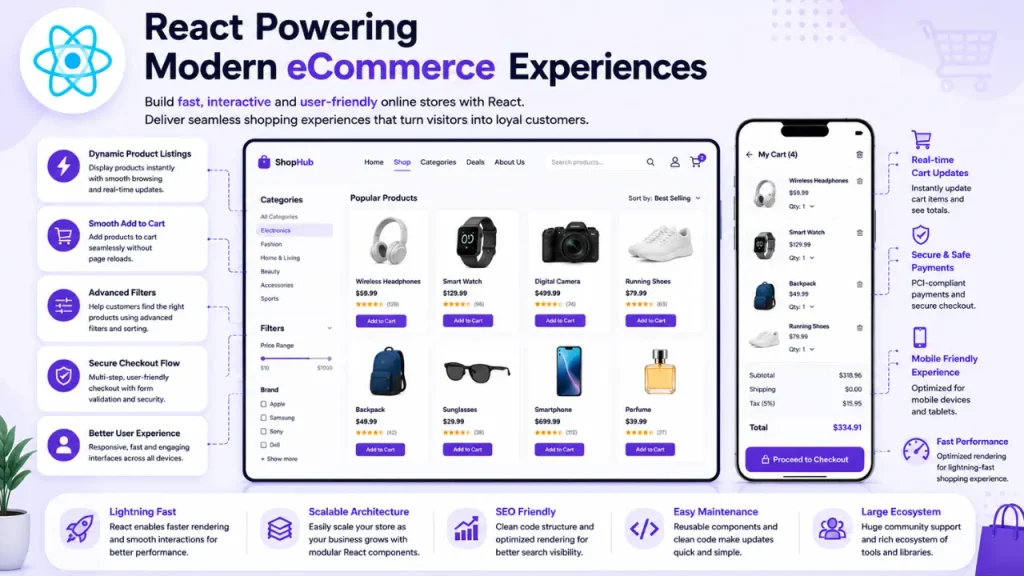
React is also useful for eCommerce interfaces where users constantly interact with products, filters, carts, search tools, checkout forms, and account features.
A React-based eCommerce interface can use reusable components for product listings, filters, product details, cart summaries, and checkout elements.
For example, when a customer applies a product filter, the interface can update the relevant product results without forcing the user through unnecessary full-page interactions.
However, React alone does not make an eCommerce website fast or successful. Good information architecture, mobile usability, optimized images, secure payments, efficient APIs, caching, SEO, accessibility, and reliable hosting are equally important.
Businesses planning an online store should therefore evaluate the complete technology stack instead of selecting a frontend library in isolation.
iBirds Digital provides eCommerce website development services for businesses that need websites designed around usability, performance, and business requirements.
Frequently Asked Questions About React
What is React used for?
React is a JavaScript library used to build user interfaces. It is especially useful for interactive web applications where the interface changes based on user actions, application state, and data.
Is React a framework or a library?
React is officially described as a library. It focuses mainly on building user interfaces. For complete applications, React’s documentation recommends using a framework such as Next.js or React Router when the project needs additional application-level features.
Is React still relevant in 2026?
Yes. React 19.2 is the latest stable React version, and the React ecosystem continues to receive new features and development improvements. React 19.2 includes Activity, useEffectEvent, cacheSignal, Performance Tracks, and partial pre-rendering.
What are the main benefits of React for web development?
The main benefits include component reusability, declarative UI development, structured application architecture, gradual adoption, and a large ecosystem. React can be particularly useful for applications with many interactive interface elements.
Can React be used for eCommerce website development?
Yes. React can be used to build interactive eCommerce interfaces such as product listings, filters, product pages, carts, checkout flows, and customer account areas. The complete eCommerce technology stack should be selected according to the project’s requirements.
Is React good for building interactive user interfaces?
Yes. Building interactive user interfaces is one of React’s main use cases. Its component and state-based approach allows developers to create interfaces that respond to user actions and changing application data.
Should I use Create React App for a new project?
No. Create React App has been deprecated. React’s current guidance recommends starting new applications with a framework, while custom setups can use tools such as Vite, Parcel, or Rsbuild when there is a specific reason not to use a framework.
Which React framework should I use for a modern web application?
The right choice depends on the application. React’s official documentation currently highlights frameworks such as Next.js and React Router. The decision should consider routing, data fetching, rendering requirements, deployment, team experience, and project complexity.
Can React improve website performance?
React provides tools and architecture that can support efficient UI rendering, but overall website performance depends on the complete application. JavaScript size, images, APIs, rendering strategy, caching, hosting, and code quality also have a major impact.
Can React be added to an existing website?
Yes. React is designed for gradual adoption. Developers can add React to an existing website and render interactive components without rewriting the entire website.
Conclusion
React remains a strong technology for building interactive user interfaces in 2026, but modern React development is no longer limited to creating client-side components.
React 19.2 brings new capabilities for application performance, rendering, state preservation, and developer tooling. At the same time, the React team recommends using appropriate frameworks for complete applications rather than relying on deprecated approaches such as Create React App.
For businesses, the biggest benefit of React is the ability to create organized, reusable, and interactive interfaces that can grow with changing application requirements.
The right implementation still depends on the project’s goals, users, content, performance requirements, backend architecture, and future plans. Choosing the technology together with a clear development strategy can create a better foundation for a modern web application.