
SEO is not something you complete once and forget. A website may be optimized today, but search behavior, competitors, content, technology, and search engine requirements can change over time. This is why businesses that want sustainable organic visibility need to treat SEO as an ongoing process rather than a one-time project.
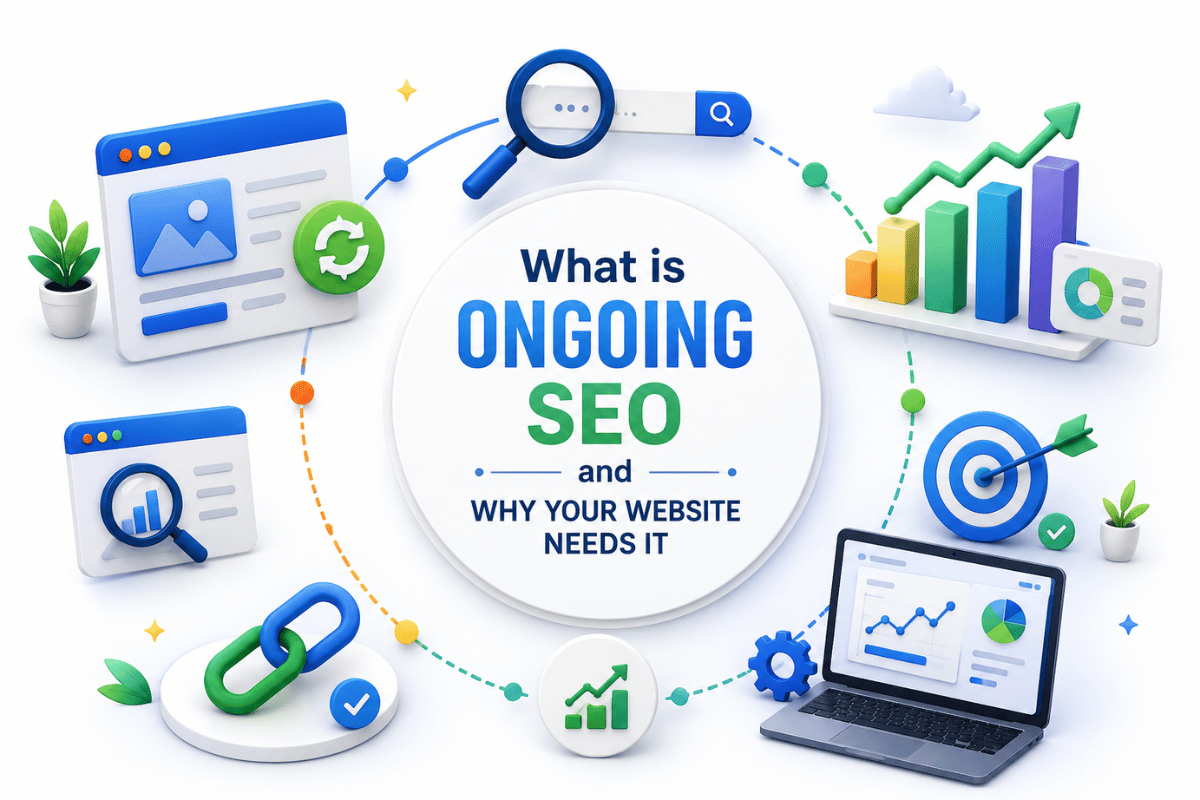
What is Ongoing SEO and Why Your Website Needs It? Ongoing SEO is the continuous process of monitoring, maintaining, improving, and adapting a website to help it remain visible and competitive in search results. It includes activities such as updating existing content, publishing useful new pages, fixing technical problems, monitoring keyword performance, improving internal linking, earning quality backlinks, and analyzing competitors.
A strong SEO foundation is important, but long-term performance depends on what happens after the initial optimization. Search engines continue crawling websites, competitors continue improving their content, and users continue changing the way they search. Ongoing SEO helps a business respond to those changes instead of allowing its website to become outdated.
Google also emphasizes the importance of making websites useful, understandable, and easy to discover in Search. Its official SEO documentation recommends maintaining content and website performance over time rather than treating optimization as a finished task.
What Does Ongoing SEO Actually Mean?
Ongoing SEO means regularly working on the factors that influence a website’s organic search performance. The goal is not simply to maintain rankings for a few keywords. Instead, the objective is to create a website that continues improving its visibility, relevance, technical health, authority, and ability to attract qualified visitors.
For example, a blog post that ranked well a year ago may gradually lose traffic because its information is outdated, competitors have created better content, search intent has changed, or technical issues are affecting the page. Ongoing SEO helps identify these problems before they become major performance losses.
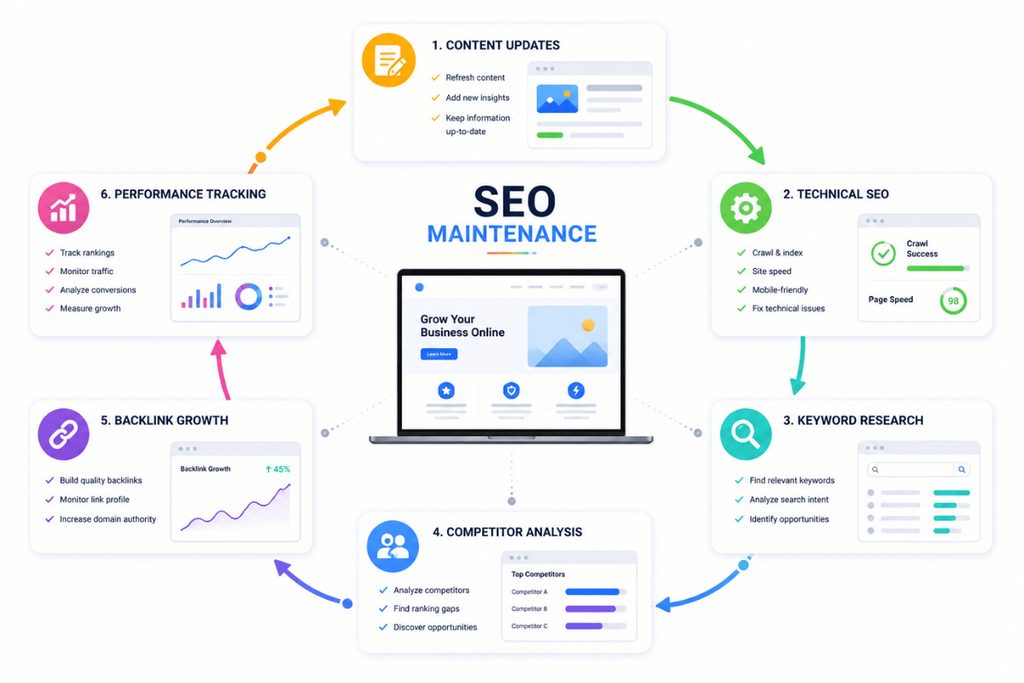
This continuous approach usually combines content optimization, technical SEO, keyword research, competitor analysis, backlink acquisition, internal linking, and performance measurement. The exact tasks may change from month to month because a successful SEO strategy should respond to real data rather than repeat the same checklist blindly.
Competitor research shows that high-ranking pages consistently position ongoing SEO as a combination of content freshness, technical maintenance, competitor monitoring, authority building, and performance tracking.
Why One-Time SEO Is Not Enough
One-time SEO can create a strong starting point. It can help fix indexing problems, improve page titles, optimize content, research keywords, and resolve technical errors. However, these improvements do not freeze the competitive search landscape.
Imagine optimizing a website today and then making no improvements for several years. During that period, competitors may publish more useful content, earn stronger backlinks, improve their website experience, and target new search opportunities. At the same time, your own content can become outdated and technical issues can develop as plugins, themes, pages, and website functionality change.
SEO also depends on understanding user needs. The keywords and questions people use today may not be exactly the same in the future. New products, technologies, services, and search behaviors can create new opportunities that a static SEO strategy will miss.
This is why businesses should view SEO as a long-term growth process. Initial optimization creates the foundation, while ongoing SEO protects and builds on that foundation.
Ongoing SEO vs One-Time SEO
| Area | One-Time SEO | Ongoing SEO |
|---|---|---|
| Main purpose | Creates an initial SEO foundation | Maintains and improves long-term performance |
| Content | Optimizes existing priority pages | Continuously updates and creates relevant content |
| Technical SEO | Fixes known issues | Monitors and resolves new issues regularly |
| Keywords | Initial keyword research | Tracks changing opportunities and search behavior |
| Competitors | Basic competitive analysis | Ongoing competitor monitoring |
| Backlinks | May include initial outreach | Focuses on continued authority growth |
| Performance | Initial measurement | Regular analysis of traffic, rankings, CTR, and conversions |
| Strategy | Mostly project-based | Data-driven and continuously adjusted |
The strongest approach is usually not choosing between the two. Businesses need an initial SEO foundation first, followed by consistent optimization and maintenance to protect and expand their results.
Why Your Website Needs Ongoing SEO
Search Results and Competition Never Stand Still
Search rankings are competitive. Your position depends partly on how well your website satisfies user needs compared with other available results. If competitors are consistently publishing better resources, improving their websites, and targeting new keywords, doing nothing can eventually create a competitive gap.
Ongoing SEO helps identify what competitors are doing well. This does not mean copying their strategy. Instead, it helps you discover content gaps, keyword opportunities, missing topics, and areas where your website can provide a better user experience.
Your Content Can Become Outdated
Content is one of the biggest areas that requires continuous attention. Statistics change, tools evolve, services change, links break, and examples can become irrelevant. A page that was highly useful when published may no longer fully answer a user’s current question.
Regular content refreshes can improve accuracy and usefulness. Depending on the page, this may involve updating information, improving examples, adding new sections, refreshing internal links, answering additional questions, or removing outdated details.
For businesses focused on long-term visibility, creating evergreen content is especially valuable, but evergreen does not mean maintenance-free. You can also explore our guide on What Is Evergreen Content and How to Build a Long-Term SEO Strategy to understand how content can continue generating value over time.
Technical Problems Can Appear After Launch
A website is not technically static. New pages are added, plugins are updated, images are uploaded, redirects are created, and website functionality changes. These activities can introduce broken links, slow pages, crawl problems, duplicate content, or other issues.
Ongoing SEO includes monitoring the technical health of the website so problems can be identified and addressed before they significantly affect users or search performance.
Google’s Search Console is particularly useful for this type of ongoing monitoring. It provides information about search performance and can help website owners identify issues affecting how pages appear in Google Search.
User Search Behavior Changes
SEO is not only about search engines. It is also about understanding what users are trying to achieve.
The words people use, the questions they ask, and the type of content they prefer can change over time. A page that targets an old search intent may become less useful even if its technical SEO is perfect.
Ongoing keyword research helps businesses identify new questions and search opportunities. This can lead to new blog topics, improved service pages, FAQs, comparison content, and more relevant resources for potential customers.
The Core Components of an Ongoing SEO Strategy
Regular Content Updates
Existing content should be reviewed periodically to determine whether it is still accurate and useful. Pages with declining traffic or outdated information are often strong candidates for improvement.
A content update may include improving the introduction, adding missing information, updating examples, expanding important sections, improving headings, refreshing metadata, and adding relevant internal links.
This is also a good opportunity to strengthen the connection between related topics across your website. For example, content about SEO maintenance can naturally connect with our guide on Why an SEO Audit Is Important for Business Growth because regular audits are an important part of identifying issues and improvement opportunities.
Publishing New Content
Content creation should not focus on publishing articles simply for the sake of frequency. New content should answer real questions, target relevant search opportunities, and support broader business goals.
An effective ongoing content strategy may include informational blog posts, service pages, guides, comparison content, FAQs, and resources that help users make decisions.
Before creating new content, businesses should look for gaps in their existing website. If users are searching for a topic that your website does not properly cover, that may represent a useful opportunity for expansion.
Technical SEO Monitoring
Technical monitoring helps ensure that search engines and users can access and use your website properly. Important areas can include indexing, crawlability, page experience, broken links, redirects, mobile usability, and website performance.
A technical issue does not always produce an immediate ranking collapse. Sometimes small problems gradually accumulate. Regular monitoring helps businesses take a proactive approach instead of waiting until traffic has already declined.
Keyword Performance Tracking
Keyword research should continue after the initial SEO strategy is implemented. Search opportunities change as industries evolve and users discover new ways to describe their needs.
Tracking performance can reveal keywords where your website is close to stronger visibility, pages that need additional optimization, and new topics that deserve dedicated content.
Google Search Console’s Performance reports can show metrics such as clicks, impressions, click-through rate, and average position, helping website owners understand how their pages are performing in Search.
Competitor Analysis
Competitor analysis should be an ongoing activity rather than a one-time exercise. Monitoring competitors can reveal new content formats, topic coverage, keyword opportunities, and areas where other websites are improving faster.
The goal is not to copy competitors. The goal is to understand the competitive environment and identify opportunities to create something more useful or distinctive.
If you want to learn more about this process, our detailed guide on How to Do a Competitive Analysis in Digital Marketing can help you understand how competitor research supports smarter marketing decisions.
Backlink Growth and Authority Building
Backlinks remain an important part of building website authority when they are earned naturally from relevant and trustworthy sources. Ongoing SEO can include creating link-worthy content, digital PR, relationship building, useful resource development, and other ethical strategies for earning quality mentions.
The focus should be on relevance and value rather than simply collecting a large number of links. A sustainable backlink strategy supports long-term authority and visibility.
For example, a business reading about ongoing SEO may also benefit from learning How Long SEO Takes to Show Results because SEO growth is generally a process that develops over time rather than producing guaranteed immediate results.
What Happens When You Stop SEO?
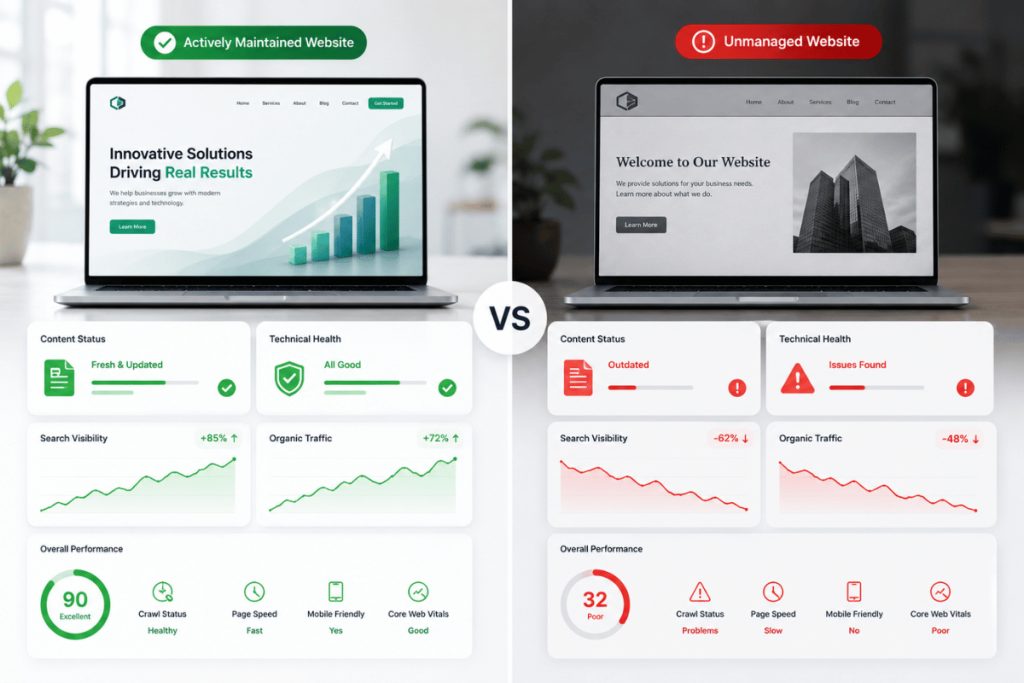
Stopping SEO does not necessarily mean that rankings disappear overnight. Some pages may continue performing well for a long time. However, without continued improvement, the risk of gradual decline increases.
Content can become outdated, competitors can gain stronger positions, backlinks can disappear, and technical problems can accumulate. Over time, a website may lose visibility for important search queries without the business immediately noticing the reason.
The biggest problem is often delayed reaction. By the time traffic and leads have significantly declined, recovery can require more work than regular maintenance would have required.
This is why ongoing SEO should focus on prevention as well as growth. Monitoring performance allows businesses to identify meaningful changes and investigate them early.
How Often Should Ongoing SEO Be Performed?
The answer depends on the size of the website, industry competition, publishing frequency, and business goals. A small local website may not need the same level of activity as a large eCommerce platform or highly competitive national brand.
However, some level of regular monitoring is valuable for most active websites.
A practical ongoing SEO process may involve:
- Reviewing search performance regularly
- Checking important technical issues
- Monitoring traffic changes
- Updating priority content
- Researching new keyword opportunities
- Publishing useful new content
- Reviewing competitor activity
- Improving internal linking
- Tracking the results of completed work
The key is consistency. SEO tasks should be prioritized based on business impact instead of performing every possible activity at the same frequency.
A Simple Ongoing SEO Workflow
A practical workflow starts with measurement. Review organic traffic, search visibility, important pages, keyword opportunities, and technical issues to understand the current situation.
Next, identify the highest-impact opportunities. This could mean refreshing a declining page, fixing an indexing problem, improving a service page, or creating content for an important missing topic.
After making improvements, monitor the results over an appropriate period. Google notes that changes can take time to be reflected in Search, so performance should be evaluated with patience rather than making constant changes based on very short-term fluctuations.
This creates a continuous cycle:
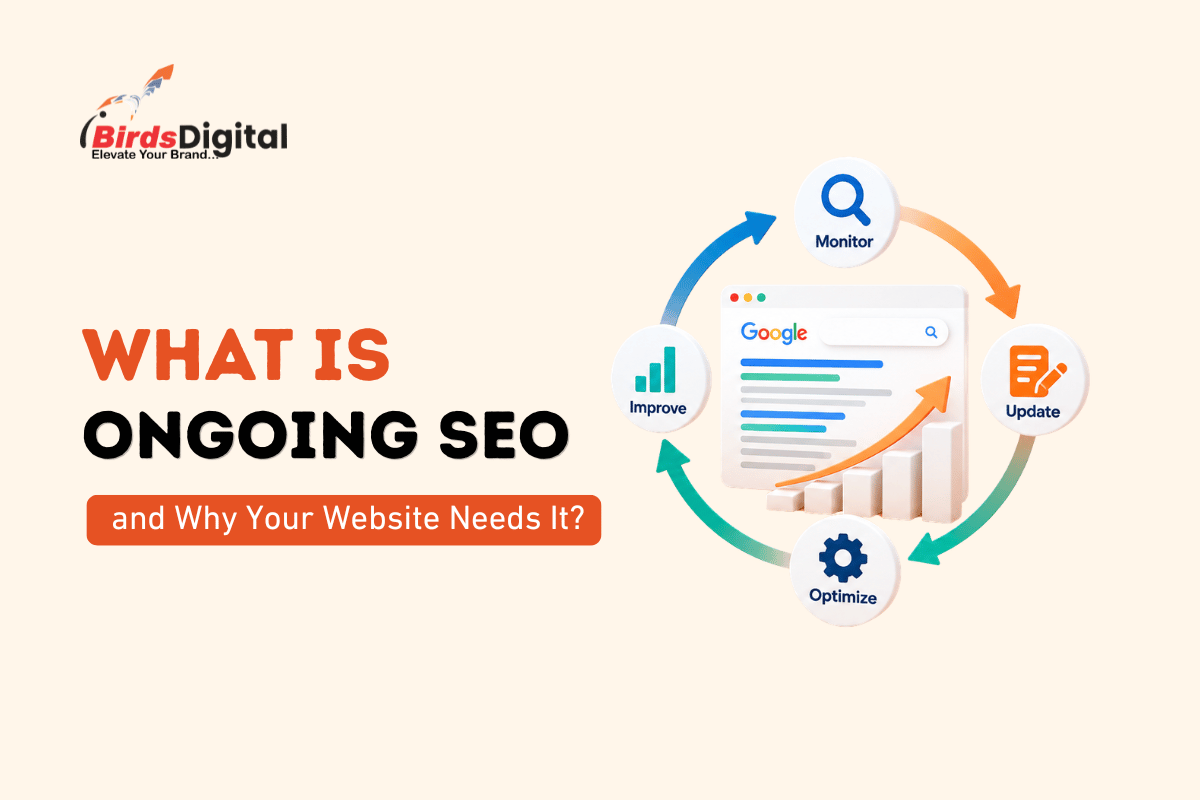
Analyze → Prioritize → Improve → Measure → Refine
That cycle is the practical foundation of ongoing SEO.
How to Measure Whether Ongoing SEO Is Working
SEO success should not be measured by rankings alone. Rankings are useful, but businesses should also look at whether organic visibility is creating meaningful business results.
Important metrics may include:
- Organic traffic growth
- Search impressions
- Clicks from search
- Click-through rate
- Keyword visibility
- Performance of priority landing pages
- Leads or conversions from organic traffic
- Revenue generated from organic search
- Technical issue trends
The best SEO strategy connects search performance with business goals. More traffic is valuable, but relevant traffic that generates leads, sales, enquiries, or other meaningful actions is usually more important.
Common Ongoing SEO Mistakes to Avoid
One common mistake is repeating the same SEO tasks every month without looking at performance data. Ongoing SEO should adapt to what the website actually needs.
Another mistake is focusing only on new content while ignoring existing pages. Updating strong but declining content can sometimes create significant value because the page may already have established relevance and visibility.
Businesses should also avoid making SEO decisions based only on rankings for a small number of keywords. Search performance is broader than one or two positions. User intent, clicks, traffic quality, and conversions all matter.
Finally, avoid viewing reports as the final product of SEO. Reporting is important, but the real value comes from using insights to make meaningful improvements.
The Long-Term Value of Ongoing SEO
Ongoing SEO creates compounding value. A useful piece of content can attract visitors over time. Internal links can strengthen topical connections. Technical improvements can make the website easier to use and understand. Better content can create stronger engagement, while authority-building efforts can support broader search visibility.
These improvements work together. The goal is not to find a single SEO tactic that solves everything. Long-term success usually comes from consistently improving the overall quality, usefulness, accessibility, and discoverability of the website.
Businesses that treat SEO as an ongoing investment are generally better positioned to respond to changes and build sustainable organic growth.
Frequently Asked Questions
Is SEO an ongoing process?
Yes. SEO is generally an ongoing process because search behavior, competition, content, and website conditions can change over time. Regular monitoring and improvement help maintain and grow search visibility.
What is included in ongoing SEO?
Ongoing SEO can include content updates, new content creation, keyword research, technical monitoring, internal linking, competitor analysis, backlink acquisition, and performance reporting.
Can I stop SEO after my website ranks well?
You can reduce or change your SEO activity depending on your goals, but completely stopping optimization can allow competitors to gain ground while your content and website become outdated. Maintaining performance usually requires some level of continued attention.
How often should I update old SEO content?
The right frequency depends on the topic. Time-sensitive content may require frequent updates, while evergreen content can often be reviewed less often. Performance data and changes in the industry should help determine priority.
Is ongoing SEO important for small businesses?
Yes. Small businesses can benefit from ongoing SEO because local competition, customer search behavior, and website performance can change. The scale of work may be smaller, but regular monitoring and improvement can still support long-term visibility.
How long does ongoing SEO take to show results?
SEO improvements can take time. Some technical fixes may have an effect relatively quickly, while content and authority growth can require weeks or months. Results depend on competition, website condition, search demand, and the type of optimization being performed.
Final Thoughts
Ongoing SEO is not about endlessly repeating a checklist. It is about continuously improving your website based on changing user needs, search opportunities, technical performance, and competition.
A one-time SEO project can create a strong foundation, but sustainable organic growth requires continued attention. Regular content updates, technical maintenance, keyword research, competitor analysis, internal linking, authority building, and performance measurement all work together to protect and improve your website’s visibility.
The businesses that perform best in search over the long term are usually not the ones that optimize once and stop. They are the ones that continue learning, improving, measuring, and adapting.