
Building a strong in-house marketing team is a major investment. Your internal team understands the brand, products, customers, sales cycle, and business priorities better than anyone outside the company. But SEO often requires a different level of specialization, technical depth, and continuous execution.
This is where SEO Agencies Boost ROI by giving internal marketing teams access to specialised expertise and focused execution.
That is why many businesses are no longer treating the choice as in-house team vs. SEO agency. Instead, they are building a hybrid model where both teams work together.
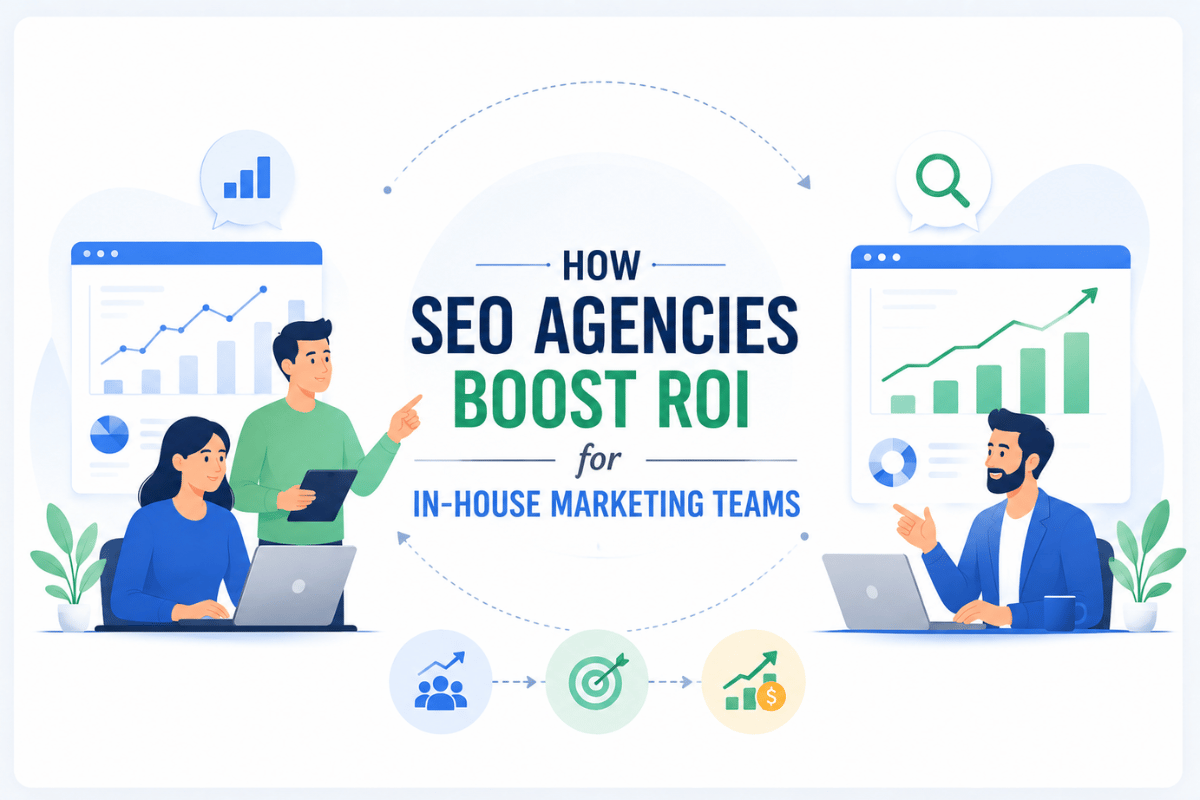
How SEO Agencies Boost ROI for In-House Marketing Teams is not simply about outsourcing more work. The real advantage comes from using each side where it creates the highest business value. The in-house team protects brand strategy and commercial priorities, while the agency adds specialist skills, systems, tools, and execution capacity.
Competitor research for this topic also highlights the same market shift toward hybrid SEO models, with agencies supporting internal teams rather than replacing them.
When this collaboration is structured correctly, businesses can improve organic visibility, reduce bottlenecks, make better use of marketing budgets, and connect SEO activity more directly to leads and revenue.
Why In-House Marketing Teams Often Need External SEO Support
An in-house marketing team may be excellent at campaign planning, brand communication, paid advertising, social media, email, and customer engagement. SEO, however, can involve a large number of specialised disciplines operating at the same time.
Technical SEO requires understanding crawling, indexing, site architecture, page speed, schema, redirects, migrations, and Core Web Vitals. Content SEO requires search intent analysis, keyword clustering, content planning, optimisation, and performance updates. Off-page SEO requires authority-building strategies and quality outreach. Analytics requires the ability to connect organic activity with leads, conversions, and revenue.
Trying to manage all of these responsibilities internally can spread a marketing team too thin.
The biggest problem is often not that the internal team lacks talent. It is that the team lacks enough dedicated hours and specialist coverage. An agency can fill these gaps without forcing the company to build a large SEO department from scratch.
A strong hybrid partnership allows the internal team to stay focused on high-value business work while the agency handles complex or resource-heavy SEO execution.
The key insight: under-resourced is not the same as underperforming
When organic growth slows, companies sometimes assume their marketing team is underperforming. In reality, the problem may be limited capacity.
For example, one internal marketing manager may be responsible for campaigns, content approvals, reporting, paid media, and social channels. Expecting the same person to perform deep technical audits and manage a large SEO content programme can create delays.
An SEO agency helps remove those capacity constraints. The goal is not to replace internal marketers. The goal is to give them specialist support where it has the greatest impact.

How SEO Agencies Boost ROI for In-House Marketing Teams Through Specialisation
ROI improves when a business stops paying for duplicated effort and starts allocating resources according to expertise. An internal team should not have to spend weeks learning a technical process that an experienced specialist can audit more efficiently.
Agencies usually work with people focused on specific areas of SEO. Depending on the service model, that can include technical specialists, SEO strategists, content professionals, digital PR or link-building specialists, and analysts.
This creates faster access to expertise without requiring multiple full-time hires.
Faster problem identification and execution
SEO issues can remain hidden for months if nobody has time to investigate them. A technical problem such as poor internal linking, indexation waste, duplicate pages, redirect chains, or slow templates can limit the performance of an otherwise strong content strategy.
An experienced agency can audit the website, prioritise issues by business impact, and provide a clear implementation roadmap.
This is especially useful when the internal team already has developers or content writers. The agency can provide the strategy and technical direction, while internal resources help execute approved changes faster.
Access to professional SEO processes and tools
SEO software can be expensive, but the bigger cost is often knowing how to use the data properly. Agencies bring established workflows for research, auditing, competitor analysis, performance monitoring, and reporting.
Instead of buying multiple platforms and training every internal employee, the business gains access to an experienced team that already understands how to turn data into action.
For companies that need stronger organic foundations, a focused technical SEO audit can identify which issues are actually limiting growth rather than wasting time on low-impact fixes.
The ROI Advantage of a Hybrid SEO Model
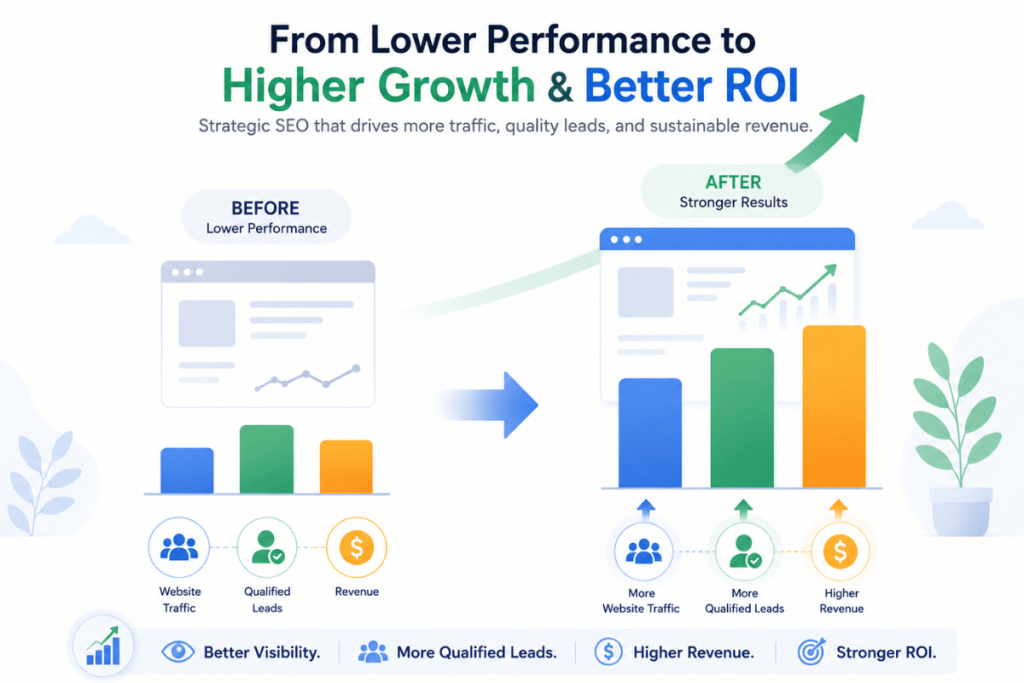
SEO ROI should not be measured only by rankings. A keyword moving from position eight to position three is useful, but the real business question is whether that movement produces qualified traffic, leads, sales, or lower acquisition costs.
One competitor analysis referenced a reported median SEO ROI of 748% across selected industries and time periods, while also showing that ROI can vary significantly by business model.
The important lesson is not to promise the same percentage to every company. SEO results depend on margins, conversion rates, competition, implementation speed, search demand, and the existing condition of the website.
A hybrid team can improve ROI because it combines two valuable assets:
- Internal knowledge: brand positioning, product expertise, customer feedback, sales insights, and business priorities.
- Agency expertise: technical SEO, search data, content opportunities, competitive analysis, and specialised execution.
When these inputs are connected, SEO becomes more commercially focused.
For example, the in-house sales team may know that one service generates the highest-quality leads. The agency can use that insight to build a keyword strategy around the service, identify supporting informational topics, optimise conversion paths, and track the resulting organic leads.
That is a much stronger approach than simply targeting high-volume keywords.
A well-structured partnership can show how SEO Agencies Boost ROI while allowing internal marketers to retain control over brand strategy.
Soft CTA: Turn SEO activity into measurable business outcomes
If your internal team is producing marketing content but organic performance is difficult to connect with leads or revenue, an external SEO strategy review can help identify where the gap exists. A professional SEO consulting service can align technical priorities, content opportunities, and conversion goals around the metrics your business actually cares about.
In-House SEO Team vs. SEO Agency vs. Hybrid Model
The best model depends on the company, but a direct comparison makes the trade-offs easier to understand.
| Area | In-House Team | SEO Agency | Hybrid Model |
|---|---|---|---|
| Brand knowledge | Very strong | Needs onboarding | Very strong |
| Specialist SEO depth | Depends on team size | Usually broad and specialised | Combines both strengths |
| Speed on internal approvals | Often faster | May depend on client communication | Fast with clear workflows |
| Technical expertise | May require additional hiring | Usually available | Agency leads, internal team implements |
| Scalability | Hiring takes time | Easier to scale services | Flexible capacity |
| SEO tools and systems | Additional budget required | Often included in service delivery | Shared advantage |
| Business alignment | Direct access to company goals | Requires communication | Strong alignment with shared planning |
| Long-term flexibility | Limited by headcount | Flexible but external | Balanced and adaptable |
The hybrid model is often the most efficient for businesses that already have a capable marketing team but need deeper SEO support.
The agency should not become a disconnected vendor that sends reports every month. The most productive relationship works more like an extension of the internal team.
How to Divide Responsibilities Between the Agency and In-House Team
The strongest collaboration begins with clear ownership. Many SEO partnerships fail because both sides assume the other team is responsible for implementation.
A practical division of work might look like this:
In-house team ownership
The internal team should usually lead brand messaging, product updates, customer knowledge, campaign priorities, internal approvals, and communication with sales or product departments.
They are closest to the business. That knowledge is difficult for an outside agency to replicate completely.
Agency ownership
The SEO agency can lead keyword research, technical audits, competitor analysis, content opportunity mapping, on-page recommendations, performance analysis, and specialist SEO projects.
The agency should also help prioritise work. A long list of 200 SEO recommendations is rarely useful if nobody knows which 10 actions could create the biggest impact.
Shared ownership
Strategy, reporting, content planning, conversion optimisation, and quarterly priorities should be collaborative.
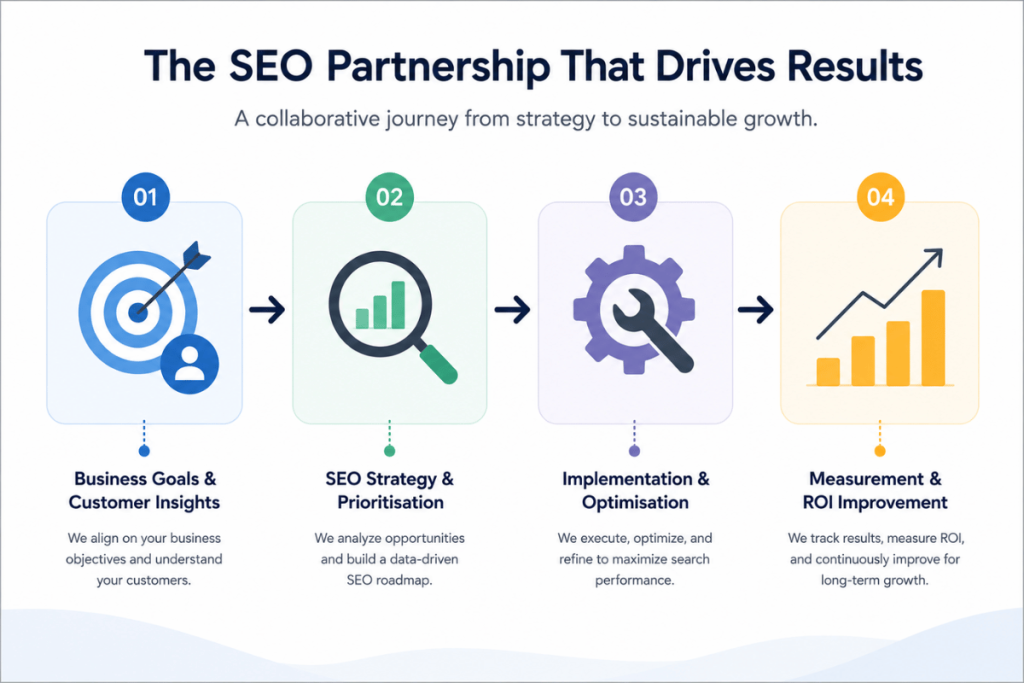
The best workflow is simple:
- The in-house team shares business priorities and market insights.
- The agency translates those priorities into SEO opportunities.
- Both teams agree on the highest-impact actions.
- Results are reviewed against traffic, leads, and revenue.
Where SEO Agencies Create the Biggest ROI Improvements
Not every SEO task needs outside support. ROI is highest when an agency is used for work that is specialised, complex, or difficult for the internal team to scale.
Technical SEO projects with high business impact
Large technical problems can affect thousands of pages. A crawl or indexing issue may prevent valuable content from appearing properly in search results. Poor site architecture can weaken the visibility of important commercial pages.
Agencies can identify these problems and help prioritise fixes according to impact.
This is where a technical SEO service can be more valuable than making random website changes based only on generic checklists.
Content systems instead of isolated blog posts
Many internal teams create content one article at a time. An agency can help build a broader topical system.
That may involve identifying content gaps, mapping search intent, refreshing underperforming pages, connecting related articles through internal links, and improving commercial pages supported by informational content.
The ROI benefit comes from building reusable content assets rather than constantly starting from zero.
Better connection between SEO and conversion performance
More traffic does not automatically mean more revenue.
A useful agency partnership looks beyond impressions and rankings. It asks:
- Which pages attract qualified visitors?
- Which keywords lead to conversions?
- Where do organic users leave the funnel?
- Which pages influence leads before conversion?
- Which SEO investments generate the strongest business return?
This allows the internal team to make better budget decisions.
Mini Example: How a Hybrid SEO Partnership Can Increase Efficiency
Imagine a B2B software company with a five-person in-house marketing team.
The team understands the product extremely well and already publishes useful content. However, the marketing manager has limited technical SEO experience, developers are busy with product work, and content is created without a clear keyword prioritisation system.
The company partners with an SEO agency.
During the first phase, the agency identifies technical issues affecting important product pages and finds high-intent keywords that the company has not targeted. The agency then creates a prioritised roadmap instead of asking the internal team to fix everything at once.
The in-house content team uses its product knowledge to create expert content, while the agency provides search intent guidance, optimisation briefs, and internal linking recommendations. The development team receives a focused list of high-impact technical changes.
The result is not that the agency “takes over marketing.” Instead, each team spends more time on the work it performs best.
That is the real ROI opportunity: less duplicated effort, faster execution, and a clearer connection between SEO work and business outcomes.
Measuring SEO ROI Without Relying Only on Rankings
SEO reporting should answer leadership questions, not simply show graphs.
A useful ROI framework connects marketing activity with business outcomes:
SEO investment → Organic visibility → Qualified traffic → Leads or sales → Revenue contribution
Track the metrics that matter at each stage.
For many businesses, these include organic sessions, non-branded traffic growth, qualified leads, conversion rate, cost per acquisition, assisted conversions, and revenue influenced by organic search.
Businesses can better understand how SEO Agencies Boost ROI when they connect organic performance with qualified leads and revenue.
If exact revenue attribution is difficult, teams can also track leading indicators. For example, growth in high-intent landing page traffic and qualified demo requests may show whether SEO is moving closer to commercial goals.
The key is consistency. Use the same reporting framework over time so that decisions are based on trends rather than isolated monthly changes.
A good agency should explain not only what changed, but also why it changed and what should happen next.
How to Choose an SEO Agency That Works Well With Internal Teams
The right agency is not always the agency that promises the fastest rankings.
For an in-house team, communication and working style are just as important as technical expertise. The agency should be able to explain recommendations clearly and work within the company’s approval processes.
Look for an agency that:
- Understands your business goals before recommending tactics.
- Prioritises work based on expected impact.
- Explains what the in-house team needs to do.
- Shares transparent reporting.
- Adapts strategy when business priorities change.
- Focuses on sustainable growth rather than short-term shortcuts.
Ask how the agency handles collaboration. Who attends strategy meetings? How are technical recommendations delivered? Who owns implementation? How often are priorities reviewed?
The answers to these questions often reveal more than a sales presentation.
Frequently Asked Questions
How do SEO agencies boost ROI for in-house marketing teams?
SEO agencies boost ROI by adding specialist skills and execution capacity without requiring the company to hire a large internal SEO department. The agency can handle technical analysis, search strategy, content optimisation, and performance reporting while the internal team focuses on brand and business priorities. This reduces bottlenecks and helps marketing resources move toward higher-impact work. The strongest results usually come when both teams share goals and measure performance against leads, conversions, or revenue rather than rankings alone.
Is it better to hire an SEO agency or build an in-house SEO team?
There is no single answer because the best option depends on budget, company size, existing expertise, and long-term goals. A fully in-house team provides deep business knowledge and fast access to internal departments, while an agency can provide broader specialist coverage and flexible capacity. For many growing businesses, a hybrid model offers the best balance because the internal team keeps strategic control while the agency supplies specialised SEO support. This approach can also reduce the time required to hire and train multiple SEO specialists.
How long does it take for an SEO agency partnership to show ROI?
SEO ROI usually develops over time rather than appearing immediately. Some technical improvements or optimisation opportunities can produce early gains, while competitive content and authority-building strategies often take longer to mature. The timeline depends on the website’s current condition, competition, search demand, implementation speed, and conversion model. A good agency should set realistic expectations and track both early indicators and longer-term business outcomes.
Can an SEO agency work directly with an internal marketing team?
Yes, and this is often one of the most effective ways to manage SEO. The internal team brings brand knowledge, customer insights, and direct access to business priorities, while the agency brings specialist SEO expertise and external perspective. Clear ownership is important so that recommendations do not get delayed between teams. Regular planning meetings and shared reporting can turn the agency into a practical extension of the marketing department.
Which SEO metrics should in-house teams use to measure ROI?
Teams should look beyond keyword rankings and track metrics connected to business performance. Depending on the business model, this can include qualified organic traffic, leads, conversion rate, revenue, assisted conversions, and customer acquisition cost. Rankings and impressions are still useful as supporting indicators, but they should not be the final measure of success. The reporting system should show how SEO activity contributes to the customer journey.
Why can external SEO expertise improve an internal team’s performance?
External specialists bring experience from working across different websites, industries, and SEO problems. They can identify patterns that an internal team may miss because internal marketers are naturally focused on day-to-day business priorities. This outside perspective is especially valuable for technical audits, competitor research, and strategic prioritisation. When the agency shares knowledge instead of keeping everything hidden, the in-house team also becomes stronger over time.
The strongest partnerships prove that SEO Agencies Boost ROI through better prioritisation, faster execution, and measurable business outcomes.
Final Thoughts:
How SEO Agencies Boost ROI for In-House Marketing Teams ultimately comes down to one principle: use the right expertise for the right work.
Your in-house team should not lose control of strategy. They should become more effective because they have specialist support behind them. The agency brings SEO depth, systems, technical knowledge, and additional execution capacity. The internal team brings the brand intelligence and commercial context that make SEO strategy more relevant.
Together, they can move faster, prioritise better, and focus on the actions most likely to improve qualified traffic and revenue.
Ready to Find Your Biggest SEO Growth Opportunities?
Your marketing team may not need more meetings, more reports, or more random SEO tasks. It may need a clearer roadmap.
Get a Free SEO Audit or Contact Us to identify technical issues, content opportunities, and the highest-impact actions your in-house marketing team can take next. A focused SEO strategy can help your existing team achieve more without increasing unnecessary workload.