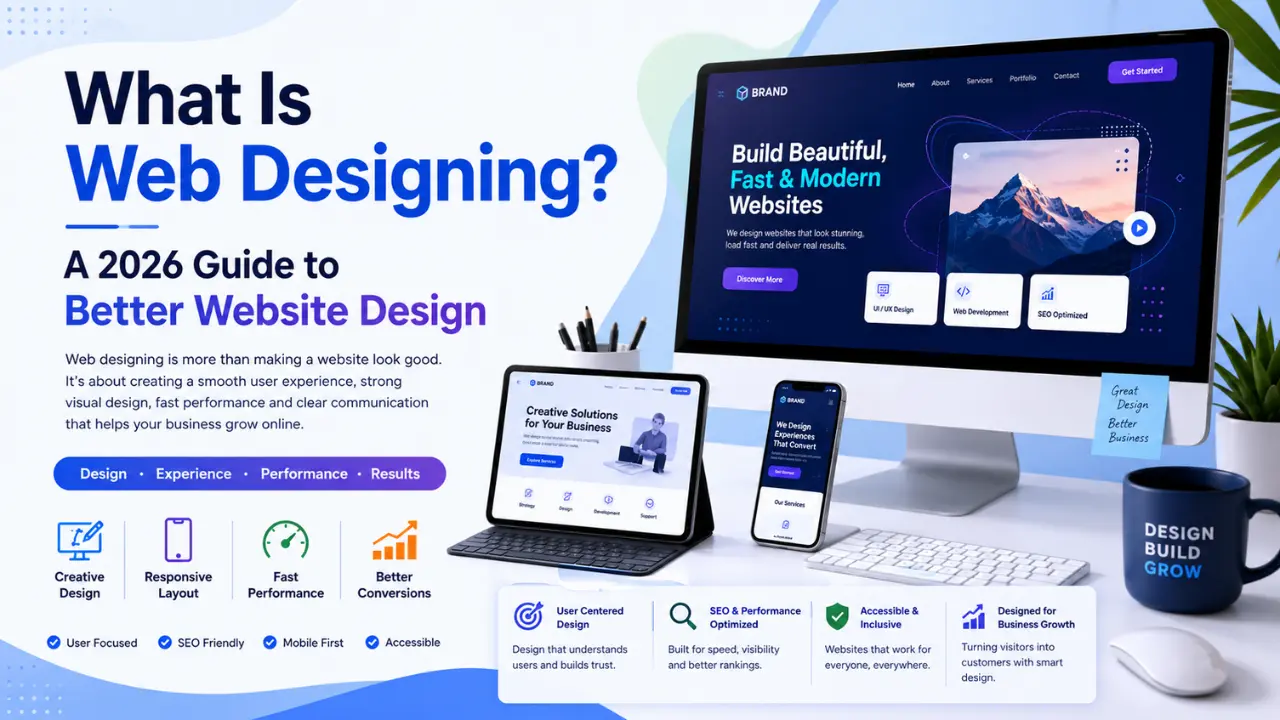

Web designing is the process of planning and creating the visual structure, layout, usability, and overall user experience of a website. It includes much more than choosing colors, images, fonts, or animations. A well-designed website should help visitors understand the business, find information easily, complete actions without confusion, and use the website comfortably across different devices.
In simple terms, web design combines visual design with user experience, navigation, content structure, accessibility, responsiveness, and performance.
Modern web design also works closely with digital marketing. A website is often the place where visitors reach after finding a business through search engines, social media, paid advertising, or content. This means a website should not only look professional but should also support SEO, conversions, page speed, mobile usability, and clear communication.
Google’s current guidance recommends focusing on overall page experience, including good Core Web Vitals, secure pages, mobile-friendly presentation, and avoiding intrusive elements that interfere with the main content.
In this guide, we will explain what web designing includes, how it differs from web development, the technologies behind modern websites, and what businesses should consider when planning a website in 2026.
Web Designing vs Development
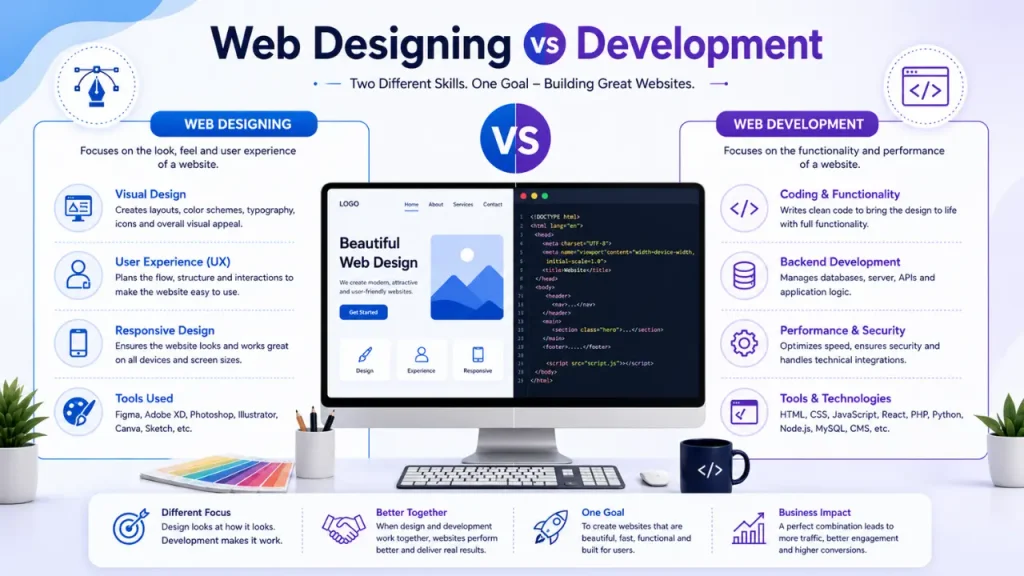
You may have seen web designing and web development used together, and there is a good reason for that.
Both areas work together to create a complete and functional website, but they focus on different parts of the project.
Web designing mainly focuses on how a website looks, feels, and works from the user’s point of view. It covers areas such as page layouts, typography, colors, navigation, visual hierarchy, responsive design, user experience, and accessibility.
Web development focuses more on implementing those designs and building the technical functionality behind the website. Developers work with frontend technologies, backend systems, databases, APIs, content management systems, security, integrations, and server-side functionality.
For example, a web designer may plan how a product page should look and where the product information, images, price, reviews, and CTA should appear. A developer then builds the functionality that allows customers to select products, add them to a cart, submit forms, or complete a purchase.
For businesses planning a new website, understanding this difference helps when selecting professional web development services.
A strong website usually needs both good design and reliable development.
HTML, CSS, and JavaScript
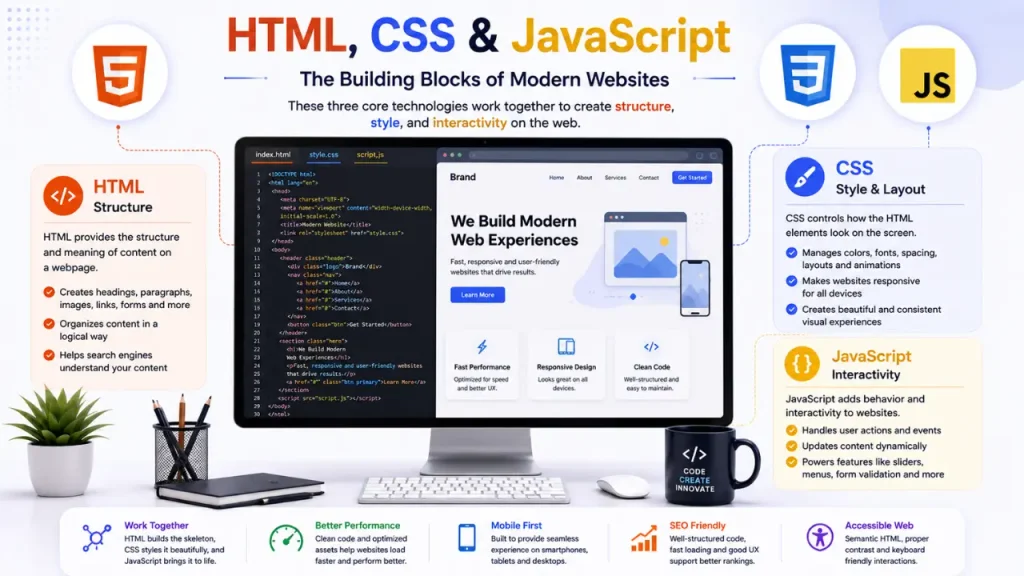
HTML, CSS, and JavaScript remain the core technologies behind many websites and web applications.
They have different responsibilities:
- HTML creates the structure and meaning of webpage content.
- CSS controls presentation, layout, spacing, colors, typography, and responsive behavior.
- JavaScript adds interaction and dynamic functionality.
Modern web projects can also use frameworks, libraries, design systems, build tools, APIs, and content management platforms, but understanding these three technologies remains important for frontend web development.
HTML
HTML stands for HyperText Markup Language. It provides the structure of a webpage and identifies different types of content.
HTML is used to create elements such as:
- Headings
- Paragraphs
- Links
- Images
- Navigation
- Forms
- Lists
- Tables
- Sections
- Articles
- Buttons
Good HTML is not only about making a page display correctly. Semantic HTML can also help browsers, assistive technologies, developers, and search engines understand the structure and meaning of the content.
For example, using an appropriate heading hierarchy helps organize content, while descriptive links and meaningful image alternative text can improve usability and accessibility.
Modern web design should therefore consider semantic HTML and accessibility from the beginning, rather than treating them as optional improvements after a website is completed.
CSS
CSS stands for Cascading Style Sheets. It controls how HTML content appears on the screen.
With CSS, designers and developers can control:
- Colors
- Fonts
- Spacing
- Layouts
- Borders
- Backgrounds
- Buttons
- Animations
- Responsive layouts
- Desktop and mobile presentation
CSS is especially important for responsive web design because the same website needs to work across different screen sizes.
A website may be viewed on a large desktop monitor, laptop, tablet, or smartphone. Responsive CSS allows layouts to adapt to those different environments instead of forcing users to zoom or scroll horizontally.
Modern CSS also provides powerful layout systems such as Flexbox and Grid, making it easier to create structured responsive layouts without relying on outdated techniques.
JavaScript
JavaScript adds behavior and interaction to websites.
HTML can define the structure of a button, and CSS can define how the button looks. JavaScript can control what happens when a user clicks it.
For example, JavaScript can be used to:
- Open navigation menus
- Validate form inputs
- Display dynamic content
- Update shopping carts
- Filter products
- Load data from APIs
- Create interactive dashboards
- Change interface states
- Handle user interactions
JavaScript has become an important part of modern web application development, but using more JavaScript does not automatically create a better website.
Excessive client-side code can affect loading and responsiveness, so modern development should balance functionality with performance.
Google’s Core Web Vitals measure real-world loading performance, responsiveness, and visual stability through LCP, INP, and CLS. Google recommends aiming for LCP within 2.5 seconds, INP below 200 milliseconds, and CLS below 0.1 for a good user experience.
Graphical elements
Graphical elements are another important part of professional website design.
A designer decides how visual elements such as images, icons, illustrations, videos, buttons, cards, colors, and typography work together.
However, modern web design is not simply about making a website attractive.
Every visual element should have a purpose.
For example, a website may use:
- Product images to explain products
- Icons to support quick understanding
- CTA buttons to guide users
- Images to establish brand identity
- Whitespace to improve readability
- Visual hierarchy to highlight important information
- Illustrations to explain complex ideas
A good designer also considers how visitors move through the website. Navigation should be clear, important information should be easy to find, and users should understand what action they can take next.
Accessibility is also an important part of modern graphical and interface design. WCAG 2.2 provides recommendations for making web content accessible across devices, and its guidance covers areas such as focus visibility, target size, accessible authentication, and input assistance.
Responsive Web Design
Responsive design has become a basic requirement for modern websites.
Instead of creating a completely separate website for every screen size, responsive design allows the layout to adapt to different devices.
A responsive website should provide a comfortable experience on:
- Smartphones
- Tablets
- Laptops
- Desktop computers
- Different screen resolutions
Responsive design includes more than shrinking a desktop page.
Designers need to consider mobile navigation, readable text, touch-friendly buttons, flexible images, spacing, forms, menus, and content hierarchy.
A mobile visitor should be able to understand the page and complete important actions without unnecessary zooming, horizontal scrolling, or difficult interactions.
Google also includes mobile presentation as one of the factors in its broader page-experience guidance.
Web Design and SEO
Web design and SEO are closely connected because the design and technical structure of a website can affect how easily users and search engines access its content.
An SEO-friendly website should have:
- Clear page structure
- Logical headings
- Descriptive URLs
- Crawlable content
- Mobile-friendly layouts
- Fast-loading pages
- Accessible navigation
- Descriptive image text where appropriate
- Clear internal linking
- Useful, original content
However, good web design alone does not guarantee higher Google rankings.
SEO also depends on content quality, search intent, technical SEO, authority, links, structured data where relevant, and many other factors.
For businesses that want to improve organic visibility, SEO services can work alongside web design and development to build a website that is useful for both visitors and search engines.
Web Design for Digital Marketing
A website often supports several digital marketing channels at the same time.
A visitor may first discover a business through Google Search, a social media post, an advertisement, or a blog article. The website then needs to provide a clear next step.
For example:
Search → Website → Information → Trust → Contact/Inquiry
Or:
Social Media → Landing Page → Product/Service Details → CTA
This is why website design should be planned around the complete customer journey rather than individual pages.
For businesses using social platforms to generate traffic, social media marketing services can bring visitors to a website, while the website design helps those visitors understand the offer and take action.
Similarly, businesses running Google Ads need landing pages that match the advertisement, provide relevant information, load properly, and make the next action clear. PPC services and conversion-focused web design can therefore work together.
Content and Web Designing
Content is another major part of effective website design.
A beautiful website with unclear content can still create a poor user experience.
Designers need to understand:
- What information users need
- Which information should appear first
- How much text should be displayed in each section
- Where images should be used
- Which headings should guide readers
- Where calls to action should appear
Content should be organized using clear headings, short paragraphs, useful lists, relevant images, and logical navigation.
This is especially important for service businesses because visitors often compare different companies before making an inquiry.
A strong content marketing strategy can support the website by creating useful blogs, landing-page content, guides, FAQs, and other resources that answer customer questions.
Accessibility in Modern Web Design
Accessibility should be considered during website planning rather than added only after development.
The goal is to make websites usable by as many people as reasonably possible, including people who use assistive technologies or have visual, auditory, physical, cognitive, or other accessibility needs.
WCAG 2.2 is the current W3C recommendation for web content accessibility, and W3C advises using the latest version to maximize future applicability.
Important accessibility considerations include:
- Clear color contrast
- Keyboard-friendly navigation
- Visible focus states
- Descriptive form labels
- Meaningful alternative text for images
- Accessible buttons and links
- Readable typography
- Clear error messages
- Touch-friendly controls
WCAG 2.2 also introduced additional criteria covering areas such as focus visibility, target size, dragging movements, consistent help, redundant entry, and accessible authentication.
For a business website, accessibility can improve usability for a wider audience while also creating a more thoughtful overall user experience.
What Makes a Good Website Design in 2026?
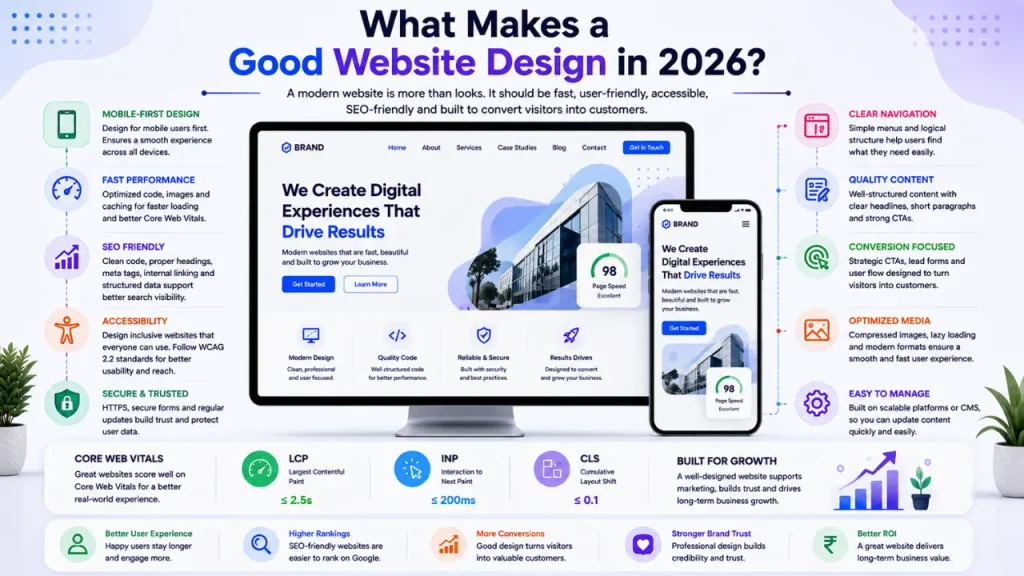
A modern website should not be judged only by how attractive it looks.
A strong website should combine:
Design + UX + Performance + Accessibility + SEO + Content + Security + Conversion Goals
Some important considerations for 2026 include:
- Mobile-first responsive layouts
- Clear and simple navigation
- Fast page loading
- Strong Core Web Vitals
- Accessible interface patterns
- Useful and well-structured content
- Clear calls to action
- Optimized images and media
- Secure website delivery
- Search-friendly structure
- Consistent branding
- Easy content management
- Conversion-focused landing pages
Google states that good Core Web Vitals are recommended for Search success and general user experience, while also making clear that strong scores alone do not guarantee top rankings.
This is an important distinction for businesses: website design should be built for users first, while SEO and performance should be considered throughout the design and development process.
Frequently Asked Questions About Web Designing
What is web designing?
Web designing is the process of planning the visual appearance, layout, usability, navigation, and user experience of a website. Modern web design also considers responsiveness, accessibility, performance, SEO, and business goals.
What is the difference between web designing and web development?
Web designing mainly focuses on the interface, visual structure, usability, and user experience. Web development focuses on implementing that design and building the technical functionality, integrations, databases, and application features.
Why is responsive web design important?
Responsive web design allows a website to adapt to smartphones, tablets, laptops, and desktop screens. It helps users access content and complete actions comfortably across different devices.
Is web design important for SEO?
Yes, web design can support SEO through clear structure, mobile usability, fast performance, accessible navigation, useful content, and strong internal linking. However, design alone does not guarantee higher rankings.
What are HTML, CSS, and JavaScript used for?
HTML creates webpage structure, CSS controls presentation and responsive layouts, and JavaScript adds interactive behavior and dynamic functionality. Together, they form the foundation of many modern websites.
What are Core Web Vitals?
Core Web Vitals are Google metrics used to measure real-world page experience across loading performance, responsiveness, and visual stability. The current metrics are LCP, INP, and CLS.
What is accessible web design?
Accessible web design aims to make websites usable by people with different abilities and assistive technologies. WCAG 2.2 provides internationally recognized guidance for improving web accessibility.
How does web design help digital marketing?
A well-designed website gives visitors a clear destination after they come from search engines, social media, advertisements, or content. Good design can make information easier to understand and help visitors take useful actions such as submitting an inquiry, calling a business, or making a purchase.
Should a business redesign its old website?
A redesign can be useful when an existing website is difficult to use on mobile devices, slow, outdated, hard to manage, difficult to navigate, or no longer matches the business goals. The decision should be based on actual user and business problems rather than design trends alone.
Digital Marketing Agency – iBirds Digital
Conclusion
Web designing in 2026 is much more than creating attractive webpages.
A successful website combines visual design with responsive layouts, intuitive navigation, useful content, accessibility, performance, SEO, security, and clear business objectives.
HTML, CSS, and JavaScript still provide the foundation for many websites, while modern frameworks, development tools, content platforms, APIs, and design systems help teams build more advanced digital experiences.
For businesses, the best website design is one that makes it easy for users to understand the business, find the right information, interact with the website, and take the next step.
A website should therefore be designed not only to look good, but also to work well, load efficiently, remain accessible, support marketing, and serve real users.