
Choosing between a B2B growth agency vs in-house marketing team is not simply a question of which option costs less. The right choice depends on how quickly you need results, how much specialist expertise your business requires, how deeply marketing must be connected to your sales team, and whether your current team has enough capacity to execute every channel effectively.
An in-house team offers direct brand control, deep product knowledge, and close collaboration with sales and leadership. A B2B growth agency can provide access to specialists across SEO, paid advertising, content, social media, analytics, and conversion optimisation without requiring you to hire every role internally.
Current B2B marketing research increasingly points toward a third option: hybrid marketing. Internal marketers retain strategic ownership and business context while an external agency adds specialist execution and scalable capacity.
So, B2B Growth Agency vs In-House Marketing: What’s Right for You really comes down to what your business needs at its current growth stage.
What Is the Real Difference Between a B2B Growth Agency and In-House Marketing?
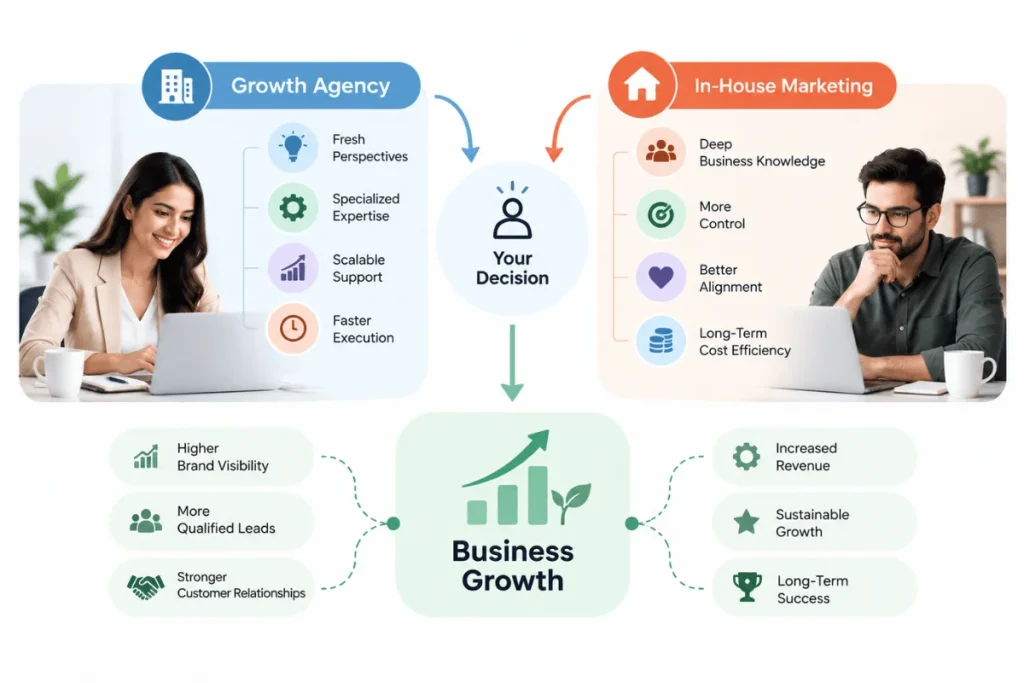
The biggest difference is not simply “outsourcing versus hiring.” It is the difference between access to specialised capacity and ownership of internal capability.
An in-house marketing team works inside your company every day. They understand your products, customers, sales objections, competitors, internal processes, and brand voice. That context can make communication and decision-making extremely efficient.
A B2B growth agency, on the other hand, brings an external team that may include specialists in SEO, PPC, content, creative, analytics, social media, CRO, and demand generation. Instead of building every capability through separate hires, the company accesses several skill sets through one partner.
Competitor research reflects this distinction. Current B2B agency comparisons commonly identify agency strengths as speed, specialist breadth, and flexible capacity, while in-house teams are stronger in brand knowledge, ownership, and institutional memory.
The important question is therefore not “Which one is better?” but “Which capabilities does our business need right now?”
7 Factors to Consider Before Choosing Between Agency and In-House Marketing
A good decision should be based on your actual operating situation rather than a generic agency-versus-employee argument.
1. Speed to market
If you need SEO, paid campaigns, content, LinkedIn marketing, or conversion optimisation immediately, hiring several specialists internally can take months.
An agency already has people and processes in place, which can shorten the time between strategy and execution. Recent B2B SaaS comparisons similarly highlight faster activation as one of the major advantages of agency support.
2. Specialist expertise
A small internal team may have excellent marketers but still lack deep expertise in technical SEO, paid media, analytics, content strategy, or CRO.
A growth agency can provide access to multiple specialists without requiring separate full-time hires for every discipline.
3. Brand and product knowledge
This is where in-house marketing has a major advantage.
Internal marketers are close to customer conversations and product development. They can quickly understand new features, positioning changes, sales objections, and customer feedback.
4. Fixed versus flexible costs
In-house marketing involves salaries, benefits, recruitment, management, software, training, and employee retention.
An agency generally works through a service agreement or retainer, making capacity easier to increase or reduce when priorities change.
5. Scalability
Suppose your company suddenly launches a new product. An internal team may already be operating at capacity. An agency can often add specialist resources without waiting for another recruitment cycle.
6. Strategic control
In-house teams naturally provide greater day-to-day control over messaging, priorities, and implementation.
However, a good agency partnership does not mean giving up strategic control. Clear briefs, reporting, approval processes, and shared KPIs can maintain alignment.
7. Measurement and accountability
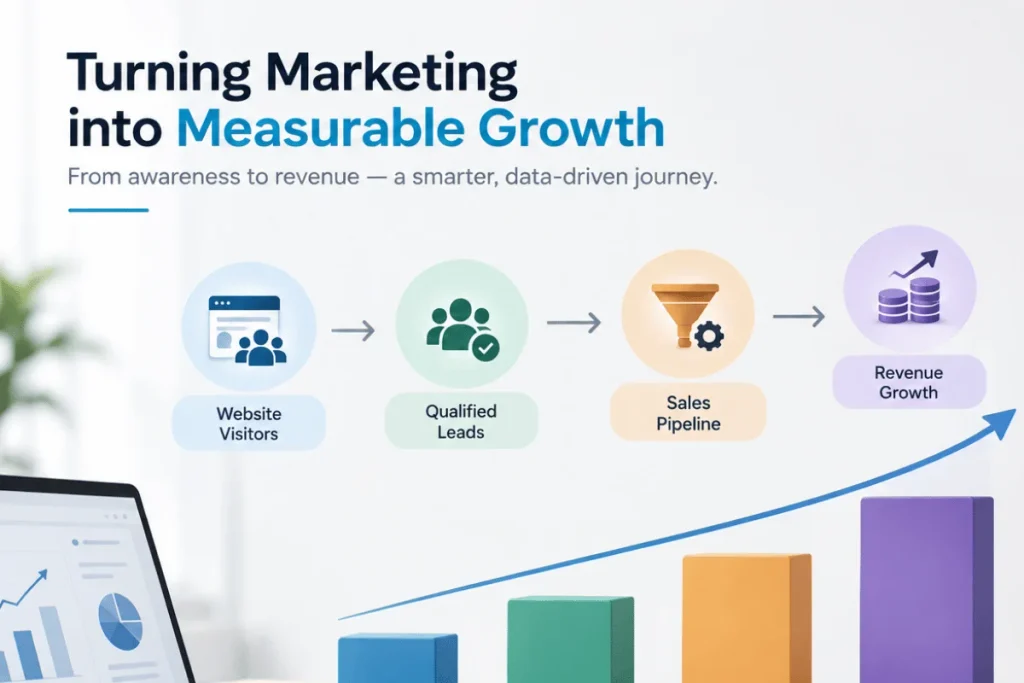
B2B marketing should ultimately connect activity to pipeline.
Instead of measuring success only through impressions or website traffic, businesses should track qualified leads, conversion rates, customer acquisition costs, sales opportunities, and revenue contribution.
B2B Growth Agency vs In-House Marketing: A Practical Comparison
The simplest way to understand the decision is to compare what each model is naturally good at.
| Factor | B2B Growth Agency | In-House Marketing | Hybrid Model |
|---|---|---|---|
| Specialist expertise | High | Depends on team | High |
| Brand knowledge | Builds over time | Very high | Very high |
| Speed to launch | Fast | Slower when hiring | Fast |
| Hiring requirement | Low | High | Moderate |
| Scalability | High | Limited by headcount | High |
| Daily collaboration | Structured | Immediate | Strong with clear processes |
| Strategic control | Shared | Direct | Internal-led |
| Access to multiple specialists | Easy | Requires multiple hires | Easy |
| Fixed overhead | Generally lower | Higher | Moderate |
| Best for | Speed and specialist depth | Ownership and context | Growth-stage businesses |
The comparison makes one point clear: there is no universal winner.
An early-stage company that needs demand generation quickly may benefit from an agency. A mature company with predictable marketing workloads and strong leadership may benefit from a larger internal team. A growing company that needs both control and specialist support may find the hybrid model more practical.
When a B2B Growth Agency Is the Better Choice
A B2B growth agency can be particularly valuable when marketing requirements are broader than your existing team can comfortably handle.
Imagine a company with one marketing manager responsible for content, email, social media, paid campaigns, website updates, reporting, and sales support. Adding SEO, LinkedIn advertising, conversion optimisation, and demand-generation strategy to that person’s workload may create bottlenecks.
An agency can fill those gaps without immediately increasing internal headcount.
Choose agency support when speed matters more than building every capability internally
If you have an upcoming product launch, a new market to enter, or an urgent need to increase qualified leads, waiting several months to recruit multiple specialists may create a significant opportunity cost.
Agencies can also be useful when you need expertise temporarily. You may need a technical SEO project, landing-page optimisation, paid campaign restructuring, or content strategy without needing a permanent employee for that single responsibility.
External perspective can uncover problems internal teams miss
Internal teams naturally become familiar with their own website and processes. An outside team can review the funnel with fresh eyes and identify gaps in positioning, content, search visibility, conversion paths, or campaign performance.
For businesses considering external support, iBirds Digital’s digital marketing services combine SEO, PPC, social media, content, and website support rather than treating each channel as an isolated activity.
When Building an In-House Marketing Team Makes More Sense
An internal marketing team becomes increasingly attractive when marketing has become a permanent strategic function and the business has enough predictable work to justify dedicated specialists.
If your marketing team works closely with product, sales, customer success, and leadership every day, keeping those capabilities internally can create significant value.
In-house teams retain institutional knowledge
Your employees learn from customer calls, sales objections, product updates, support conversations, and internal meetings. That knowledge accumulates over time.
For highly technical B2B businesses, this can be particularly important because marketing often needs to understand complex products and communicate them accurately to a specialised audience.
In-house can provide stronger control
Internal teams can change campaigns, messaging, content, and priorities without coordinating with an external partner.
They also retain the processes and knowledge developed during campaigns.
But the hidden cost is capacity
The downside is that building an internal team requires more than salaries.
You need recruitment, onboarding, management, tools, training, specialist development, and retention. You also need enough ongoing work to keep each specialist productive.
That is why “we’ll just hire someone” is not always the cheaper solution.
Why the Hybrid Model Is Often the Strongest Option for Growing B2B Companies
The biggest mistake in the B2B Growth Agency vs In-House Marketing debate is assuming the company must choose only one.
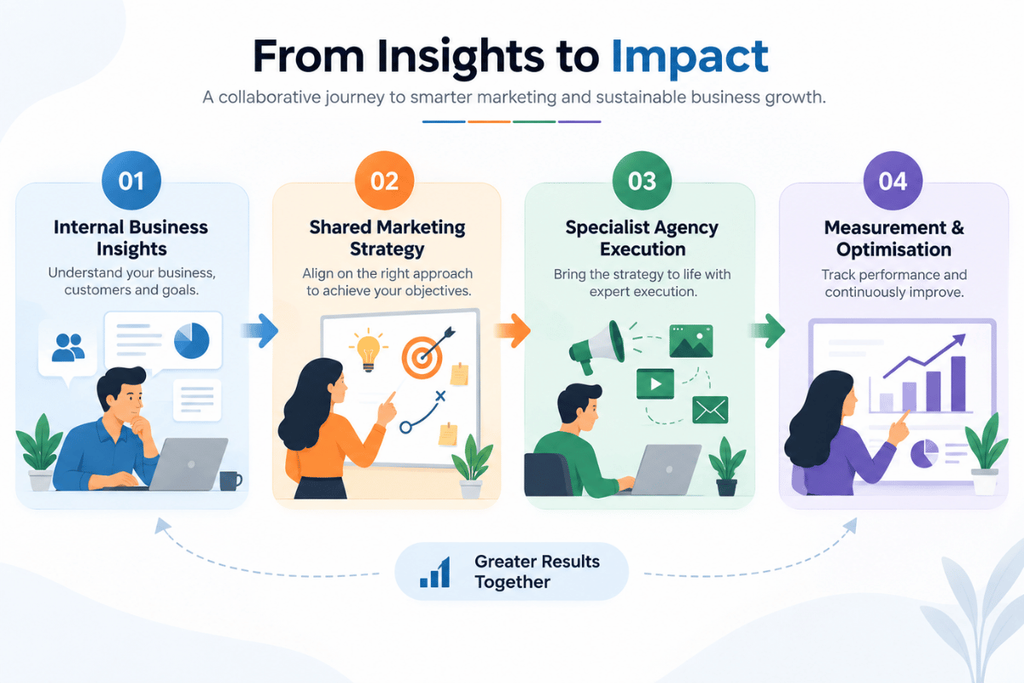
A hybrid model combines internal ownership with external specialist capacity.
The internal team can own:
- Brand positioning
- Product messaging
- Customer insights
- Sales alignment
- Marketing priorities
- Internal stakeholder coordination
The agency can support:
- SEO
- Paid advertising
- Content production
- Technical optimisation
- Creative execution
- Analytics
- CRO
- Specialist campaigns
This model works because the two teams solve different problems.
Recent B2B research also identifies hybrid structures as a common approach for growth-stage businesses, with internal teams maintaining strategy and brand ownership while agencies provide specialist execution.
A simple example
Suppose your internal marketing manager knows that sales is struggling to generate qualified leads from a particular industry segment.
The internal team provides the customer and sales insight. The agency researches search demand, competitor positioning, paid opportunities, content gaps, and conversion paths.
Both teams then agree on a campaign.
The result is much stronger than either side working independently because the strategy is grounded in business knowledge while execution benefits from specialised marketing expertise.
Which Model Is Right for Your Business Stage?
The best decision can change as your company grows.
Early-stage businesses
If you are still testing your marketing channels, an agency can provide broader expertise without requiring a large permanent team.
This allows the company to discover which channels actually generate qualified demand before committing to multiple full-time hires.
Growth-stage businesses
This is where hybrid marketing often becomes particularly useful.
You may have one or two internal marketers who understand the business extremely well, but they cannot realistically become experts in every marketing channel.
Adding an agency gives them additional execution capacity without removing their strategic role.
Mature businesses
Larger companies with established marketing operations may benefit from a substantial in-house team. When workloads are consistent and marketing is deeply integrated with product, sales, and customer success, permanent specialists can make financial and operational sense.
Even then, agencies can remain useful for specialist projects, major launches, technical SEO, creative campaigns, or additional capacity.
The decision should therefore be reviewed periodically rather than treated as permanent.
How to Measure Whether Your Marketing Model Is Actually Working
The most useful question is not whether an agency or employee is cheaper.
It is whether the marketing structure produces better business output for the resources invested.
Track metrics such as:
- Qualified leads
- Marketing-generated pipeline
- Cost per qualified lead
- Customer acquisition cost
- Conversion rate
- Organic traffic
- Paid campaign efficiency
- Sales-qualified opportunities
- Revenue influenced by marketing
- Time required to launch campaigns
For example, an agency retainer may look more expensive than one employee’s salary. But if the agency provides SEO, PPC, content, analytics, design, and strategy, comparing its cost with one salary does not give you the full picture. A better approach is to compare marketing costs against measurable business outcomes such as leads, conversions, and revenue. Google Analytics allows businesses to measure important actions and evaluate marketing performance across different channels.
Likewise, an internal employee may appear cheaper than an agency but require additional software, management, training, recruitment, and specialist support.
The right comparison is total cost against useful output.
iBirds Digital’s approach includes SEO, PPC, social media, content, and website development, with reporting and performance tracking used to guide ongoing optimisation.
A Simple Decision Framework for Choosing Your Marketing Model
Before choosing between an agency, an internal team, or both, answer these five questions:
1. Do we need specialist expertise right now?
If yes, agency support can provide faster access to specialised skills.
2. Do we have enough consistent work for a full-time specialist?
If not, an agency may provide better flexibility.
3. How important is deep product knowledge?
For complex B2B products, maintaining internal ownership can be valuable.
4. How quickly do we need marketing execution?
Urgent growth goals often favour existing external capacity.
5. Can our current team manage strategy and execution without bottlenecks?
If the answer is no, additional specialist support may be justified.
These questions turn the B2B Growth Agency vs In-House Marketing: What’s Right for You decision into a business decision rather than a personal preference.
Frequently Asked Questions
Is a B2B growth agency better than an in-house marketing team?
Not necessarily. An agency is usually stronger when a company needs specialist expertise, faster execution, or flexible capacity, while an in-house team provides deeper brand and product knowledge. The right choice depends on business stage, budget, workload, and marketing goals. For many growing B2B companies, combining internal strategy with agency expertise can provide a practical middle ground.
Is hiring an agency cheaper than building an in-house marketing team?
It can be, but comparing a monthly retainer directly with one employee’s salary is misleading. An internal team also requires recruitment, benefits, management, software, training, and specialist coverage. An agency may provide several disciplines through one partnership, which can make the total cost more efficient when the company needs broad expertise. The better comparison is total cost versus the amount and quality of marketing output produced.
When should a B2B company build an in-house marketing team?
Building internally makes more sense when marketing work is consistent, strategically important, and large enough to justify permanent roles. Companies with complex products can also benefit from having marketers deeply embedded with sales, product, and customer success. In-house teams are particularly valuable when the business has strong marketing leadership and enough budget to recruit and retain specialists. Agencies can still be used for specialist projects even after an internal team is established.
What is a hybrid B2B marketing model?
A hybrid model combines an internal marketing team with external specialists. The internal team generally owns brand strategy, customer knowledge, business priorities, and cross-functional coordination, while the agency provides specialist execution and additional capacity. This approach can be useful when a company has strong internal knowledge but lacks expertise across every marketing channel. It also allows the business to scale specific activities without continuously increasing headcount.
How do I decide between a B2B growth agency vs in-house marketing?
Start by looking at your current bottleneck rather than choosing a model first. If the problem is lack of specialist skills or execution capacity, an agency may solve it faster; if the problem is lack of strategic ownership or product knowledge, strengthening the internal team may be better. If both problems exist, a hybrid model deserves serious consideration. Review the decision against pipeline, cost, speed, and long-term capability rather than choosing based only on monthly price.
Final Verdict:
There is no universal winner in the B2B Growth Agency vs In-House Marketing decision.
An in-house team gives you ownership, product knowledge, and close collaboration. A B2B growth agency gives you specialist expertise, faster access to resources, and flexible capacity. A hybrid approach can combine the strongest elements of both.
For a growing company, the smartest model is often the one that removes its biggest current bottleneck.
If your internal team understands the business but lacks time or specialist expertise, agency support can extend its capabilities. If your marketing engine is already mature and predictable, expanding internally may make more sense.
The goal is not to choose between “agency” and “in-house” for the sake of structure. The goal is to build a marketing system that creates qualified demand, efficient customer acquisition, and sustainable B2B growth.
Ready to Find the Right Marketing Model for Your Business?
iBirds Digital can help you assess your current marketing setup, identify channel gaps, and build a practical strategy around your growth goals.
Get a Free Digital Marketing Audit and find out whether your business needs an agency, stronger in-house capabilities, or a combination of both.