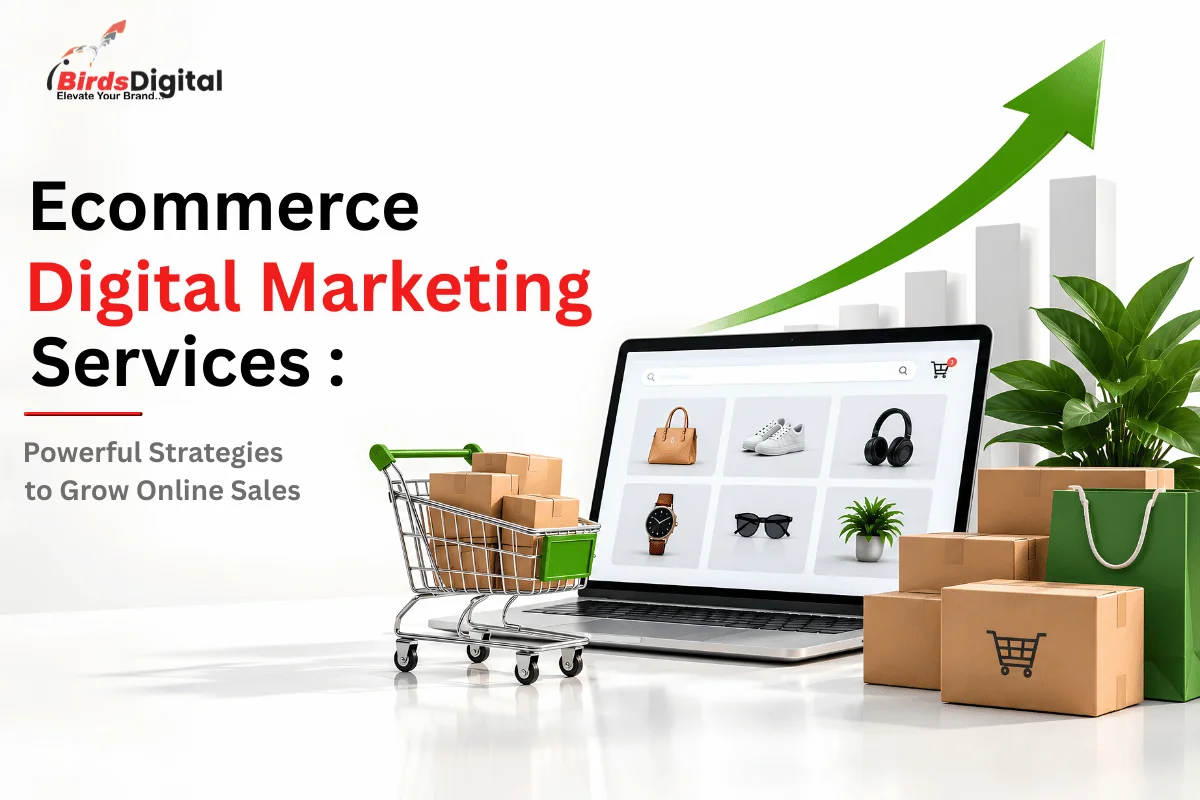

Ecommerce
Running an ecommerce store is not just about adding products to a website and waiting for customers to find them. Online stores need a connected marketing strategy that brings the right shoppers to product pages, helps them make purchase decisions, and encourages them to return.
Ecommerce digital marketing services bring different channels together to support the complete customer journey. These can include ecommerce SEO, Google Ads, social media marketing, content, conversion optimization, email and WhatsApp marketing, remarketing, analytics, and marketplace promotion.
The goal is not simply to generate more website traffic. The bigger goal is to turn relevant traffic into orders, repeat purchases, and sustainable revenue.
What Are Ecommerce Digital Marketing Services?
Ecommerce digital marketing services are online marketing activities designed specifically for businesses that sell products through websites, marketplaces, or both.
Unlike general digital marketing, ecommerce marketing has a strong focus on the shopping journey.
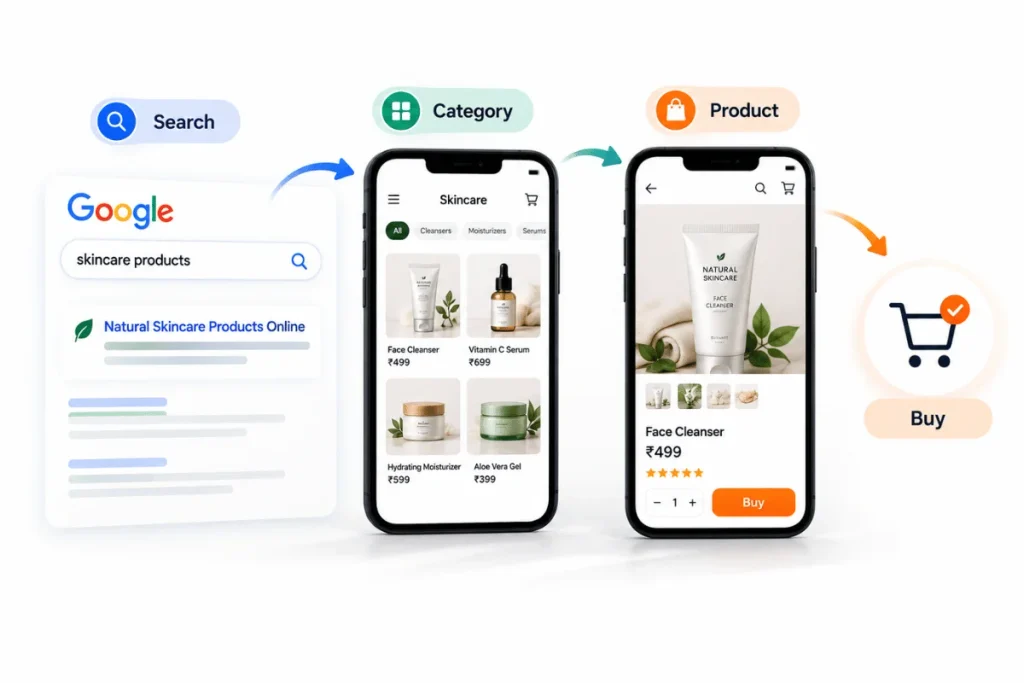
A typical journey looks like:
Search or Social → Product Discovery → Product Page → Cart → Checkout → Purchase → Repeat Order
Every stage can have different problems.
For example, a store may have good traffic but poor product-page conversions. Another store may have a good conversion rate but very little traffic. A third store may get plenty of first-time orders but very few repeat customers.
This is why ecommerce marketing works better when channels are connected rather than managed separately.
7 Ecommerce Digital Marketing Services That Drive Growth
1. Ecommerce SEO for Long-Term Product Visibility
Ecommerce SEO helps products, categories, and important store pages appear when potential customers search for relevant products.
The strategy can include:
- Product keyword research
- Category-page optimization
- Product title and description optimization
- Technical SEO
- Internal linking
- Image optimization
- Structured data
- Site architecture
- Content marketing
- SEO for product variations
Google recommends ecommerce-specific practices that help search engines understand product information, site structure, and ecommerce content. Product structured data and Merchant Center feeds can also make product information eligible for richer experiences across Google.
For example, instead of targeting only a broad keyword like “running shoes,” an ecommerce store may also target searches around specific product types, sizes, materials, use cases, and buying needs.
The aim is to capture customers at different stages of purchase intent.
For businesses looking for specialist support, iBirds Digital currently offers ecommerce SEO as part of its SEO services, including work intended to improve product visibility and conversions.
Google also recommends using product structured data and Merchant Center product feeds to help ecommerce products become eligible for richer appearances across Google. Google’s ecommerce SEO best practices can help online stores understand how to structure and optimize their product pages.
2. Google Ads and Shopping Ads for High-Intent Traffic
Paid advertising can help ecommerce brands reach shoppers who are already searching for products or responding to relevant offers.
Common ecommerce advertising channels include:
- Google Search Ads
- Google Shopping
- Performance Max
- Meta Ads
- Display campaigns
- Remarketing
Shopping campaigns are especially useful because product information such as images, prices, and availability can appear directly in shopping experiences.
Google explains that ecommerce businesses can provide product information through Product structured data and Google Merchant Center, increasing eligibility for different product-related search experiences.
Paid campaigns should not be measured only by clicks.
For an ecommerce store, useful metrics may include:
| Metric | Why It Matters |
|---|---|
| CTR | Measures ad engagement |
| Conversion Rate | Shows how well traffic converts |
| CPA | Shows acquisition cost |
| ROAS | Connects ad spend with revenue |
| AOV | Shows average order value |
| Repeat Purchase Rate | Shows customer retention |
iBirds Digital’s current PPC service includes Google Ads, social advertising, remarketing, conversion optimization, reporting and Shopping Ads for online stores.
The important part is connecting paid traffic with actual ecommerce outcomes.
3. Social Media Marketing That Supports Product Discovery
Social media is often where customers discover new products, brands, offers, and creators.
For ecommerce businesses, platforms such as Instagram, Facebook, YouTube and other social channels can support:
- Product awareness
- Content distribution
- Paid social campaigns
- Product demonstrations
- Customer reviews
- UGC
- Influencer campaigns
- Remarketing
- Community engagement
But simply posting product images every day is not enough.
Good ecommerce social media content should answer customer questions, demonstrate product value, show how products are used, and give shoppers a reason to visit the store.
For example, a skincare brand can create content around:
Problem → Product → How to Use → Expected Experience → Purchase
This creates a stronger connection between content and the buying journey.
iBirds Digital provides social media marketing services covering major platforms including Facebook, Instagram, LinkedIn and YouTube.
4. Conversion Rate Optimization for Ecommerce Websites
Getting visitors to your store is only one part of ecommerce marketing.
The next question is:
How many of those visitors actually buy?
Conversion Rate Optimization, or CRO, focuses on improving the experience between landing on a website and completing an action.
For ecommerce stores, this can include:
- Better product-page layouts
- Clear product benefits
- Stronger CTAs
- Better product images
- Reviews and trust signals
- Easier navigation
- Simplified checkout
- Mobile optimization
- Faster page loading
- Better cart experience
Imagine an ecommerce store receiving 10,000 monthly visitors.
If the store converts 1% of visitors, that means roughly:
100 orders
If the same store improves its conversion rate to 1.5% without increasing traffic, it could generate:
150 orders
The example shows why ecommerce growth is not always about buying more traffic. Improving the percentage of existing visitors who purchase can also have a major impact.
This is why website performance, usability and marketing need to work together.
5. Retargeting, Email and WhatsApp Marketing for Repeat Sales
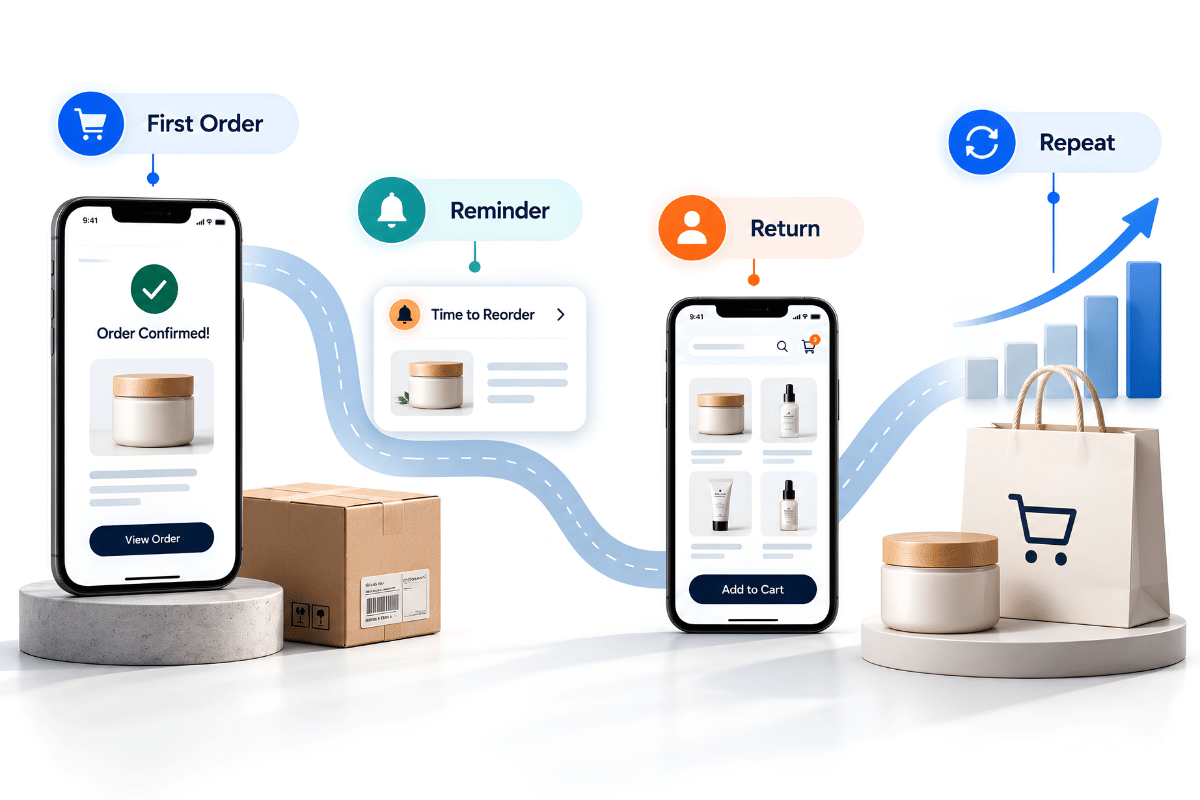
The first purchase should not necessarily be the end of the customer journey.
Existing customers already know the brand, which makes them an important audience for retention campaigns.
Ecommerce retention strategies can include:
- Abandoned-cart reminders
- Product recommendations
- Order updates
- Replenishment reminders
- New-product announcements
- Special offers
- Customer win-back campaigns
- Loyalty communication
For example:
Product View → No Purchase → Reminder → Offer → Return Visit → Purchase
Email and WhatsApp can be particularly useful for communicating with customers who have already interacted with a store.
However, retention should be relevant and controlled. Sending too many promotional messages can reduce engagement and damage customer trust.
The aim is to provide useful reasons for customers to return, not simply send more messages.
6. Marketplace Marketing for Amazon, Flipkart and Other Platforms
For many Indian ecommerce businesses, the website is only one sales channel.
Marketplaces can provide access to customers who already use platforms such as:
- Amazon
- Flipkart
- Meesho
- Myntra
- Nykaa
- Other category-specific marketplaces
Marketplace marketing can include:
- Product listing optimization
- Product titles and descriptions
- Marketplace SEO
- Sponsored ads
- Product images
- Reviews and ratings
- Promotions
- Inventory coordination
- Marketplace analytics
Current Indian ecommerce competitors increasingly position marketplace management as part of a broader ecommerce growth strategy rather than as a completely separate service. Brand Chanakya, for example, combines marketplace management with performance advertising, SEO, quick commerce, social commerce, retention and analytics.
This approach can be useful for brands that sell through multiple channels.
Instead of thinking:
Website OR Marketplace
a stronger model can be:
Website + Marketplace + Paid Media + Organic Search + Retention
Each channel can serve a different part of the customer journey.
7. Analytics and Performance Tracking
One of the most important ecommerce digital marketing services is measurement.
Without proper tracking, it becomes difficult to understand which marketing activities are actually producing revenue.
Track metrics such as:
- Website traffic
- Product views
- Add-to-cart rate
- Checkout rate
- Conversion rate
- Revenue
- Average order value
- Customer acquisition cost
- ROAS
- Repeat purchase rate
- Customer lifetime value
A Simple Ecommerce Measurement Funnel
Traffic → Product Views → Add to Cart → Checkout → Purchase → Repeat Purchase
This allows you to identify where customers are dropping out.
For example:
If traffic is strong but product views are low, navigation may need attention.
If product views are strong but add-to-cart activity is weak, product presentation or pricing may be a problem.
If carts are high but completed orders are low, the checkout experience may need improvement.
This is more useful than looking only at total website traffic.
Full-Funnel Ecommerce Digital Marketing Strategy
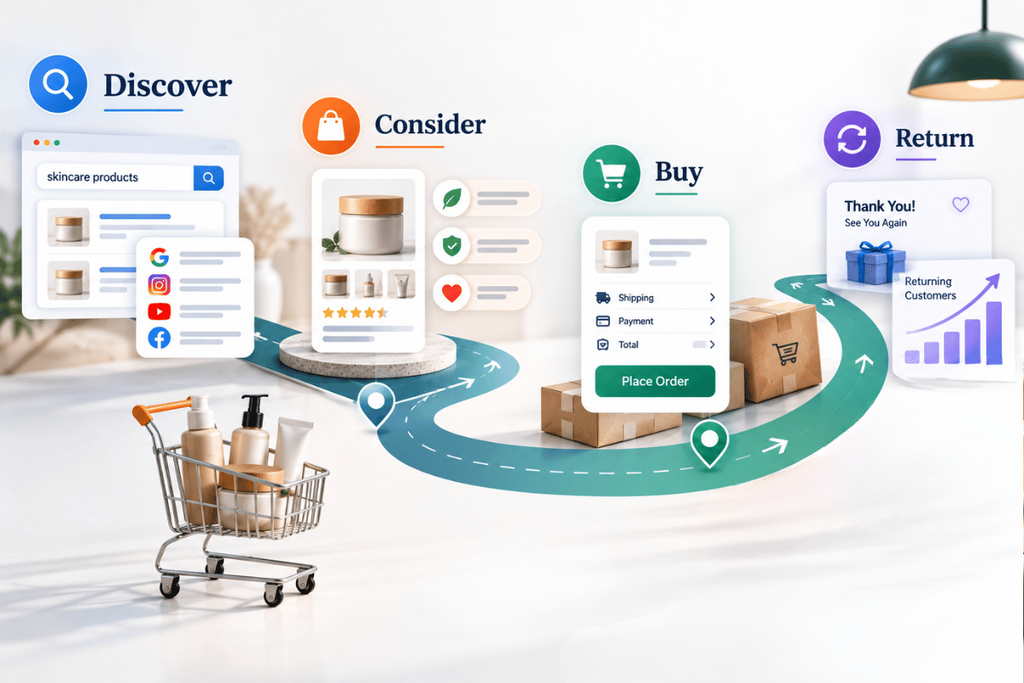
The strongest ecommerce marketing strategies connect multiple services into one customer journey.
| Funnel Stage | Main Goal | Useful Services |
|---|---|---|
| Discover | Reach potential shoppers | SEO, social media, content |
| Consider | Build product interest | Product content, social, remarketing |
| Convert | Generate orders | PPC, Shopping Ads, CRO |
| Retain | Bring customers back | Email, WhatsApp, remarketing |
| Grow | Increase customer value | Analytics, loyalty, personalization |
This full-funnel approach is also visible across current competitor positioning. A37, for example, organizes ecommerce services around Acquire, Convert, Retain, Marketplace and Automate, while other agencies combine paid media, SEO, CRO, retention and marketplace management into one growth system.
The advantage is that every channel has a clear job.
How to Choose the Right Ecommerce Digital Marketing Services
You do not necessarily need every marketing channel from day one.
Start by identifying your biggest problem.
If your store has very little traffic
Focus on:
- Ecommerce SEO
- Google Ads
- Social media
- Content marketing
If your store gets traffic but few sales
Focus on:
- CRO
- Product-page optimization
- Website UX
- Checkout improvements
- Product content
If you get many first-time customers but few repeat orders
Focus on:
- Email marketing
- WhatsApp marketing
- Retargeting
- Loyalty campaigns
- Customer segmentation
If marketplaces are an important revenue source
Focus on:
- Marketplace SEO
- Product listings
- Marketplace advertising
- Catalog management
- Marketplace analytics
This problem-first approach prevents businesses from spending money on channels that do not address their current bottleneck.
Common Ecommerce Digital Marketing Mistakes
Focusing Only on Traffic
More visitors do not automatically mean more revenue.
Running Ads Without CRO
Paid traffic can become expensive if the product page and checkout experience are weak.
Ignoring Product Data
Incomplete product information can create problems across search, Shopping and marketplace experiences.
Using the Same Content Everywhere
A product page, Instagram post, Google Shopping listing and email campaign serve different purposes.
Ignoring Existing Customers
Acquiring a new customer is only one part of ecommerce growth. Retention can help increase the value of customers you already acquired.
Measuring Vanity Metrics
Likes, impressions and traffic can be useful signals, but ecommerce businesses should connect marketing activity with orders, revenue, acquisition costs and repeat purchases.
Ecommerce Digital Marketing Services: Website vs Marketplace
| Area | Ecommerce Website | Marketplace |
|---|---|---|
| Brand control | High | More limited |
| Customer experience | Fully customizable | Platform controlled |
| Product presentation | Full control | Platform rules |
| Customer data | More control | Platform dependent |
| Organic discovery | SEO | Marketplace search |
| Paid promotion | Google/Meta/etc. | Marketplace ads |
| Long-term brand building | Strong | Depends on platform |
| Competition | Other websites | Sellers on same platform |
Many ecommerce brands can benefit from using both.
Your own website gives you greater control over the customer experience, while marketplaces can provide additional product discovery and purchasing opportunities.
Mini Example: How an Ecommerce Brand Can Connect Its Marketing
Imagine an online fashion store launches a new collection.
The strategy could look like this:
Step 1: SEO brings shoppers searching for relevant products.
Step 2: Google Shopping and Meta Ads reach high-intent and interested audiences.
Step 3: Product pages provide strong images, information, reviews and clear CTAs.
Step 4: Remarketing brings interested visitors back.
Step 5: Email and WhatsApp campaigns communicate new arrivals and relevant offers.
Step 6: Analytics identifies which products, campaigns and channels generate profitable sales.
Instead of relying on one marketing channel, the brand creates a connected system.
Why Website Experience Matters in Ecommerce Marketing
Marketing cannot compensate indefinitely for a poor ecommerce website.
If your website is slow, difficult to navigate, confusing on mobile, or has a complicated checkout process, marketing traffic may not turn into enough orders.
iBirds Digital’s web development service includes ecommerce website development, responsive layouts, shopping carts, secure payment features and performance optimization.
This makes website development an important part of ecommerce marketing rather than something completely separate.
For example:
SEO brings the visitor → Ads bring the visitor → Website converts the visitor
That is why marketing and website experience should be planned together.
How iBirds Digital Supports Ecommerce Growth
iBirds Digital offers a combination of SEO, PPC, social media, content marketing and web development, allowing ecommerce businesses to connect marketing activity with their website experience.
Its SEO service specifically includes ecommerce SEO, while its PPC offering includes Shopping Ads, remarketing, conversion optimization and reporting.
For businesses that need an ecommerce website, iBirds Digital also provides online-store development with product listings, shopping carts, payment functionality and performance optimization.
You can explore its digital marketing services for a broader multi-channel strategy.
For organic product visibility, see its SEO services.
For paid acquisition, explore its PPC services.
And for the store itself, its ecommerce web development services can support the technical side of the customer journey.
FAQ: Ecommerce Digital Marketing Services
What are ecommerce digital marketing services?
Ecommerce digital marketing services are marketing activities designed to help online stores attract shoppers, increase conversions and generate repeat purchases. They can include SEO, PPC, Shopping Ads, social media, content marketing, CRO, remarketing, email, WhatsApp and analytics.
Which digital marketing service is best for ecommerce?
There is no single service that works best for every ecommerce business. Stores with low visibility may need SEO and paid acquisition, while stores with strong traffic but weak sales may need CRO and product-page optimization. The right mix depends on the store’s traffic, products, audience, margins and growth stage.
How can ecommerce SEO increase online sales?
Ecommerce SEO can help product and category pages appear for relevant searches. Better visibility can bring more qualified organic traffic, while optimized product pages can help turn that traffic into purchases. Google also provides ecommerce-specific guidance around product data, site structure and structured data.
Are Google Ads useful for ecommerce businesses?
Google Ads can help ecommerce businesses reach people searching for products or related solutions. Shopping campaigns can display product information such as images and prices, while remarketing can reconnect with previous website visitors. Results should be evaluated using conversions, acquisition costs and revenue rather than clicks alone.
How can an ecommerce store increase repeat purchases?
Stores can use relevant email, WhatsApp, remarketing, loyalty programs and personalized product communication to encourage customers to return. The strategy should be based on customer behavior and purchase cycles rather than sending the same promotion to everyone.
Should ecommerce businesses sell through marketplaces?
Marketplaces can provide another route to reach customers, but they also come with platform rules, competition and fees. For many brands, the choice does not have to be either a website or a marketplace; using both can diversify customer acquisition and sales channels.
Final Takeaway
Ecommerce digital marketing services work best when they are connected to one clear goal: turning relevant shoppers into profitable customers.
A strong ecommerce strategy can combine:
SEO → Paid Ads → Social → Product Experience → CRO → Retention → Analytics
But you do not need to implement everything at once.
Start with your biggest growth problem, choose the channels that address it, measure the results, and then expand the strategy as your store grows.
The best ecommerce marketing strategy is not the one with the most channels. It is the one where each channel has a clear purpose and contributes to the customer journey.