
Launching a website and optimizing it once does not mean your SEO work is finished. Search behavior changes, competitors publish new content, websites gain technical issues, and pages can become outdated over time.
This is where ongoing SEO becomes important.
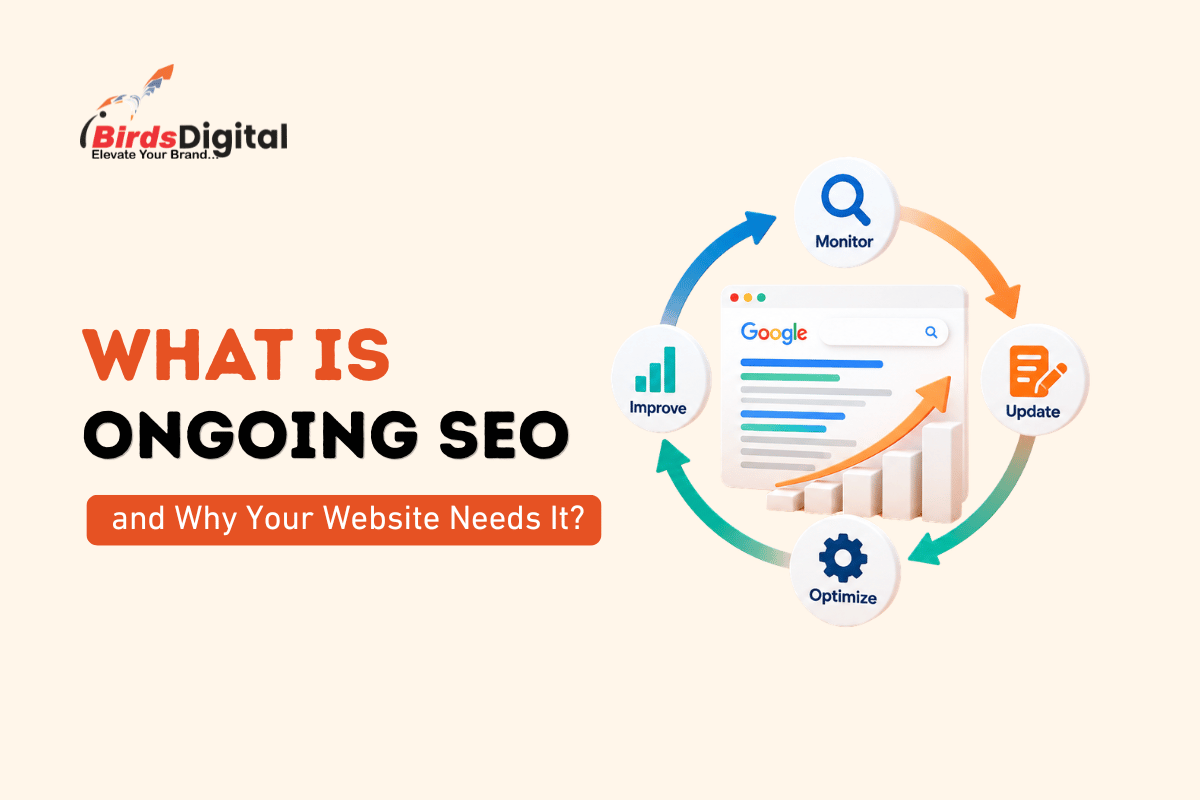
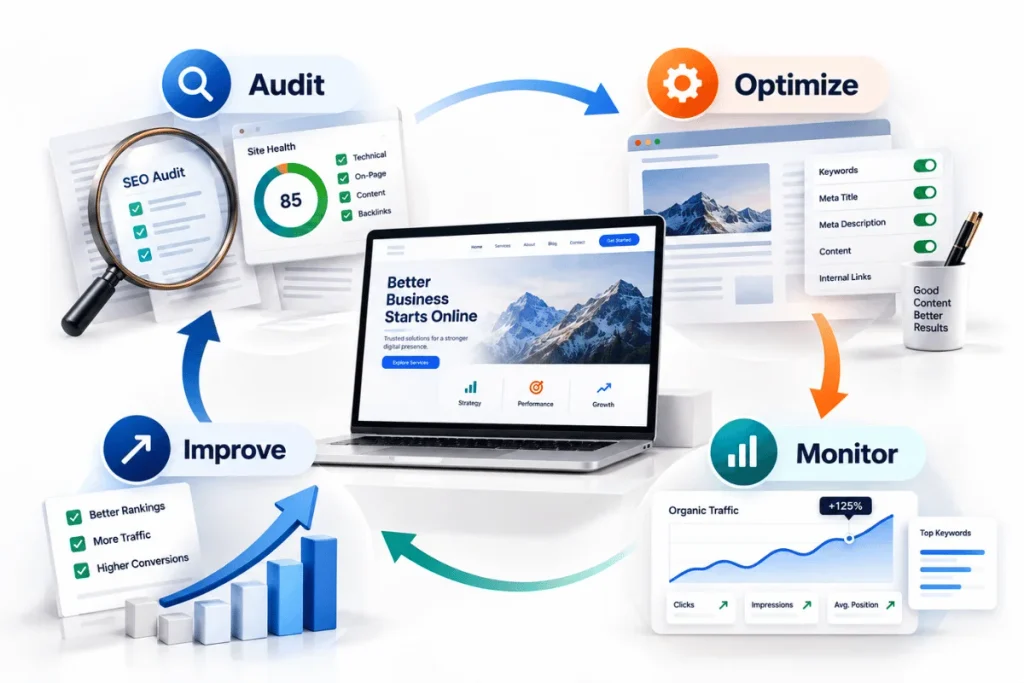
Ongoing SEO is the continuous process of monitoring, maintaining, updating, and improving a website to support its search visibility and organic performance. Instead of treating SEO as a one-time project, businesses use an ongoing strategy to identify new opportunities and address problems as they appear.
Google explains that SEO helps search engines understand your content and helps users discover your website through search. It also notes that changes made to a website can take different amounts of time to appear in Search, depending on the change and other factors.
So, what does ongoing SEO actually involve, and why does your website need it?
Let’s break it down.
What Is Ongoing SEO?
Ongoing SEO means continuously working on a website after the initial optimization is complete.
It can include:
- Monitoring keyword performance
- Updating existing content
- Publishing useful new content
- Fixing technical SEO problems
- Improving internal links
- Monitoring competitors
- Checking website performance
- Improving pages based on search data
- Reviewing conversion and user behavior
- Finding new keyword and content opportunities
The exact activities depend on the website, industry, competition, and business goals.
For example, an ecommerce website may need regular product and category optimization, while a local service business may focus more on local landing pages, Google Business Profile activity, reviews, and location-based content.
The main idea is simple: SEO needs continuous attention because the website and search environment are not static.
7 Powerful Reasons Your Website Needs Ongoing SEO
1. Search Trends and Keywords Keep Changing
The words people use to search for products and services can change over time.
A keyword that was valuable six months ago may become less important, while a new search term may start bringing qualified visitors to your industry.
This is why ongoing keyword research matters.
Regular keyword analysis can help you identify:
- New search opportunities
- Changing search intent
- Declining keywords
- New long-tail queries
- Content gaps
- Keywords your competitors are targeting
Instead of continuously creating completely new pages, you can sometimes improve existing pages around better and more relevant search opportunities.
2. Existing Content Can Become Outdated
Publishing a blog post does not mean it will remain equally useful forever.
Statistics can change. Products can change. Services can change. Industry practices can change. Even the questions customers ask can change.
For example, a blog titled “Best Digital Marketing Strategies” may contain information that becomes outdated after a few years.
Ongoing SEO gives you a reason to regularly review older pages and decide whether they should be:
- Updated
- Expanded
- Reorganized
- Consolidated
- Redirected
- Removed
The goal should not be adding words simply to make a page longer. The goal is to make the page more useful and accurate for its intended audience.
Google’s Search Essentials also emphasizes creating helpful, reliable, people-first content.
3. Technical SEO Problems Can Appear Over Time
Technical SEO is not something you should check only when launching a website.
Websites change constantly.
New pages are added, old pages are deleted, plugins are updated, URLs change, redirects are created, images are replaced, and website structures evolve.
These changes can introduce problems such as:
- Broken internal links
- Redirect chains
- 404 pages
- Indexing issues
- Duplicate pages
- Slow-loading pages
- Mobile usability problems
- Incorrect canonical tags
- Missing metadata
- Crawlability problems
Regular technical checks help identify these issues before they become bigger problems.
Google provides tools and documentation for understanding how its systems crawl and index websites, while Search Console can help website owners monitor performance and identify search-related issues.
4. Your Competitors Are Also Optimizing
Your website does not compete against a static list of pages.
Competitors can publish new articles, create new service pages, improve their existing content, earn backlinks, and target new keywords.
That means a page that performs well today may face stronger competition later.
Ongoing SEO includes competitor monitoring to understand:
- Which topics competitors are covering
- Which keywords they target
- How their content is structured
- What pages attract search visibility
- Where content gaps exist
- Which opportunities your website has not covered
The purpose is not to copy competitors.
Instead, competitor research can help identify areas where your website can provide more useful, relevant, and original information.
5. User Search Intent Can Change
Search engines are not only matching individual keywords. The meaning behind a search matters too.
For example, someone searching:
“SEO services”
may be looking for an agency.
Someone searching:
“how to do SEO”
may be looking for educational information.
And someone searching:
“SEO audit services for ecommerce website”
may have a more specific commercial need.
Ongoing SEO allows you to review whether your existing pages still match the intent behind the searches you want to target.
If a page receives impressions but very few clicks, for example, you may review its title, description, content relevance, and search intent alignment rather than simply adding more keywords.
6. Your Website Performance Needs Continuous Monitoring
SEO should not be measured only through rankings.
A more complete SEO review can include:
| SEO Metric | What It Helps You Understand |
|---|---|
| Organic clicks | How much search traffic reaches your site |
| Impressions | How often pages appear in search |
| Average position | How pages perform for tracked queries |
| CTR | How often users click after seeing a result |
| Organic conversions | Whether search traffic produces business actions |
| Indexed pages | Whether important pages can appear in search |
| Engagement data | How visitors interact with the website |
| Top landing pages | Which pages attract organic visitors |
Google Search Console provides website owners with search-performance information and tools for understanding how their site performs in Google Search.
The important part is not simply collecting these numbers.
The value comes from using the data to decide what should be improved next.
7. SEO Opportunities Keep Appearing
One of the biggest advantages of ongoing SEO is that optimization does not stop with the original keyword list.
As your website grows, you may discover:
- New keywords
- New customer questions
- New product opportunities
- New service areas
- New content gaps
- Pages ranking on page two
- Pages receiving impressions but few clicks
- Older articles that can support newer pages
For example, a page ranking around positions 11–20 may already have search visibility but need better content, internal links, search intent alignment, or other improvements.
This creates an opportunity to improve an existing asset rather than starting from zero every time.
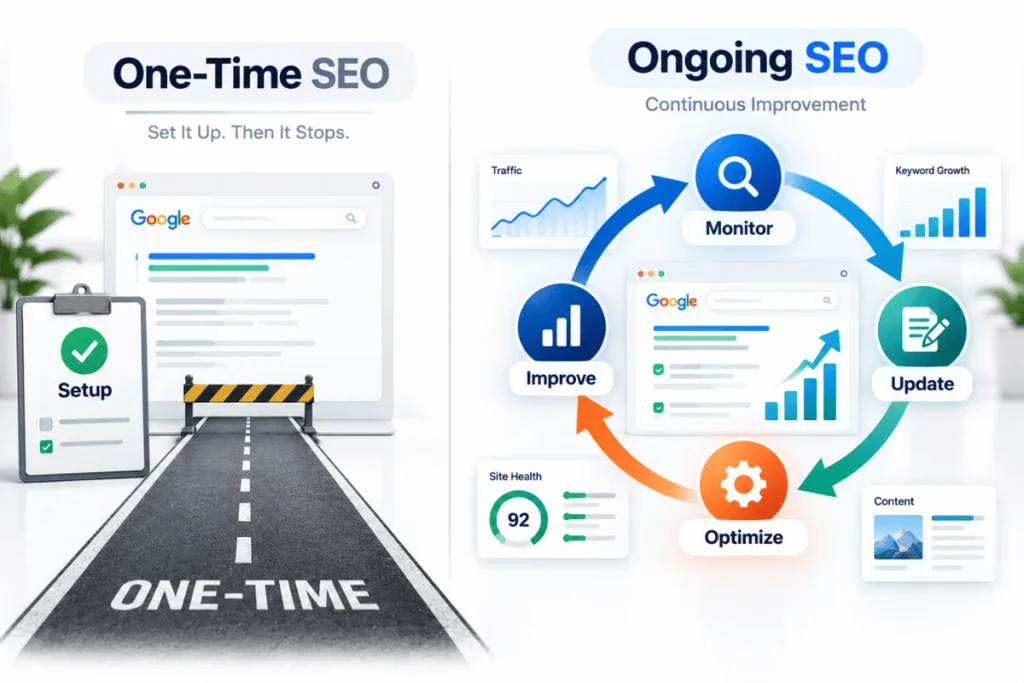
Ongoing SEO vs One-Time SEO
The difference becomes clearer when you compare the two approaches.
| One-Time SEO | Ongoing SEO |
|---|---|
| Initial website audit | Regular technical audits |
| Initial keyword research | Continuous keyword research |
| Initial on-page optimization | Regular page optimization |
| Initial metadata setup | Metadata review and improvement |
| Initial content strategy | Continuous content updates |
| Initial internal linking | Ongoing internal-link optimization |
| Website launch optimization | Continuous performance monitoring |
| One-time competitor research | Regular competitor analysis |
One-time SEO can establish a foundation.
Ongoing SEO builds on that foundation and adapts it as the website, audience, competitors, and search environment change.
What Does an Ongoing SEO Process Look Like?
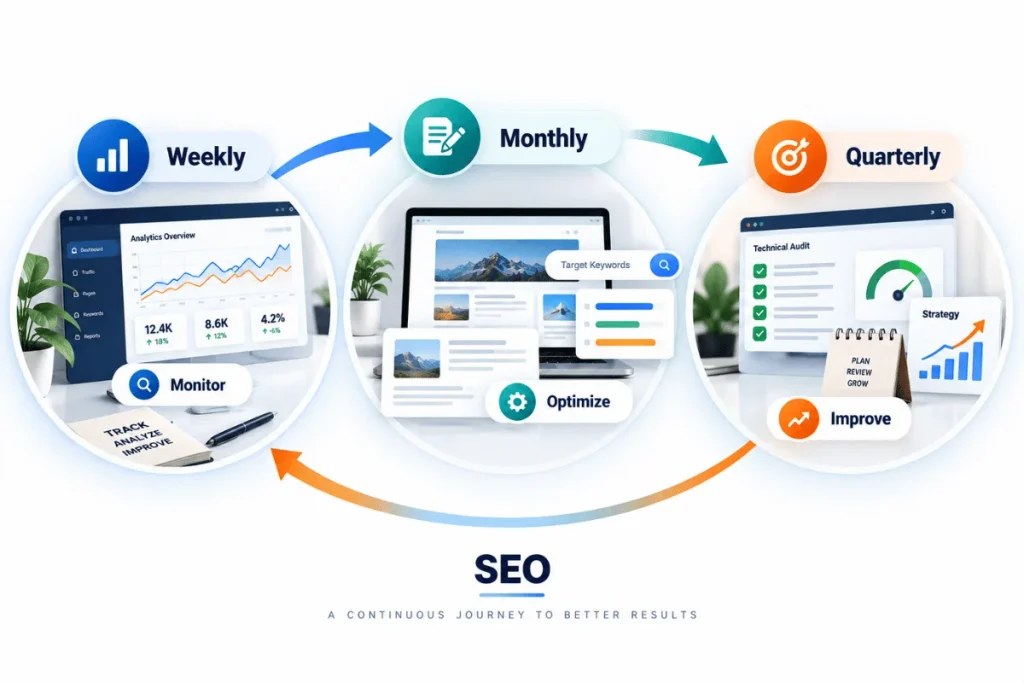
A practical ongoing SEO process can be divided into three levels.
Weekly SEO Activities
Depending on the website, weekly work may include:
- Monitoring important rankings
- Checking Search Console
- Reviewing new technical issues
- Tracking organic traffic
- Checking important pages
- Monitoring competitors
- Reviewing newly published content
Monthly SEO Activities
Monthly activities can include:
- Technical SEO checks
- Content updates
- Keyword research
- Internal-link improvements
- New content creation
- Metadata optimization
- Competitor analysis
- Performance reporting
Quarterly SEO Activities
A deeper quarterly review can include:
- Full technical audit
- Content gap analysis
- Content pruning
- Keyword strategy review
- Website architecture review
- Conversion-path analysis
- Backlink profile review
- SEO strategy adjustment
Not every website needs exactly the same schedule. The frequency should depend on the website’s size, industry, competition, publishing activity, and business goals.
How to Know If Your Website Needs Ongoing SEO
Your website may benefit from ongoing SEO if:
- Organic traffic has stopped growing
- Important keywords are losing visibility
- Older content is outdated
- Your competitors are publishing more content
- Your website has technical problems
- New pages are not performing as expected
- Your rankings fluctuate frequently
- You are launching new products or services
- Your business is entering new locations
- You want consistent organic lead generation
A website that changes frequently usually needs more regular monitoring than a small, relatively stable website.
Mini Example: Why Ongoing SEO Matters
Imagine a local digital marketing company creates a service page targeting “SEO services in Ajmer.”
The page is technically optimized and begins receiving search impressions.
After several months, the company notices that:
- Some competitors have published newer service pages.
- Search queries have changed.
- The page is receiving impressions but fewer clicks.
- Several internal links point to older pages.
- New relevant services have been added to the business.
Instead of creating an entirely new page, the SEO team reviews the existing page.
They update the content, improve internal links, review metadata, add relevant service information, analyze competitor coverage, and monitor the results.
This is the practical role of ongoing SEO: use performance data to continuously improve the existing website.
Common Ongoing SEO Mistakes to Avoid
Treating SEO as a One-Time Task
Completing an initial optimization checklist does not mean future improvements are unnecessary.
Updating Content Without a Purpose
Adding random paragraphs or keywords can make content less useful. Every update should have a clear reason.
Focusing Only on Rankings
Rankings matter, but traffic, clicks, conversions, indexing, and user behavior can provide additional context.
Ignoring Technical Issues
A strong article cannot compensate for every technical problem. Technical health should remain part of regular SEO maintenance.
Publishing Too Much Low-Value Content
More content is not automatically better. Focus on useful topics that genuinely address customer needs.
Never Reviewing Old Pages
Older content can contain valuable search equity. Before creating a new page, check whether an existing page can be improved.
How to Measure the Success of Ongoing SEO
A good ongoing SEO strategy should have measurable goals.
For a lead-generation website, you might track:
- Organic traffic
- Qualified leads
- Organic conversions
- Search impressions
- Click-through rate
- Important keyword visibility
- Top-performing landing pages
For an ecommerce website, you may also track:
- Organic product traffic
- Product-page visibility
- Organic revenue
- Add-to-cart activity
- Organic conversion rate
For a local business, useful metrics may include:
- Local organic traffic
- Location-page performance
- Calls or enquiries
- Local search visibility
- Website conversions
The right metrics depend on what the website is trying to achieve.
How iBirds Digital Can Help With Ongoing SEO
Ongoing SEO works best when technical improvements, content, keyword research, and performance analysis are treated as connected activities.
iBirds Digital’s SEO Services include technical SEO, on-page SEO, keyword research, content creation, link building, local SEO, and performance analysis.
For businesses that need broader support, iBirds Digital’s Digital Marketing Services combine SEO with PPC, social media, content marketing, and website development.
Content can also play an important role in ongoing SEO. iBirds Digital’s Content Marketing Services cover blogs, articles, videos, social content, and other content designed to support online visibility.
FAQs About Ongoing SEO
1. What is ongoing SEO?
Ongoing SEO is the continuous process of monitoring, maintaining, and improving a website’s search performance. It can include technical SEO, keyword research, content updates, internal linking, competitor analysis, and performance tracking. The exact activities depend on the website and its goals.
2. Is SEO a one-time process?
No. Initial SEO can establish the basic foundation, but ongoing optimization helps a website adapt to new content opportunities, technical changes, competitors, and changing search behavior. A continuous strategy can therefore be useful for websites that depend on organic search traffic.
3. How often should SEO be done?
There is no single schedule that works for every website. Important performance and technical issues may be monitored weekly, while content, keyword, and competitor reviews can be handled monthly or quarterly. Larger or highly competitive websites may require more frequent work.
4. What does ongoing SEO include?
Ongoing SEO can include keyword research, content optimization, technical audits, internal linking, competitor analysis, metadata updates, performance monitoring, and new content creation. The activities should be prioritized according to actual website data and business goals.
5. Can ongoing SEO improve organic traffic?
Ongoing SEO can help improve a website’s search visibility and organic performance by identifying and addressing optimization opportunities. However, SEO results are not guaranteed and can vary based on competition, website quality, industry, search behavior, and many other factors.
6. Why should old website content be updated?
Old content can become inaccurate, outdated, or less relevant to what users are currently searching for. Reviewing and improving existing pages can help keep information useful and aligned with the audience’s needs. Updates should be based on genuine content or search-intent improvements rather than adding text only for SEO.
Final Takeaway
Ongoing SEO is not about changing your website every day. It is about continuously making informed improvements when there is a reason to do so.
Search behavior changes. Websites change. Competitors change. Content becomes outdated. New opportunities appear.
That is why SEO should be viewed as a long-term process rather than a one-time checklist.
By regularly monitoring performance, improving useful content, maintaining technical health, analyzing competitors, and responding to new search opportunities, businesses can build a website that remains useful and search-friendly over time.