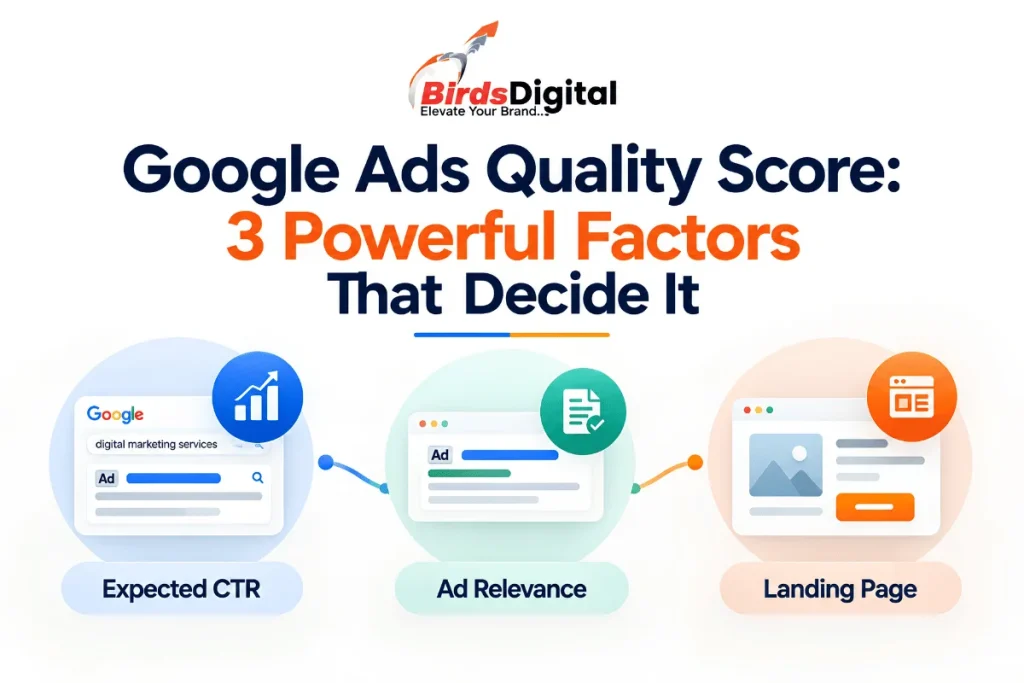

Google Ads Quality Score is one of the most useful diagnostic metrics for understanding how closely your keywords, ads, and landing pages match what people are searching for. The score is shown on a 1–10 scale at the keyword level, with higher scores generally indicating stronger relevance and usefulness compared with other advertisers for the same searches.
But there is an important distinction: Quality Score itself is not a direct auction input or a performance KPI. Instead, Google uses it as a diagnostic tool to show where your ad experience may need improvement. The three components behind it are Expected Click-Through Rate (CTR), Ad Relevance, and Landing Page Experience.
Understanding these three factors can help you identify why a keyword is receiving a Below average rating and what to improve first.
What Is Google Ads Quality Score?
Google Ads Quality Score is a 1–10 diagnostic rating available at the keyword level in Search campaigns. It compares the quality and relevance of your ad and landing-page experience with other advertisers showing for the same searches.
Google evaluates each of the three components as:
- Above average
- Average
- Below average
These evaluations are based on comparisons with other advertisers whose ads appeared for the same searches over a historical period.
This means a Quality Score of 6 should not automatically be considered “bad,” and a 10 should not automatically be considered a campaign success.
Your real business goals still matter more:
Clicks → Leads → Sales → Revenue
Google also recommends looking at metrics such as CTR, conversion rate, and site engagement alongside Quality Score rather than trying to maximize the score by itself.
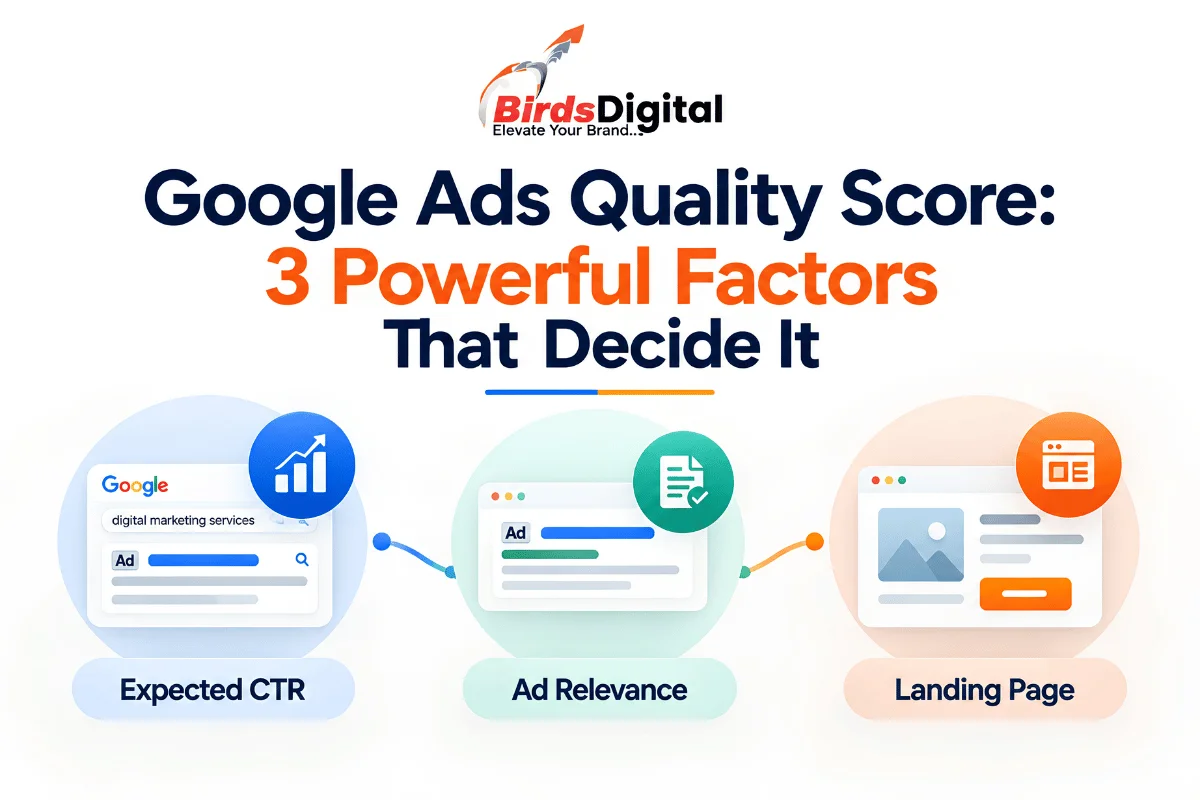
The 3 Factors Behind Google Ads Quality Score
Google Ads Quality Score is calculated using three main components:
| Quality Score Factor | What It Measures | What to Improve |
|---|---|---|
| Expected CTR | Likelihood that users will click your ad | Ad copy and search intent |
| Ad Relevance | How closely your ad matches the search | Keywords and ad messaging |
| Landing Page Experience | Relevance and usefulness after the click | Page content and user experience |
Google officially identifies these as the three components used to calculate Quality Score.
The important part is that each component points toward a different type of problem.
1. Expected Click-Through Rate (CTR)
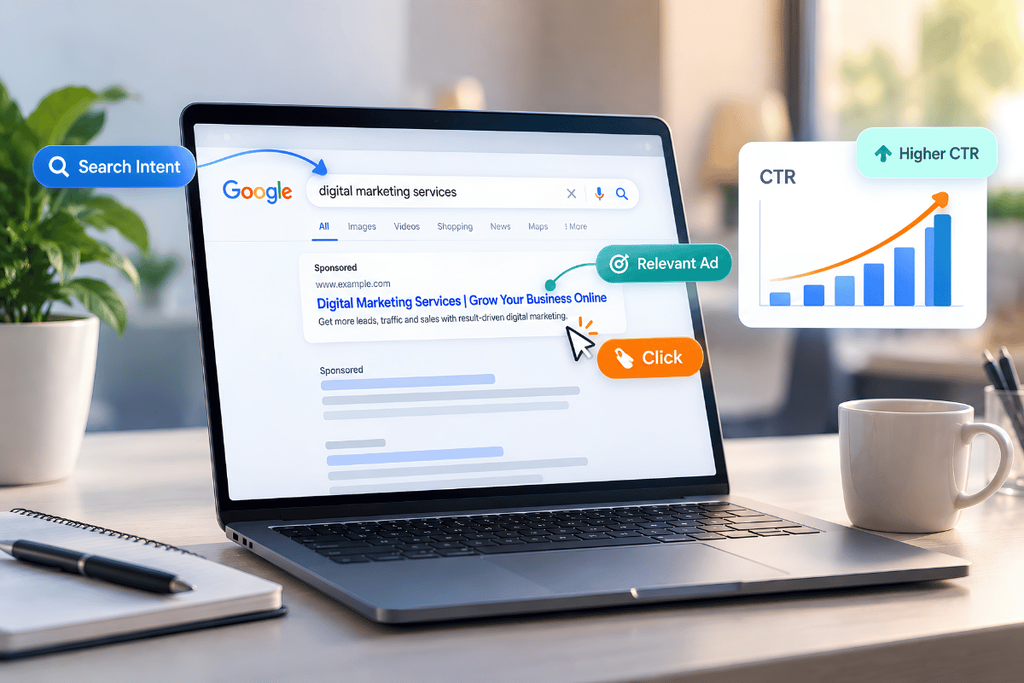
Expected CTR estimates how likely people are to click your ad when it appears for a particular search.
It is not simply a report of your current CTR. Google uses historical performance and other signals to estimate how likely your ad is to receive clicks compared with other ads shown for the same search.
What Can Lower Expected CTR?
Your Expected CTR may be weaker when:
- Your ad does not clearly address the search intent.
- Your offer is too generic.
- Your headline does not communicate a useful benefit.
- Your keywords trigger irrelevant searches.
- Your ad does not give users a strong reason to click.
For example, imagine someone searches:
“Google Ads management services for small business”
An ad saying:
“Digital Marketing Services – Contact Us”
may be less compelling than an ad that directly communicates:
“Google Ads Management for Small Businesses”
The second message immediately tells the searcher that the advertiser understands the specific need behind the search.
How to Improve Expected CTR
Google recommends making ad text more compelling, matching the details of your ad to keyword intent, highlighting relevant benefits, and testing calls to action that connect with the landing page.
You should also review search terms regularly.
If your keyword is attracting searches that are not relevant to your offer, adding appropriate negative keywords can help prevent wasted impressions and clicks.
2. Ad Relevance
The second factor is Ad Relevance.
It measures how closely your ad matches the intent behind the user’s search. Google recommends matching your ad language more closely to the search terms and organizing keywords into tighter themes when different keywords cannot be addressed effectively by the same ad.
Why Ad Relevance Matters
Suppose an ad group contains:
- Google Ads management
- Facebook advertising
- SEO services
- Website design
- Social media marketing
Trying to write one ad that speaks naturally to all these searches can make the message too broad.
A better approach is to create tighter keyword themes.
For example:
Ad Group: Google Ads Services
- Google Ads agency
- Google Ads management
- Google PPC services
- Google Ads company
The ad can then focus specifically on Google Ads.
This creates a clearer relationship:
Keyword → Ad → User Intent
How to Improve Ad Relevance
Google recommends grouping keywords around meaningful themes and splitting ad groups when different keyword sets cannot be addressed by the same ad.
You should review whether the ad:
- Uses language relevant to the search.
- Communicates the right service.
- Matches the user’s intent.
- Provides a clear benefit.
- Leads to an appropriate landing page.
However, do not force keywords into every line of an ad.
The goal is relevance, not keyword stuffing.
3. Landing Page Experience
The third factor is Landing Page Experience.
This looks at how relevant and useful the landing page is for someone who clicks the ad. Google specifically recommends keeping the landing page message consistent with the ad, making the site mobile-friendly, improving loading speed, and giving users the information they expect.
Think of the journey like this:
Search → Ad → Landing Page → Action
If any part feels disconnected, the user experience becomes weaker.
Example
A user searches:
“PPC services for eCommerce”
They click an ad promising:
“eCommerce PPC Management”
But the landing page only contains a generic:
“Digital Marketing Services”
The visitor now has to search through the website to find the promised service.
A more relevant landing page would immediately explain:
- eCommerce PPC services
- Campaign types
- Targeting approach
- Benefits
- Case studies or proof
- Pricing/contact information
- Clear CTA
The landing page should deliver what the ad promised.
What Makes a Strong Landing Page?
A strong landing page should make it easy for visitors to understand what you offer and what they should do next.
Focus on:
Message Match
The ad and landing page should communicate the same offer.
Clear Information
Visitors should quickly understand the product, service, benefit, or solution.
Mobile Experience
The page should work properly on smartphones and make navigation easy.
Loading Speed
Slow pages can create a poor user experience, especially when users arrive from paid search.
Clear CTA
Give visitors a clear next action such as:
- Get a Quote
- Book a Consultation
- Request an Audit
- Buy Now
- Contact Us
Google specifically recommends improving mobile usability, loading speed, and consistency between the ad and landing page when Landing Page Experience is not performing well.

How the 3 Quality Score Factors Work Together
The three components should not be treated as completely separate problems.
They form a connected user journey:
Search Intent → Ad Message → Landing Page → Conversion
For example:
- Someone searches for a specific service.
- Your ad addresses that search clearly.
- The user clicks because the offer is relevant.
- The landing page delivers what the ad promised.
- The visitor takes the desired action.
When these elements are aligned, you create a stronger experience for the searcher.
That is the bigger lesson behind Quality Score: relevance should exist across the entire paid-search journey, not just inside the ad.
How to Find Your Quality Score in Google Ads
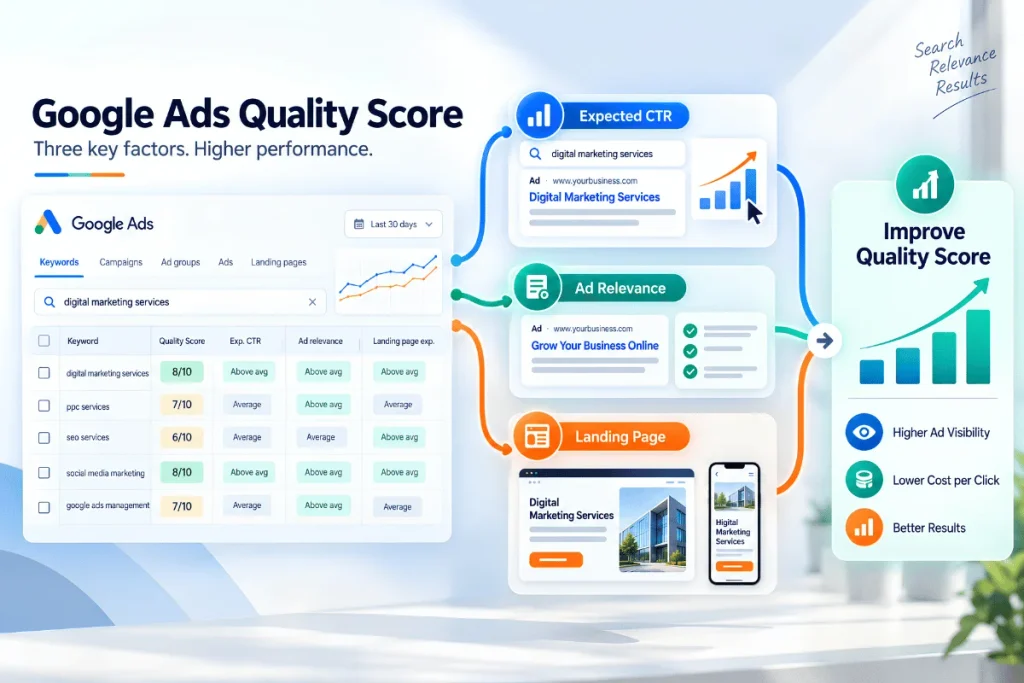
Quality Score is available in the Keywords section of Google Ads.
Google’s current instructions are:
- Open your Google Ads campaign.
- Go to the Keywords section.
- Select the columns option.
- Open the Quality Score section.
- Add:
- Quality Score
- Expected CTR
- Ad Relevance
- Landing Page Experience
You can also review historical versions of these metrics to understand how performance has changed over time.
This makes diagnosis much easier.
Instead of saying:
“Our Quality Score is low.”
you can ask:
“Which component is Below average?”
That gives you a much more actionable starting point.
What to Fix When Your Quality Score Is Low
Use this simple diagnosis framework:
| If You See | Possible Problem | First Action |
|---|---|---|
| Expected CTR: Below average | Weak or mismatched ad messaging | Improve ad copy and search intent |
| Ad Relevance: Below average | Keywords and ads are too broad | Create tighter keyword themes |
| Landing Page: Below average | Page does not meet search expectations | Improve message match and UX |
| Multiple components below average | Wider relevance problem | Review keyword → ad → page journey |
Google recommends using the component statuses as diagnostic signals and then focusing on the areas where improvements can actually affect user experience.
Does a Higher Quality Score Always Mean Better Performance?
No.
This is one of the most important points missing from many simplified Quality Score articles.
Google explicitly says Quality Score is not a KPI and should not be optimized or aggregated with your other performance data. It is primarily a diagnostic tool.
Your campaign should ultimately be evaluated using business metrics such as:
- Conversions
- Cost per conversion
- Conversion rate
- Revenue
- ROAS
- Qualified leads
- Customer acquisition cost
For example, a keyword with a Quality Score of 7 that generates profitable leads may be more valuable to your business than a keyword with a score of 10 that produces little commercial value.
So use Quality Score to find problems, not as the final definition of success.
Common Google Ads Quality Score Mistakes
Trying to Reach 10/10 Everywhere
A perfect score is not the objective. Focus on meaningful improvements and profitable campaign performance.
Changing Campaign Names
Google says changing campaign or ad-group structure alone does not automatically improve ad quality. If the ads and keywords remain the same, simply moving them around does not create a better user experience.
Increasing Bids Just to Improve Quality Score
Higher bids do not improve Quality Score. Google specifically notes that ad position itself does not increase expected CTR because expected CTR is normalized for position and other visibility factors.
Sending Every Keyword to the Homepage
A generic homepage may not adequately answer a specific search.
If someone searches for a specific service, a dedicated and relevant landing page can provide a clearer experience.
Ignoring Search Terms
Irrelevant searches can waste budget and weaken the relationship between your targeting and user intent.
Regular search-term review and appropriate negative keywords can help maintain tighter targeting.
A Simple Google Ads Quality Score Checklist
Before making major campaign changes, review these questions:
Expected CTR
- Does the ad directly address the search intent?
- Is the benefit clear?
- Is the offer specific?
- Are irrelevant searches being filtered?
Ad Relevance
- Are keywords grouped into meaningful themes?
- Does the ad match those themes?
- Is the messaging specific enough?
- Are unrelated keywords being mixed together?
Landing Page Experience
- Does the landing page deliver what the ad promised?
- Is the content relevant?
- Does the page work well on mobile?
- Does it load efficiently?
- Is the CTA clear?
If one component is Below average, start there instead of changing everything at once.
Google Ads Quality Score vs Actual Campaign Performance
| Metric | What It Tells You |
|---|---|
| Quality Score | Diagnostic view of keyword/ad/landing-page relevance |
| CTR | How often users click |
| Conversion Rate | How often clicks become conversions |
| CPA | Cost to acquire a conversion |
| ROAS | Revenue generated relative to ad spend |
| Conversion Value | Business value generated by campaigns |
This distinction is important because Quality Score and campaign profitability are not the same thing.
Google recommends using Quality Score alongside other performance metrics rather than treating it as the main campaign KPI.
How iBirds Digital Can Help Improve Google Ads Performance
Improving Quality Score is not about chasing a number.
It starts with better keyword targeting, relevant ad copy, useful landing pages and continuous campaign optimization.
iBirds Digital provides PPC services in India covering Google Ads management, keyword targeting, paid search, landing-page creation, remarketing and campaign reporting. Its current PPC content also specifically discusses keyword research, negative keywords, landing-page alignment and Quality Score optimization.
For businesses that want a broader acquisition strategy, digital marketing services can connect paid advertising with SEO, content, social media and website optimization.
You can also explore iBirds Digital’s existing guide on how to run Google Ads for a small business for a broader campaign setup and optimization framework.
FAQ: Google Ads Quality Score
What is Google Ads Quality Score?
Google Ads Quality Score is a 1–10 diagnostic rating shown at the keyword level. It reflects how your keyword, ad and landing-page experience compare with other advertisers for relevant searches. Google calculates it using Expected CTR, Ad Relevance and Landing Page Experience.
What are the 3 factors that determine Quality Score?
The three factors are Expected Click-Through Rate, Ad Relevance, and Landing Page Experience. Each component receives an Above average, Average or Below average status, helping advertisers identify where improvements may be needed.
Is a Quality Score of 10 always better?
Not necessarily. Google says Quality Score is a diagnostic tool rather than a key performance indicator, so advertisers should not optimize only for the highest possible score. Conversion rate, cost per conversion, revenue and other business metrics should also guide decisions.
How can I improve Expected CTR?
Make your ad closely match the user’s search intent and communicate a clear, relevant benefit. Google also recommends making ad copy more compelling, using relevant calls to action and ensuring that the ad details align with the keyword intent.
How can I improve Ad Relevance?
Start by creating tighter keyword themes and making sure your ad messaging directly addresses those themes. If one ad group contains keywords with very different intents, separating them can make it easier to write more relevant ads.
How can I improve Landing Page Experience?
Make sure the landing page delivers what the ad promises. Improve message consistency, mobile usability, page speed, navigation and the clarity of the information or CTA that visitors need after clicking the ad.
Final Takeaway
Google Ads Quality Score: 3 Powerful Factors That Decide It ultimately comes down to one idea: relevance across the search journey.
The three components are:
Expected CTR → Ad Relevance → Landing Page Experience
Instead of chasing a perfect 10/10 score, use these three signals to diagnose where your campaign experience can improve.
Make the keyword relevant.
Make the ad useful.
Make the landing page deliver on the promise.
Then judge the campaign by what really matters to the business: qualified traffic, conversions, cost efficiency and revenue.