
Running Google Ads can be a practical way for a small business to reach people who are already searching for its products or services. The challenge is that a limited advertising budget can disappear quickly if campaigns are created without clear targeting, proper keywords, conversion tracking, or regular optimisation. Knowing how to run Google Ads for a small business is not only about creating an ad. It is about deciding who you want to reach, what you want them to do, how much you can spend, and how you will measure the results.
For a local service provider, ecommerce store, consultant, restaurant, education business, or professional service company, Google Ads can bring highly relevant traffic when the campaign is structured around real customer searches. This guide explains the process step by step, including campaign setup, keyword selection, budgeting, ad writing, landing pages, tracking, and common mistakes beginners should avoid.

How Google Ads Works for a Small Business
Google Ads allows businesses to show advertisements when people search for products, services, or information related to what they offer. For example, someone searching for “digital marketing agency in Jaipur” may see relevant paid results above or around the organic search listings.
The advertiser generally pays when someone clicks the advertisement in a Search campaign. The actual cost of a click can vary significantly depending on the industry, competition, location, keyword, ad quality, and other factors.
The important point for a small business is that you do not need to advertise to everyone. You can narrow your campaign based on factors such as:
- Location
- Search keywords
- Language
- Audience signals
- Device
- Time and day
- Campaign objective
- Budget
This level of targeting makes Google Ads particularly useful for businesses that want to reach customers with a specific need.
Google also provides its own beginner resources for understanding campaigns, targeting, bidding, and measurement. You can refer to the official Google Ads Help and learning resources before launching your first campaign.
1. Decide What You Want Google Ads to Achieve
Before opening Google Ads, decide what a successful campaign should produce.
A small business might want:
| Business Goal | Useful Conversion |
|---|---|
| Generate enquiries | Contact form submission |
| Get phone calls | Phone call |
| Sell products | Completed purchase |
| Get appointments | Booking |
| Generate local visits | Store visit or direction request |
| Get quote requests | Quote form submission |
This decision affects your campaign settings, landing page, conversion tracking, and bidding strategy.
For example, a local plumber should not judge success only by impressions. If the campaign generates 1,000 impressions but no enquiries, the campaign is not doing its job. Five qualified calls may be more valuable than thousands of impressions.
Before spending money, define one primary action that you want visitors to take.
2. Choose the Right Google Ads Campaign Type
Google offers several campaign options, but beginners do not necessarily need to use all of them.
For many small businesses, a search campaign is a sensible starting point because it can reach people who are actively searching for a product or service.
For example:
- “AC repair near me”
- “best accounting services in Ajmer”
- “website development company Jaipur”
- “buy office furniture online”
- “dentist appointment in Bangalore”
These searches show a stronger commercial intention than broad informational searches.
Other campaign types can be useful in different situations. Display campaigns can help with awareness and remarketing, shopping campaigns are useful for eligible e-commerce products, and YouTube campaigns can support video advertising.
The right choice depends on the business objective rather than simply selecting the campaign type Google recommends during setup.
3. Find Keywords Your Customers Actually Search
Keyword research is one of the most important parts of learning how to run Google Ads for a small business.
Think about the words a customer would type when they are ready to contact or buy from you.
Suppose you own a website development company in Jaipur. Instead of immediately targeting a very broad keyword such as “website”, you could research more specific searches such as:
- website development company Jaipur
- web development services Jaipur
- business website development
- website development agency
- ecommerce website development company
The best keywords are not always the ones with the highest search volume. A keyword with fewer searches can generate better leads if the search intent is stronger.
Use Different Keyword Match Types Carefully
Google Ads provides keyword matching options that influence how closely a user’s search needs to relate to your selected keyword.
For a beginner campaign, it is important to understand the difference between broad, phrase, and exact matching before putting a large budget behind keywords.
Also create a list of negative keywords.
Negative keywords prevent your ads from appearing for searches that are not relevant to your business.
For example, a company selling paid professional courses may want to exclude searches containing terms such as:
- free
- jobs
- salary
- tutorial
- download
- internship
The right negative keywords can save a small business a considerable amount of wasted advertising spend.
4. Organise Keywords Into Relevant Ad Groups
Do not put every keyword related to your business into one large group.
Instead, organise closely related searches together.
For example, a digital marketing company could create separate groups for:
SEO Services
Keywords related to SEO services and SEO agencies.
Google Ads Services
Keywords related to PPC management and Google Ads management.
Social Media Marketing
Keywords related to social media management and marketing services.
This structure makes it easier to write advertisements that match the user’s search.
A person searching for “Google Ads management services” should see an advertisement focused on Google Ads rather than a generic advertisement about all digital marketing services.
5. Write Google Ads That Match Search Intent
Your advertisement has a short amount of space to convince someone to click, so the message needs to be relevant.
A good ad generally communicates:
- What you offer
- Why someone should consider your business
- Where you operate, if location matters
- What action the visitor should take
For example, a local service business could use messaging around:
Professional AC Repair Services
Fast service from experienced technicians. Serving customers across Jaipur. Book a service today.
The advertisement should match the page the user reaches after clicking.
If your ad promises “same-day AC repair in Jaipur” but the landing page does not mention same-day service or Jaipur, the visitor may leave without contacting you.
6. Set a Budget You Can Actually Manage
A common mistake is deciding a budget based on what competitors appear to be spending.
Your starting budget should be connected to your business economics.
Consider:
- Average customer value
- Expected conversion rate
- Cost per click
- Number of leads required
- Lead-to-customer conversion rate
- Profit per customer
For example, imagine a service business receives 20 leads from paid advertising. If 5 become customers and each customer generates ₹20,000 in revenue, the campaign needs to be evaluated based on the actual cost and profit generated, not simply the number of clicks.
Start with a controlled budget, collect data, identify what works, and then increase spending on campaigns that produce meaningful results.
Do not increase the budget simply because traffic increased.
7. Set Up Conversion Tracking Before Launch
This is one of the steps beginners often overlook.
If you only measure clicks, you may know that people visited your website but not whether those visitors became customers.
Useful conversions can include:
- Contact form submissions
- Phone calls
- WhatsApp enquiries
- Appointment bookings
- Purchases
- Quote requests
- Sign-ups
Google Ads performance becomes much easier to understand when these actions are tracked correctly.
If your website already uses Google Analytics 4, you can also connect your measurement setup with your advertising strategy. For businesses that are still learning website measurement, iBirds Services also has a useful guide on Salesforce CRM and related customer data management that can help businesses think about how leads and customer information are organised after acquisition.
For more complex businesses, connecting advertising data with CRM records can provide a clearer view of which campaigns are producing genuine sales rather than just online enquiries.
8. Send Paid Traffic to the Right Landing Page
One of the biggest problems with poorly managed campaigns is sending every visitor to the homepage.
Your homepage usually talks about the entire business. A landing page should focus on one specific offer or service.
For example, if someone searches for “PPC management services in India”, sending them to a page specifically about PPC services makes more sense than sending them to a general homepage.
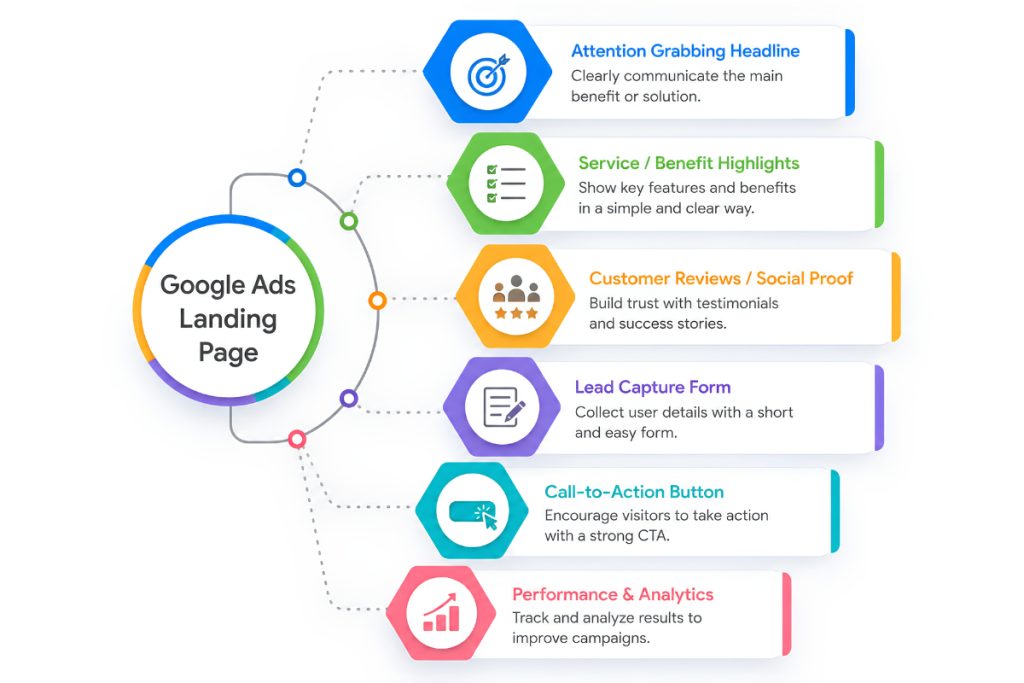
A strong landing page should include:
- A clear headline
- Short explanation of the service
- Benefits
- Relevant proof or reviews
- Important trust signals
- Clear contact option
- Simple enquiry form
- Strong call to action
If you want to improve your understanding of conversion-focused pages, you can also read iBirds Digital’s guide on landing page design and high conversion strategies.
The advertisement gets the visitor to your website. The landing page gives them a reason to take action.
9. Target the Right Location
Location targeting is especially important for local businesses.
A business serving customers only in Ajmer does not need to spend money showing ads across every city in India.
Depending on the business, you may target:
- A specific city
- Several cities
- States
- Countries
- A radius around a location
You should also check the location settings carefully. A campaign can appear to be geographically targeted while still attracting users who are not useful to the business if the settings and targeting options are not configured properly.
Think about where your customers actually come from before selecting the location.
10. Monitor the Search Terms Report
Launching a campaign is not the end of the work.
One of the most useful reports for beginners is the search terms report. It shows the searches that resulted in your ads being displayed.
This can reveal three important things:
Useful searches: Add relevant terms to your keyword strategy when appropriate.
Irrelevant searches: Add negative keywords to reduce wasted clicks.
Unexpected opportunities: Find customer searches you had not considered before.
Reviewing search terms regularly can make the campaign more focused over time.
Common Google Ads Mistakes Small Businesses Should Avoid
A small budget needs careful management. These mistakes can quickly reduce campaign efficiency.
Using Very Broad Keywords
A broad keyword may generate plenty of clicks but attract people who are not looking to purchase your product or service.
Ignoring Negative Keywords
Without negative keywords, you may pay for searches related to jobs, free resources, courses, definitions, or other irrelevant topics.
Sending Everyone to the Homepage
A generic homepage often does not provide the focused information needed to convert paid visitors.
Running Ads Without Conversion Tracking
Without conversion data, it becomes difficult to identify which campaigns, keywords, and advertisements are actually producing business results.
Setting the Campaign and Forgetting About It
Google Ads needs regular attention. Search behaviour changes, competitors change their offers, keywords perform differently, and some searches may become irrelevant over time.
Focusing Only on Clicks
A campaign with a low cost per click is not automatically successful. A more expensive click can be valuable if it generates a qualified customer.
How to Know If Your Google Ads Campaign Is Working
There is no single number that tells you everything.
Look at several metrics together:
| Metric | What It Tells You |
|---|---|
| Impressions | How often your ads were shown |
| Clicks | How many people visited |
| CTR | How often people clicked after seeing the ad |
| CPC | Average cost of each click |
| Conversions | Number of tracked actions |
| Conversion Rate | Percentage of visitors who converted |
| Cost per Conversion | Average advertising cost for each conversion |
| ROAS | Revenue generated compared with ad spend |
The most important metric depends on the business model.
For an ecommerce store, revenue and ROAS may be central. For a service company, qualified leads and cost per lead may matter more.
If you are also working on broader online growth, it can help to understand how paid advertising fits with SEO and organic website traffic, rather than treating Google Ads as the only source of visitors.
Should a Small Business Run Google Ads Itself or Hire an Agency?
A simple campaign with a small number of products or services can be managed internally if someone has enough time to learn the platform and review performance regularly.
Professional support can become more useful when:
- The industry has high CPCs
- Several campaigns need to be managed
- The business operates in multiple locations
- Conversion tracking is complicated
- The monthly advertising budget is significant
- The team does not have time for weekly optimisation
- Previous campaigns generated clicks but few qualified leads
The decision should not be based only on management fees. Compare the cost of professional management with the potential cost of poorly targeted campaigns, missed conversions, and wasted advertising spend.
A Simple Google Ads Setup Checklist
Before launching your first campaign, check the following:
- Business goal is clearly defined
- Target audience is identified
- Location targeting is correct
- Relevant keywords are researched
- Negative keywords are prepared
- Ad groups are organised by topic
- Ads match the selected keywords
- Landing page matches the advertisement
- Conversion tracking is configured
- Budget is realistic
- Search terms will be reviewed regularly
- Campaign performance will be measured using conversions
Following this process gives a small business a much stronger starting point than simply creating an advertisement and waiting for results.
Frequently Asked Questions
How much should a small business spend on Google Ads?
There is no fixed amount that works for every business. The appropriate budget depends on the average CPC, competition, location, customer value, conversion rate, and business goals. It is usually better to start with a manageable amount, collect reliable conversion data, and increase spending when the campaign demonstrates that it can produce profitable results.
Is Google Ads worth it for a small business?
Google Ads can be worthwhile when a business has clear customer demand, relevant keywords, a suitable landing page, and proper conversion tracking. It may be less effective if the business targets extremely broad searches, has a weak landing page, or cannot clearly measure enquiries and sales.
What is the best Google Ads campaign for beginners?
For many businesses that want to capture existing search demand, a Search campaign is a practical place to start. The best campaign type still depends on the business objective, product or service, audience, and available budget.
How long does it take for Google Ads to work?
Ads can start receiving clicks shortly after a campaign becomes active, but meaningful performance evaluation usually requires enough data from clicks and conversions. A campaign should not be judged only by the first few days because early results may not represent long-term performance.
Can I run Google Ads without a website?
Some advertising options can support businesses with limited online presence, but having a well-designed website or landing page gives you greater control over the customer journey, information, trust signals, and conversion tracking. For most service businesses, a relevant landing page is a strong part of the advertising setup.
Get Better Results From Your Google Ads Campaign
Learning how to run Google Ads for a small business is a good first step, but successful campaigns require more than selecting keywords and setting a daily budget. The strongest results usually come from connecting keyword research, ad copy, landing page experience, conversion tracking, location targeting, and regular optimisation.
For businesses that want to build a broader acquisition strategy, iBirds Digital can help with Google Ads and PPC management, campaign planning, landing page optimisation, conversion tracking, and ongoing performance analysis. The goal should be to understand where your advertising budget is going and which activities are generating meaningful business results.
If you are unsure whether your existing campaigns are targeting the right searches or tracking conversions correctly, you can reach out to iBirds Digital for a consultation and review your current advertising setup.