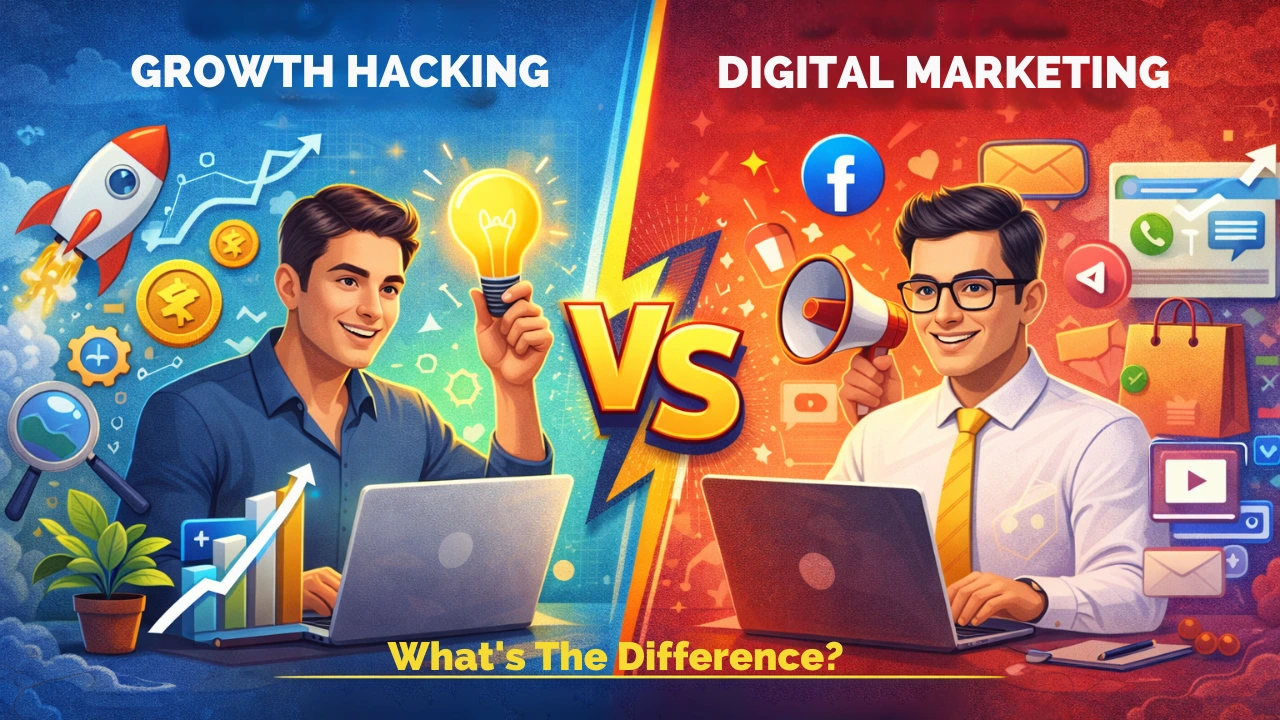
Have you ever wondered what makes growth hacking different from digital marketing? Is it the mindset, process, or tools used? Many business owners and marketers often get confused when comparing growth hacking vs digital marketing. In this guide, we will clearly explain the difference in simple words so that you understand both concepts deeply.
The world is moving fast towards digitization. Every day, new technology is being created. Startups are growing quickly, and businesses are trying hard to survive and expand. Growing and scaling a business comes under growth hacking. Promoting products and services using search engines, social media, email, and online advertising comes under digital marketing. Many people fail to clearly understand the difference between growth hacking vs digital marketing. Before we compare them directly, let us first understand each one properly.
What is Growth Hacking?
The term growth hacking became popular after Sean Ellis, founder and CEO of Qualaroo, defined it clearly. He said, “A growth hacker is a person whose true north is growth.”
Growth hacking is the process of experimenting with different strategies to find the most effective and low-cost way to grow a business. It is not limited to marketing only. It can include product changes, technical improvements, automation, data analysis, and creative campaigns. The main focus is simple — growth.
Because of this strong focus on growth, many new strategies and tools were created that did not exist before. Growth hacking is mostly seen in startups because they need rapid user acquisition and fast results. However, even established companies can benefit from growth hacking methods.
The Process of Growth Hacking
Growth hacking follows a practical and measurable process. First, a company identifies the area that affects business growth. It could be customer acquisition, retention, activation, or engagement. After identifying the area, a clear goal is set. For example, increasing leads by 200 per month or improving conversion rate by 15 percent.
Once the goal is defined, the team brainstorms multiple ideas to achieve it. These ideas are tested quickly. Results are measured using data. If a strategy works, it is scaled. If it fails, it is improved or replaced. Growth hacking heavily depends on testing, measuring, and improving.
There is no fixed formula for growth hacking. Every company experiments differently based on its product, audience, and budget.
A famous example of growth hacking is Airbnb. In its early days, Airbnb used Craigslist to grow its user base. They allowed hosts to post listings on Craigslist, which generated inbound links and traffic. This smart move helped Airbnb increase user acquisition quickly. Though the method was later restricted, it successfully helped Airbnb during its growth stage.
Traits of Growth Hackers
Growth hacking requires knowledge of marketing, analytics, programming, and product development. Growth hackers often solve problems like reducing costs, increasing conversions, and improving user experience.
Following are some traits they possess –
Their primary focus is on growth and all efforts are directed toward measurable expansion
They understand growth platforms and tools deeply
They are result-oriented and prefer fast outcomes
They combine technical and creative skills effectively
They think outside the box and experiment with new ideas
They love data and analyze trends carefully
They are willing to take risks to discover new opportunities
Now that we understand growth hacking, let us look at digital marketing to better understand growth hacking vs digital marketing.
What is Digital Marketing?
Digital marketing is the promotion of products or services using digital channels such as search engines, social media platforms, email, websites, and online advertising. Unlike traditional marketing, digital marketing allows businesses to target specific audiences and measure results in real time.
There are several advantages of digital marketing over traditional marketing such as –
Digital marketing allows precise audience targeting
Campaigns can be optimized in real time
Results are measurable and data-driven
Return on investment is higher compared to traditional media
It is more cost-effective
It improves engagement with customers
Communication can be personalized
Sample Modules of Digital Marketing
Search engine optimization involves ranking websites in organic search results and improving visibility.
Search engine marketing focuses on both organic search and paid search ads.
Social media marketing uses platforms like Facebook, Twitter, and Pinterest to promote brands.
Display marketing includes banner ads and image ads on websites.
Content marketing uses blogs, videos, podcasts, and webinars to educate and attract audiences.
Affiliate marketing promotes third-party products for commission.
Email marketing communicates directly with customers through newsletters and updates.
Mobile marketing connects with users through smartphones and apps.
Traits of Digital Marketers
A digital marketer needs knowledge from multiple fields. They must be creative, strategic, and analytical at the same time. Most digital marketers are self-motivated and independent, but teamwork is also important.
They work without constant supervision
They enjoy solving challenges
Creativity is essential for campaign success
They are always learning new tools and trends
Strong communication skills are required
They must adapt to industry changes
Leadership skills help in managing campaigns
Strategic and analytical thinking is important
Growth Hacking vs Digital Marketing
Now that we understand both concepts clearly, let us compare growth hacking vs digital marketing in terms of their objectives and work style.
Even though both use similar channels like SEO, social media, and paid ads, their mindset is different.
Objective – Growth hacking focuses on the entire sales funnel including acquisition, activation, retention, revenue, and referrals. Digital marketing mainly focuses on acquisition and activation while building long-term brand trust. Growth hackers aim for rapid business growth, whereas digital marketers aim for sustainable brand building.
Technical Skills – Growth hackers usually have a technical background and can execute ideas independently. Digital marketers focus more on strategy and often work with designers, developers, and analysts.
Budget – Digital marketing usually operates with a larger promotional budget. Growth hacking is commonly used by startups with limited resources, so strategies are more cost-sensitive.
Degree of Risk – Digital marketers are cautious because brand reputation is important. Growth hackers are more willing to experiment and take calculated risks for faster results.
Conclusion
It is not completely right to compare growth hacking vs digital marketing as competitors because both serve different purposes. Growth hacking is ideal for startups and businesses that need rapid user acquisition and fast growth. Digital marketing is better suited for companies that want long-term brand value, customer trust, and consistent revenue.The right approach depends on business goals, budget, and growth stage. Many smart companies combine both strategies to achieve balanced success. Businesses that want structured digital growth, performance marketing, SEO strategy, and long-term brand development often seek expert guidance — and that is where iBirds Digital helps brands grow with clarity and measurable results.
Frequently Asked Questions
1. What is the main difference between Growth Hacking vs Digital Marketing?
The main difference between growth hacking vs digital marketing is the objective and approach. Growth hacking focuses on rapid business growth through experimentation across the entire funnel, while digital marketing focuses on promoting products and building long-term brand value using structured strategies.
2. Is growth hacking a part of digital marketing?
Growth hacking is not limited to digital marketing. It includes marketing, product development, automation, data analysis, and technical improvements. Digital marketing mainly focuses on promotional activities through online channels.
3. Who introduced the term Growth Hacking?
The term growth hacking was popularized by Sean Ellis, the founder and CEO of Qualaroo, who defined a growth hacker as someone whose primary focus is business growth.
4. Can established companies use growth hacking strategies?
Yes, although growth hacking is commonly used by startups, established companies can also use growth hacking techniques to improve customer acquisition, retention, and revenue growth.
5. What are the key channels used in digital marketing?
Digital marketing uses channels like SEO, social media marketing, email marketing, content marketing, paid advertising, affiliate marketing, and mobile marketing to promote products and services online.
6. Is growth hacking risky compared to digital marketing?
Growth hacking involves more experimentation and calculated risks to achieve faster results. Digital marketing is generally more structured and brand-focused, so it involves lower risk compared to growth hacking.
7. Which is better for startups: Growth Hacking vs Digital Marketing?
For startups with limited budgets and a need for rapid growth, growth hacking is often more suitable. However, combining growth hacking with digital marketing strategies can provide balanced and sustainable growth.
8. Do growth hackers need technical skills?
Yes, growth hackers often require technical skills such as data analysis, automation tools, and basic programming knowledge to quickly test and implement ideas.
9. Is digital marketing only about social media?
No, digital marketing is much broader. It includes search engine optimization, paid ads, email campaigns, content marketing, display advertising, and more.
10. Can businesses combine growth hacking and digital marketing?
Yes, many successful companies combine both approaches. Growth hacking helps achieve rapid results, while digital marketing ensures long-term brand visibility and trust.