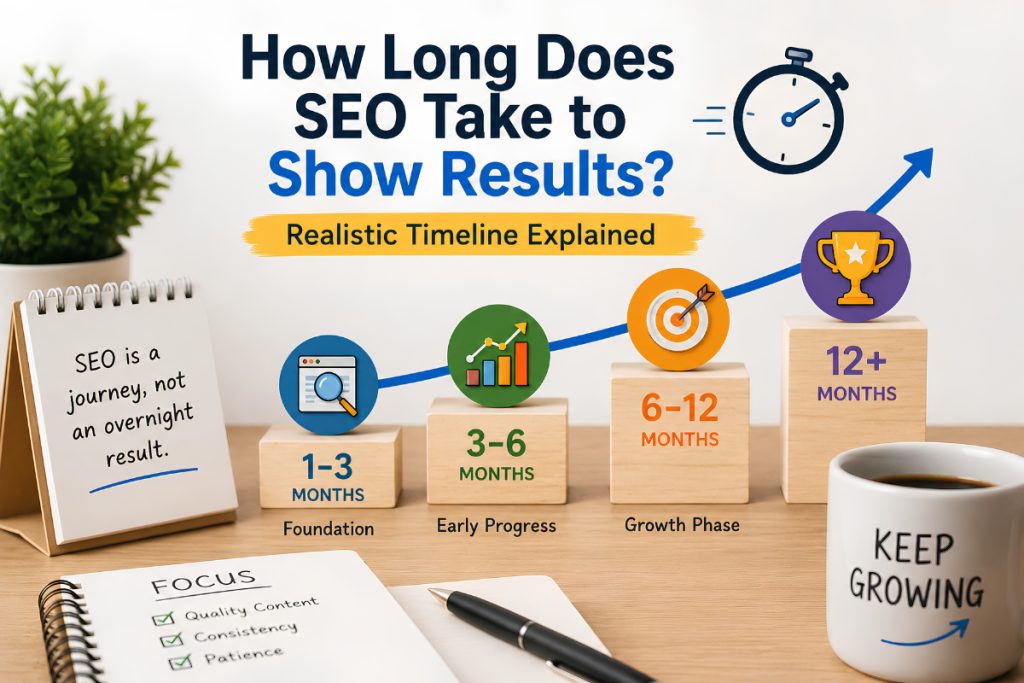

How Long Does SEO Take to Show Results?
If you have recently started working on SEO, one of the first questions you are likely to ask is, How Long Does SEO Take to Show Results? Realistic Timeline Explained. You may publish new content, improve your website, fix technical issues, and optimize your pages, but the rankings may not change immediately. This often makes business owners wonder whether their SEO strategy is working or whether they should change direction.
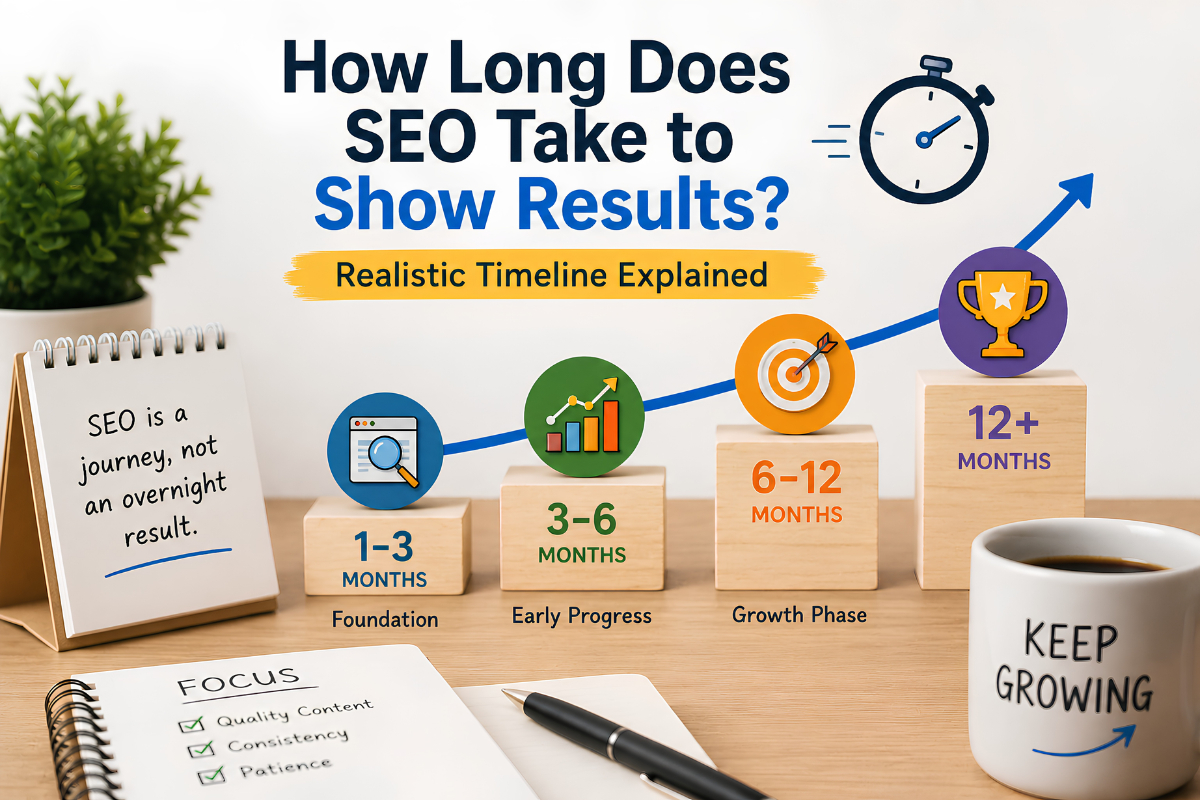
The reality is that SEO usually needs time to produce measurable results. A realistic expectation is around 3 to 6 months for noticeable improvements, while competitive industries and newer websites may need 6 to 12 months or longer to build meaningful organic traffic, rankings, leads, and revenue. The exact timeline depends on factors such as your website’s age, authority, competition, technical condition, content quality, backlinks, implementation speed, and how quickly Google crawls and reassesses your changes.
This does not mean you should spend six months doing nothing and wait for rankings. Good SEO work should produce smaller signs of progress much earlier. Technical errors can decrease, impressions can increase, new pages can become indexed, and long tail keywords can begin moving before major traffic growth becomes visible.
How Long Does SEO Take to Work for a New Website?
A new website normally takes longer to establish search visibility because it has little history, limited backlinks, low brand recognition, and fewer signals showing search engines that the website is trustworthy and relevant.
During the first few weeks, the main focus should be on creating a strong foundation. This includes checking whether important pages can be crawled and indexed, improving the website structure, researching relevant keywords, fixing technical problems, creating useful content, and setting up proper measurement.
A new website should not be judged only by its Google position during this period. If Google is discovering more pages, impressions are increasing, technical errors are decreasing, and relevant keywords are beginning to appear in Search Console, those can be useful early indicators that the work is moving in the right direction. The source material also notes that brand new domains generally move more slowly because they have limited backlink data, branded search demand, historical performance information, and engagement signals.
SEO Timeline: What Can You Expect Month by Month?
There is no fixed schedule that applies to every website, but a month by month framework makes SEO progress much easier to understand.
| SEO Period | Main Focus | What You May See |
|---|---|---|
| Month 1 | Audit and planning | Technical issues, keyword gaps and content opportunities identified |
| Months 1 to 2 | Foundation and strategy | Technical fixes, content planning and internal linking improvements |
| Months 2 to 3 | Implementation | New content, optimized pages and early keyword movement |
| Months 3 to 4 | Crawling and indexing | More pages indexed, impressions increasing and ranking fluctuations |
| Months 4 to 6 | Early gains | Long tail rankings, increased impressions and initial traffic growth |
| Months 6 to 9 | Significant progress | More page one rankings, organic traffic and potential leads |
| Months 9 to 12 | Growth | Broader keyword visibility, stronger authority and more consistent traffic |
| 12 months and beyond | Scaling | Compounding traffic, stronger rankings and improved SEO ROI |
The timeline is only a starting point. Your actual results depend heavily on where your website begins, the competition around your target keywords, technical health, content quality, authority, and the resources available to implement SEO recommendations.
Month 1: SEO Audit, Research and Planning
The first month is usually about understanding the website rather than expecting dramatic ranking improvements. A proper SEO audit can reveal technical problems, content gaps, weak internal linking, indexing issues, keyword opportunities, and areas where competitors are performing better.
A typical first month can include:
- Reviewing website structure and technical health
- Checking indexing and crawlability
- Researching target keywords
- Mapping keywords to relevant pages
- Reviewing existing content
- Identifying content gaps
- Checking backlinks and website authority
- Comparing competitors
- Setting baseline traffic and ranking metrics
- Creating a prioritized SEO action plan
For smaller websites, this work can often move relatively quickly because there are fewer pages and fewer technical dependencies. Large websites may require considerably more time because SEO teams have to work with developers, content teams, designers, product teams, and other stakeholders.
This is why the first month should not be judged only by keyword positions. A clear SEO roadmap and completed technical work are valuable results at this stage.
Months 2 to 3: SEO Implementation Begins
Once the initial audit and strategy are complete, the focus moves toward implementation. This is where changes begin appearing across the website.
You may start improving title tags, headings, page content, internal links, page templates, images, metadata, and technical elements. New articles and service pages may also be published based on the keyword research.
This is also a good time to strengthen your website’s content structure. For example, a detailed article can link to a related service page, while supporting blog posts can link back to a main topic page. This gives visitors a clearer path through the website and helps search engines understand the relationship between important pages.
If your website covers Salesforce, for example, a guide about SEO for SaaS businesses could naturally connect with related resources such as Salesforce CRM, Salesforce integration, or Salesforce Sales Cloud features where those topics are genuinely relevant.
During months two and three, Google may begin crawling and indexing updated pages. Some lower competition and long tail keywords may show early movement, although rankings can still fluctuate considerably while Google reassesses the updated content.
Months 3 to 4: Crawling, Indexing and Early Ranking Changes
By this stage, search engines have had more time to process the changes made during the earlier months. Updated pages may become properly indexed, internal linking improvements may start passing authority between pages, and some keywords may begin moving upward.
You may notice:
- More impressions in Google Search Console
- New keywords appearing
- Previously weak pages receiving more visibility
- Long tail keywords reaching better positions
- Small increases in organic traffic
- Ranking fluctuations across target keywords
Do not worry if rankings move up one week and down the next. SEO performance is rarely a straight upward line. Google continues to reassess pages, competitors continue improving their websites, and search results can change based on the query and search intent.
For many businesses, this is the stage where the first real evidence of progress becomes visible.
Months 4 to 6: When SEO Results Start Becoming Noticeable
For many websites, months four to six are an important period because enough SEO work has been implemented and processed for broader trends to become easier to see.
Lower competition keywords may reach page one, impressions may increase more consistently, and organic traffic may begin showing measurable growth. Some pages can also start generating enquiries or other conversions if the content matches what users are actually looking for.
However, this is not necessarily the point where every important keyword reaches the first position on Google. Highly competitive commercial keywords can require much more authority and stronger content before significant movement occurs.
A useful way to judge progress during this stage is to look beyond one keyword and review the overall trend across your website.
Ask yourself:
- Are impressions increasing?
- Are more relevant keywords ranking?
- Are important pages receiving more clicks?
- Are long tail keywords improving?
- Is organic traffic growing?
- Are organic visitors taking useful actions?
- Are technical errors decreasing?
These indicators give you a much clearer picture than checking one keyword every day.
Months 6 to 9: Significant SEO Progress
Between months six and nine, a well-executed SEO campaign can begin producing more stable improvements. Earlier technical fixes, content improvements, internal links, and authority-building efforts have had more time to work together.
You may see:
- More keywords reaching page one
- Broader keyword groups improving
- Higher organic impressions and clicks
- More consistent organic traffic
- Better performance for commercial keywords
- More enquiries and conversions
- Stronger internal authority across related pages
This is also when the difference between a consistent SEO strategy and a short-term campaign becomes easier to see. Websites that continue publishing useful content, improving existing pages, earning relevant links, and maintaining technical health can build momentum over time.
Months 9 to 12: SEO Growth Becomes More Consistent
At nine to twelve months, SEO can start moving from early experimentation into more predictable growth. Pages that were optimized several months earlier may continue gaining visibility as the website develops stronger topical authority and a larger content base.
Businesses in low and medium competition markets may see substantial growth during this period. More competitive industries may need longer, particularly when competitors already have strong domains, large backlink profiles, extensive content libraries, and established brands.
This is why SEO should not be treated as a campaign that ends as soon as a website reaches page one. Search results continue changing, competitors continue publishing, and Google continues updating its systems.
What Factors Determine How Long SEO Takes?
There is no single answer to how long SEO takes because every website starts from a different position. Several important factors can speed up or slow down the timeline.
1. Website Age and Authority
An established website with a strong content structure and relevant backlinks may gain visibility faster than a brand new domain. A new website needs time to establish authority and demonstrate its relevance.
2. Keyword Competition
A page targeting a specific low competition search term may rank much faster than a page targeting a highly competitive commercial keyword. The stronger the websites already ranking for a query, the more work it may take to compete with them.
3. Technical SEO
Technical problems can delay SEO progress even when the content itself is good. Crawlability, indexing, site speed, Core Web Vitals, redirects, canonical URLs, duplicate content, and site structure can all affect how efficiently search engines process a website.
If your website has technical problems, starting with a technical SEO audit can be more valuable than simply publishing more articles.
4. Content Quality
Publishing more pages does not automatically mean faster rankings. Content needs to address real search intent, provide useful information, and fit the needs of your audience.
A strong content strategy can also create topical depth. Instead of publishing unrelated articles every week, create supporting content around your important services, products, and topics.
5. Backlinks and Brand Authority
Relevant backlinks can strengthen a website’s authority, particularly when they come from trustworthy and relevant websites. Brand mentions, reviews, citations, and other external signals can also contribute to a stronger overall presence.
However, building authority takes time. It should be approached consistently rather than through sudden low-quality link-building campaigns.
6. Speed of Implementation
An SEO recommendation cannot improve a website until someone actually implements it. If technical fixes remain in a developer queue for several months, the SEO timeline naturally becomes longer.
The source material highlights implementation speed as an important factor because SEO changes must be completed before search engines can crawl and reassess them.
How Can You Measure SEO Progress Before Traffic Increases?
One of the biggest mistakes businesses make is looking only at organic traffic. Traffic is important, but it is not always the first sign that SEO is working.
You can monitor early progress through:
| Metric | What It Can Tell You |
|---|---|
| Impressions | Whether Google is showing your pages for more searches |
| Average position | Whether target queries are gradually improving |
| Clicks | Whether search visibility is generating visits |
| Indexed pages | Whether important pages are entering Google’s index |
| Crawl errors | Whether technical barriers are being reduced |
| Organic sessions | Whether search traffic is increasing |
| Conversions | Whether organic visitors are becoming leads or customers |
| Revenue | Whether SEO is contributing to business growth |
Google Search Console is particularly useful for monitoring impressions, clicks, average position, indexing information, and crawl-related issues. Google Analytics 4 can then help connect organic visitors with engagement, conversions, and business outcomes.
Google Search Console can help you understand how your website is appearing in Google Search, while Google Analytics 4 can help you understand what users do after reaching your website.
Is It Possible to Get SEO Results in 30 Days?
Yes, but it is important to define what you mean by results.
A website can see early changes within 30 days. For example, technical errors may decrease, pages may become indexed, impressions may increase, or low competition keywords may begin appearing in search results.
However, stable and meaningful rankings for competitive keywords rarely happen within 30 days. Thirty days is often enough to complete research, audit the website, establish tracking, prioritize work, and begin implementing important changes.
There are exceptions. An established website with strong authority may rank new content quickly, especially when the target keyword has relatively low competition. But this should not be treated as the normal expectation for every business.
Does SEO Take a Year to Work?
Not necessarily. Some websites see measurable improvements within a few months, while others need more than a year to reach their larger business goals.
The important distinction is between initial SEO progress and significant SEO growth.
A business may see its first ranking improvements within three to six months, while substantial traffic, leads, and revenue growth may take six to twelve months or longer. Highly competitive industries can require an even longer investment because the website has to build enough authority to compete with established websites.
SEO is also an ongoing process. Once a website starts ranking, competitors can publish stronger pages, search behavior can change, and Google can update its ranking systems. Maintaining visibility therefore requires continued improvement rather than stopping after reaching a particular ranking.
What Should You Do If SEO Results Are Taking Longer Than Expected?
If several months have passed and there is little meaningful progress, do not immediately assume that SEO does not work. First, review the campaign and identify where the problem may be.
Check:
- Whether important pages are indexed
- Whether technical errors are preventing crawling
- Whether the selected keywords are realistic
- Whether the content actually satisfies search intent
- Whether pages are competing with each other for the same keywords
- Whether internal linking is strong enough
- Whether the website has relevant authority and backlinks
- Whether recommended changes were actually implemented
- Whether competitors have significantly stronger content
- Whether you are measuring conversions and business results, not rankings alone
Sometimes the problem is not the SEO timeline. The strategy itself may need adjustment.
How Can You Make SEO Results More Consistent?
The goal should not be to find a shortcut that makes Google rank your website overnight. A better approach is to build a website that becomes stronger with every round of optimization.
Start with technical health, create content around clear search intent, improve existing pages, build useful internal links, earn relevant backlinks, and monitor the results regularly. Your SEO plan should also include both informational content and commercial pages so that visitors can move from learning about a topic to exploring your services or products.
If you are working on a Salesforce-focused website, for example, supporting resources such as Salesforce CRM, Salesforce Sales Cloud features, Salesforce integration, and Salesforce data security can be connected where the subject naturally overlaps. This creates a more useful content journey rather than adding internal links simply for SEO.
Final Thoughts: How Long Does SEO Take to Show Results?
So, How Long Does SEO Take to Show Results? Realistic Timeline Explained comes down to one simple answer: SEO usually takes several months, not several days.
For many websites, 3 to 6 months is a reasonable period to begin seeing measurable improvements, while 6 to 12 months can be a more realistic window for significant growth. New websites, highly competitive industries, technically complex websites, and businesses targeting difficult keywords may need longer.
The most important thing is to watch the complete picture. Better rankings are useful, but increasing impressions, clicks, qualified organic traffic, leads, conversions, and revenue are stronger indicators of business value. The source material also emphasizes that SEO progress should be measured through these gradual signals rather than waiting for one dramatic ranking jump.
SEO works best when it becomes part of your regular marketing process. Audit the website, fix technical issues, publish useful content, improve existing pages, strengthen internal links, build authority, measure results, and keep improving based on what the data shows.
Frequently Asked Questions
How long does SEO take to show results for a new website?
A new website may need several months before meaningful organic visibility develops. Initial indexing and ranking movement can happen earlier, but stronger traffic and keyword growth often require 3 to 6 months or longer because the website first needs to establish authority and trust.
Can SEO results appear within three months?
Yes. Some websites can see early ranking and traffic improvements within three months, particularly when technical problems are fixed and the website targets realistic, lower competition keywords. These early improvements do not necessarily mean that the full SEO potential has been reached.
Why does SEO take longer for competitive keywords?
Competitive keywords already have strong websites ranking for them. To compete, your website may need better content, stronger authority, relevant backlinks, improved technical performance, and a stronger overall topical presence. Building these signals takes time.
What should I track while waiting for SEO results?
Track impressions, clicks, average position, indexed pages, organic sessions, conversions, and revenue. Google Search Console is useful for search visibility and indexing data, while Google Analytics 4 helps connect organic traffic with user activity and conversions.
Is SEO a one time process?
No. SEO requires ongoing work because competitors change their content, search behavior evolves, and search engines continue updating their systems. Maintaining and improving rankings requires regular content updates, technical maintenance, authority building, and performance analysis.