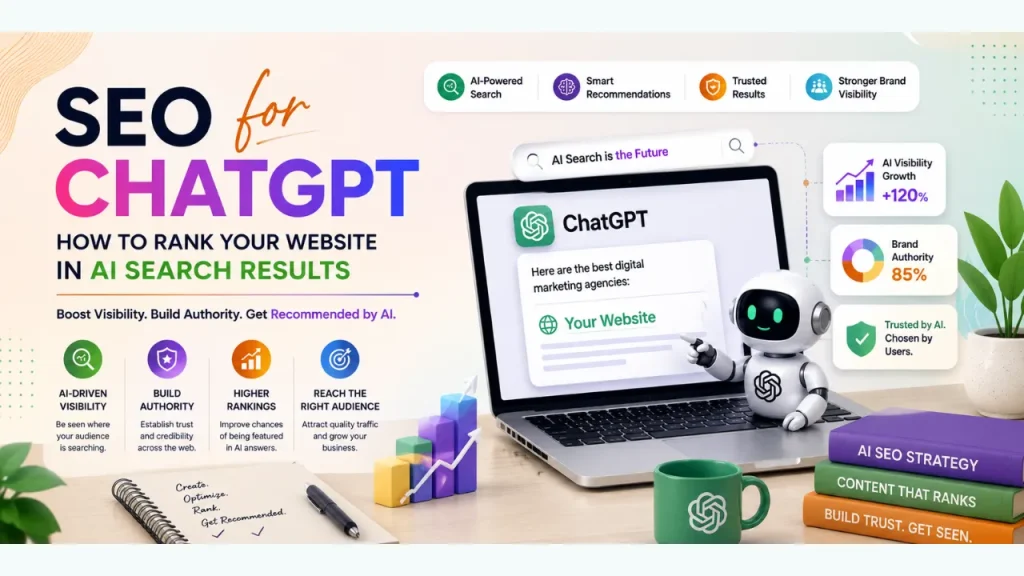

Key Takeaways
- Ranking in ChatGPT is different from ranking in Google. AI platforms evaluate trusted sources, brand mentions, structured content, and topical authority instead of relying only on search rankings.
- E-E-A-T has become even more important. Demonstrating experience, expertise, authoritativeness, and trustworthiness increases the chances of your content being referenced in AI-generated answers.
- Brand mentions strengthen AI visibility. Consistent mentions across reputable websites help Large Language Models (LLMs) recognize your business, even when those mentions don’t include backlinks.
- Clear, well-structured content performs better. AI systems prefer pages that directly answer user questions with logical headings, concise explanations, and easy-to-read formatting.
- Original insights create a competitive advantage. Research, industry data, case studies, and unique perspectives are more likely to be cited by AI-powered search experiences.
- Traditional SEO still matters. Strong rankings, quality backlinks, technical SEO, and topical authority continue to support visibility across both search engines and AI platforms.
- Optimize for natural questions and search intent. AI assistants understand conversational queries, making question-focused content an essential part of modern SEO.
- Content distribution improves AI recognition. Publishing valuable content across trusted websites, digital PR campaigns, industry publications, and social platforms helps strengthen your online authority.
- AI visibility is becoming a new performance metric. Appearing in ChatGPT, Google AI Mode, Google AI Overviews, Gemini, Claude, and Perplexity is increasingly as valuable as earning organic website traffic.
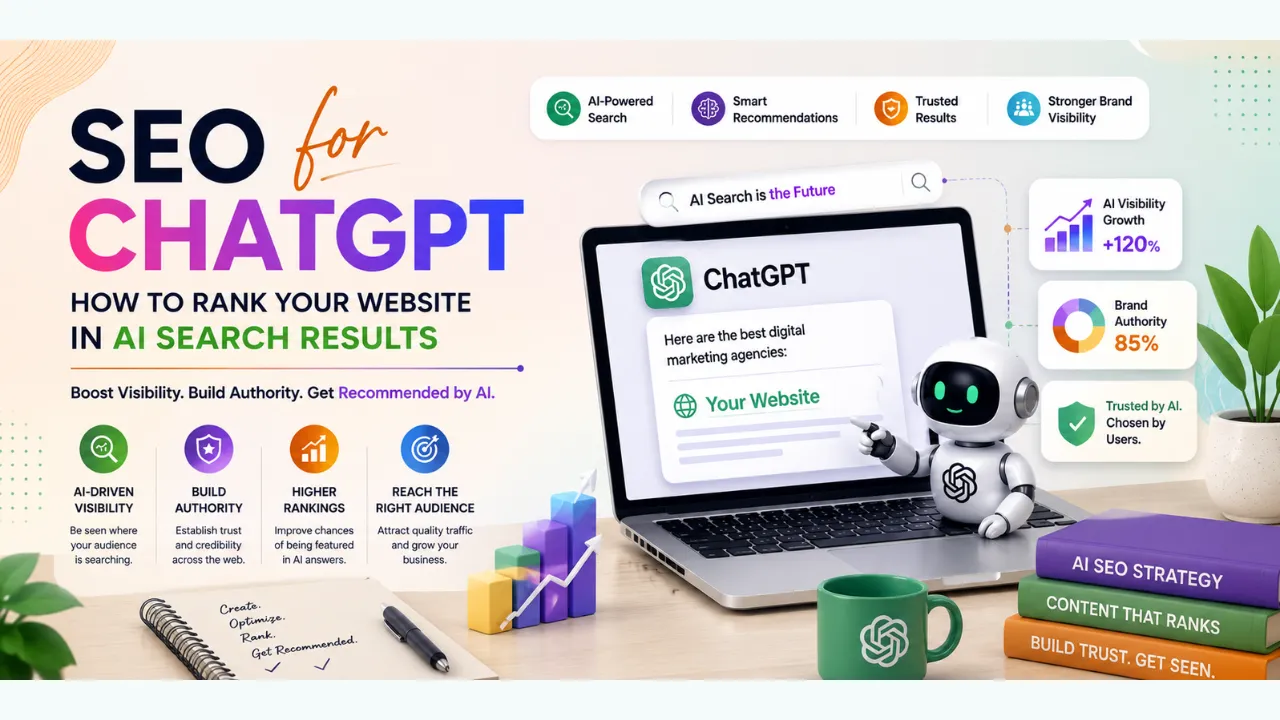
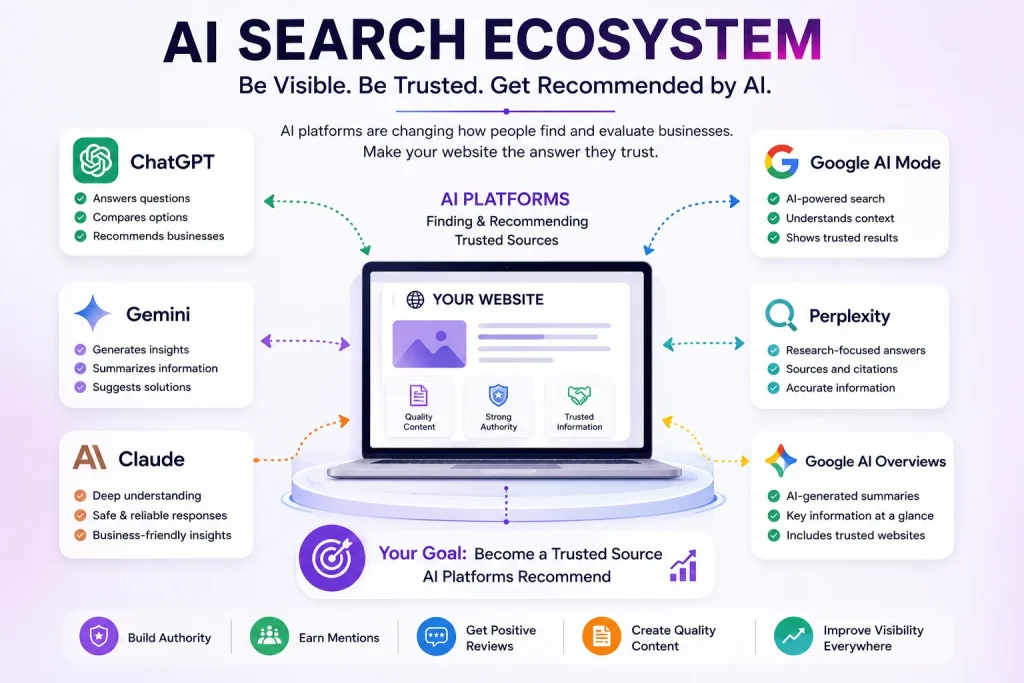
AI search has changed how people find information online. Instead of opening multiple websites, users now ask ChatGPT, Google AI Mode, Google AI Overviews, Claude, Gemini, and Perplexity AI for direct answers, product recommendations, and service providers. This shift means businesses need to optimize their websites not only for traditional search engines but also for Large Language Models (LLMs) that generate AI-powered responses.
Unlike Google Search, AI platforms don’t simply rank pages based on keywords and backlinks. They analyze trusted sources, brand reputation, structured content, topical authority, and real-world signals before mentioning a business or website in their responses. If your brand consistently appears across authoritative websites and publishes reliable content, it has a better chance of being referenced by AI-powered search experiences.
Today, LLM SEO, Generative Engine Optimization (GEO), and Answer Engine Optimization (AEO) have become important parts of digital marketing strategies. While traditional SEO continues to build website authority, AI-focused optimization helps improve brand visibility inside AI-generated answers, where users are increasingly making purchase decisions and evaluating companies before visiting a website.
Modern AI models also understand natural language much better than earlier search systems. They prioritize content that answers real questions clearly, follows a logical structure, demonstrates expertise, and provides accurate information. Businesses that create helpful, well-organized content are more likely to earn visibility across AI search platforms.
Social Media Marketing Services
Who Does ChatGPT Recommend?
Many businesses assume ChatGPT recommends companies based only on popularity or search rankings. In reality, AI recommendations are influenced by several trust and relevance signals collected from publicly available information.
For broad questions such as “Which digital marketing agency should I hire?”, AI platforms often return a general response instead of recommending a specific company. However, when users ask more detailed questions like “Which agency provides the best SEO services for enterprise businesses?”, the recommendations become much more specific.
This difference highlights an important point about SEO for ChatGPT. AI systems evaluate the context of the question, the authority of brands discussed across the web, and how consistently businesses are associated with specific services or topics. Companies that build strong topical authority, maintain a trusted online presence, and publish valuable content are more likely to appear in AI-generated recommendations.
Understanding these ranking signals is the first step toward improving your website’s visibility across modern AI search platforms.
What Determines ChatGPT Recommendations?
Many businesses want to know why certain companies appear in AI-generated answers while others do not. To better understand this, it’s important to examine how ChatGPT, Google AI Mode, and other AI search platforms evaluate information before recommending a website, brand, or service.
When asked how it selects businesses, ChatGPT often references factors such as online reputation, trusted sources, industry authority, content relevance, and publicly available information. While these responses provide useful direction, they don’t fully explain the ranking process behind AI-generated recommendations.
Further analysis shows that AI platforms combine multiple trust signals instead of relying on a single ranking factor. They review how often a brand is mentioned, whether reputable websites discuss it, the quality of available content, and how closely that content matches the user’s question. Rather than using traditional keyword rankings alone, AI models focus on identifying the most relevant and trustworthy answer.
The Obvious Lesson
One important observation is that AI-generated recommendations are not always perfect. In some cases, platforms recommend companies that are well known in a particular industry but may not directly provide the service a user is searching for.
This happens because Large Language Models (LLMs) rely on relationships between brands, topics, industry mentions, and publicly available information instead of manually verifying every recommendation. Strong brand recognition and topical authority often influence whether a company appears in AI-generated responses.
For businesses, this creates an important opportunity. Building a trusted online presence, publishing high-quality content, earning positive reviews, and increasing authoritative brand mentions can improve visibility across AI search platforms. While AI recommendations continue to evolve, organizations with stronger credibility and consistent topical relevance are more likely to appear in future AI-generated answers.
SEO Services for business growth
How Does ChatGPT Rank Websites?
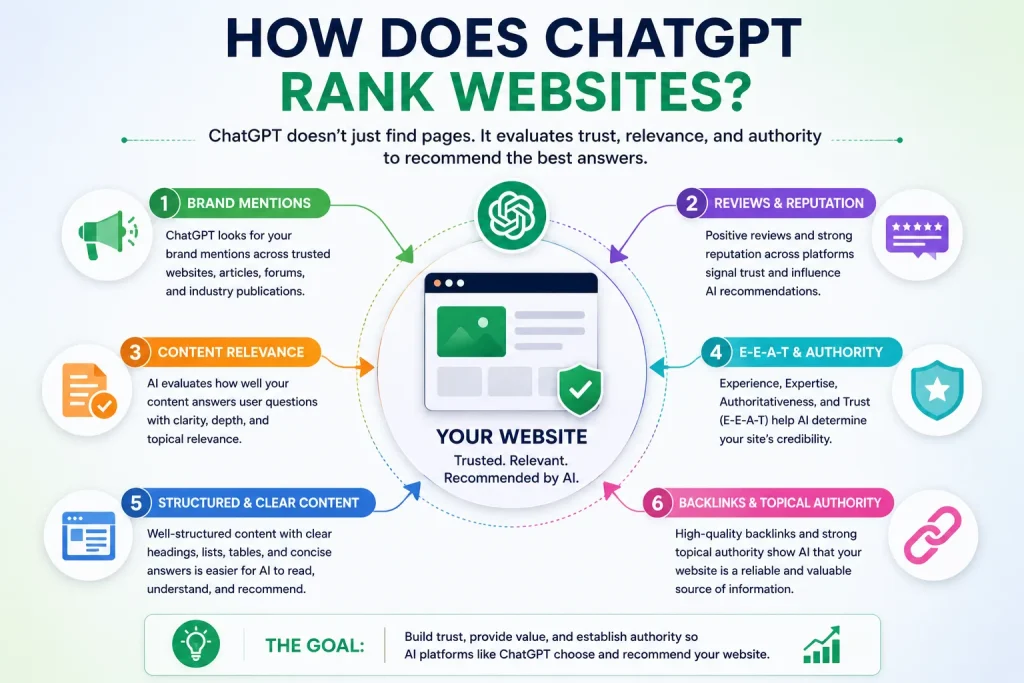
Instead of relying only on assumptions, marketers have started analyzing AI-generated recommendations by testing hundreds of different prompts across multiple industries.
Questions covering products, software, financial services, vehicles, consumer electronics, and professional services reveal consistent ranking patterns. Although AI models evaluate a wide range of information, several factors repeatedly influence whether a website, product, or business appears in AI responses.
These observations suggest that SEO for ChatGPT extends beyond traditional search optimization. Visibility inside AI platforms depends on building trust, topical authority, brand recognition, and content that directly answers user intent. As AI search continues to develop, businesses that optimize for these signals will be better positioned to appear in AI-generated recommendations.
Key Factors That Influence ChatGPT Rankings
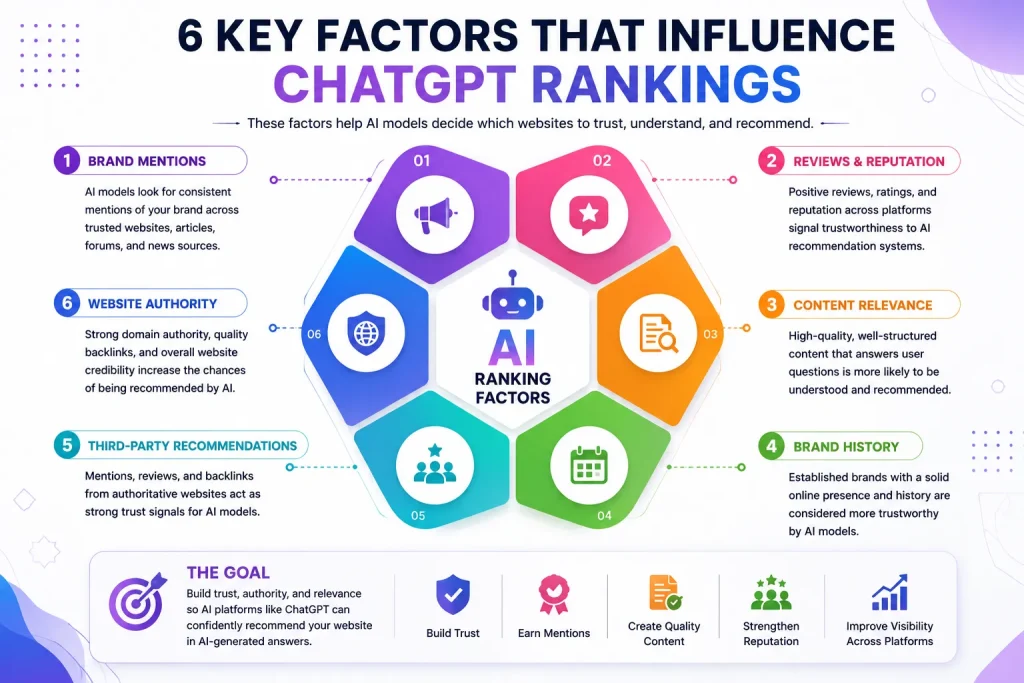
After evaluating a wide range of AI-generated recommendations across different industries, several ranking signals consistently appear to influence whether a website, brand, or business is mentioned in ChatGPT, Google AI Mode, and other AI-powered search platforms.
Although AI systems evaluate hundreds of signals, the following factors have the strongest impact on LLM SEO, AEO, and Generative Engine Optimization (GEO) strategies.
1. Brand Mentions
One of the strongest ranking signals for AI search is how frequently your brand is mentioned across trusted websites. AI models don’t rely only on backlinks—they also recognize consistent brand references from industry publications, business directories, news websites, blogs, podcasts, and community discussions.
The more credible sources that mention your business in the right context, the stronger your brand authority becomes for AI-generated recommendations.
2. Reviews and Reputation
Positive customer reviews help AI platforms understand whether a business is trusted by real users. Reviews published on platforms such as Google Business Profile, Trustpilot, Clutch, G2, and other reputable review websites strengthen online credibility.
Consistent positive feedback, higher ratings, and authentic customer experiences increase the likelihood of your business being recognized by AI systems.
3. Content Relevance
AI platforms closely evaluate whether your content directly answers the user’s question. Pages built around clear topics, natural language, and search intent perform better than content focused only on repeating keywords.
Well-structured articles, question-based headings, and complete topic coverage help AI models understand the context of your website more accurately.
4. Brand History and Consistency
Established businesses with a consistent online presence often receive greater trust signals. While newer companies can still gain visibility, maintaining accurate business information, publishing regularly, and building long-term authority improves recognition across AI search platforms.
5. Third-Party Recommendations
AI systems frequently reference trusted websites that compare products, services, software, or agencies. Being featured in industry roundups, expert recommendations, research articles, and comparison pages strengthens your credibility beyond your own website.
These independent recommendations help AI models validate that your business is recognized by authoritative sources.
6. Website Authority
Website authority continues to play an important role in AI visibility. Factors such as topical expertise, high-quality backlinks, author credibility, trusted publications, social proof, and consistent content publishing all contribute to stronger authority signals.
Businesses that build authority across multiple channels are more likely to appear in AI-generated responses when users search for relevant products or services.
The Biggest Challenge with ChatGPT Rankings
Optimizing for AI search is becoming an important part of modern SEO, but there are still limitations. Although AI platforms continue to improve, they do not always provide perfectly accurate recommendations.
Current Large Language Models (LLMs) occasionally recommend businesses based on brand recognition or publicly available information rather than verifying whether a company actually offers a specific product or service. As AI models become more frequently updated and access fresher information, these limitations are expected to improve.
For businesses, the best strategy is to strengthen the ranking signals that AI consistently values—brand mentions, topical relevance, authoritative content, positive reviews, and overall trustworthiness. These factors not only improve traditional SEO but also increase the chances of being referenced across AI-powered search experiences.
Frequently Asked Questions
1. What is SEO for ChatGPT?
SEO for ChatGPT is the process of optimizing your website so AI platforms like ChatGPT can better understand, trust, and reference your content in AI-generated answers.
2. Can websites rank in ChatGPT?
ChatGPT doesn’t use traditional search rankings. Instead, it references trusted brands, authoritative content, and relevant information when generating responses.
3. What is LLM SEO?
LLM SEO focuses on optimizing content for Large Language Models by improving topical authority, content quality, brand mentions, and trust signals.
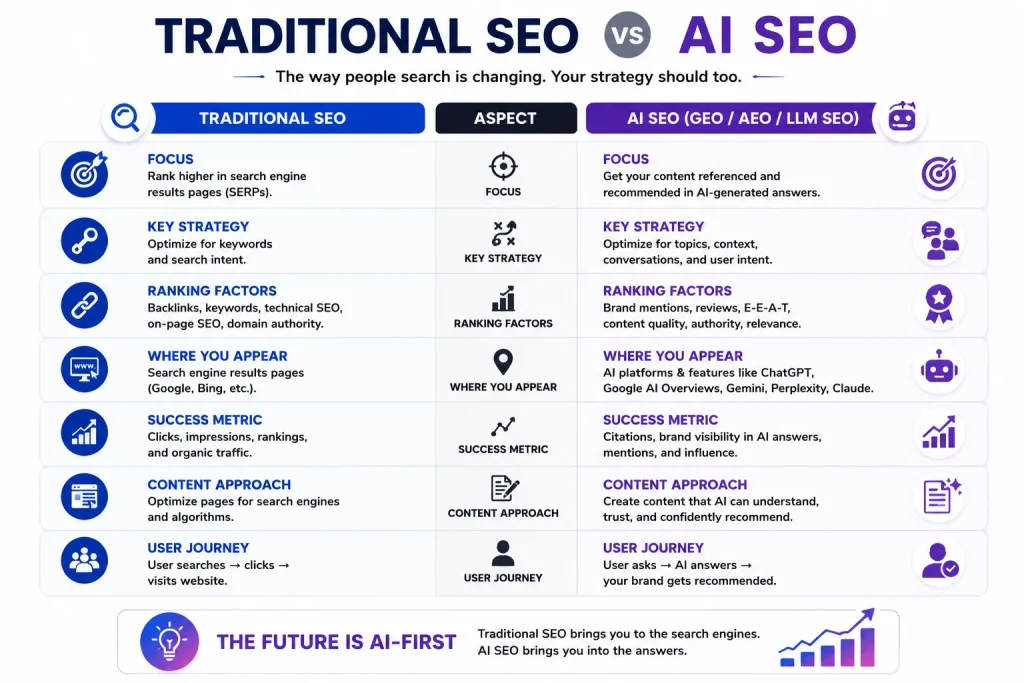
4. How is AI SEO different from traditional SEO?
Traditional SEO aims to improve search engine rankings, while AI SEO helps your content become a trusted source that AI assistants can reference in their answers.
5. Does E-E-A-T affect ChatGPT visibility?
Yes. Strong Experience, Expertise, Authoritativeness, and Trustworthiness (E-E-A-T) increase the likelihood of your content being recognized by AI-powered search platforms.
6. Why are brand mentions important for AI search?
Brand mentions help AI models identify trusted businesses and understand their expertise, even when those mentions don’t include backlinks.
7. How can structured content improve AI visibility?
Well-organized headings, question-based sections, concise answers, and schema markup make it easier for AI systems to interpret and reference your content.
8. Should businesses optimize for both Google and AI search?
Yes. A combined strategy that includes technical SEO, content optimization, and AI-focused best practices provides better long-term online visibility.
9. Which AI platforms should businesses optimize for?
Businesses should create content that can be understood by ChatGPT, Google AI Mode, Google AI Overviews, Gemini, Claude, Perplexity, and other AI-powered search experiences.
10. What is the biggest ranking factor for AI search?
There is no single ranking factor. Strong topical authority, brand mentions, relevant content, positive reputation, website authority, and E-E-A-T all work together to improve AI visibility.
Conclusion
Search optimization has evolved beyond traditional search engines. As AI-powered platforms such as ChatGPT, Google AI Mode, Google AI Overviews, Gemini, Claude, and Perplexity continue to influence how users discover businesses, websites must adapt to new ranking signals.
While traditional SEO remains the foundation of online visibility, LLM SEO, Answer Engine Optimization (AEO), and Generative Engine Optimization (GEO) help businesses improve their chances of being mentioned in AI-generated responses. Success now depends on combining technical SEO with high-quality content, strong brand authority, trustworthy reviews, structured information, and consistent topical relevance.
Businesses that publish helpful content, earn recognition from authoritative sources, and build credibility across the web are more likely to become trusted references for AI search platforms. Rather than focusing only on website traffic, modern SEO strategies should also prioritize visibility wherever users search for answers—including AI assistants.
As AI search continues to evolve, organizations that invest in long-term authority, user-focused content, and a strong digital presence will be better positioned to earn recommendations from both search engines and Large Language Models.