
Understanding the Role of Web Designers and Developers
Websites have changed significantly from simple pages containing text and images. Businesses now use websites for lead generation, online sales, customer support, bookings, payments, account management, content publishing, and connections with other business systems. A modern website may work with databases, APIs, payment gateways, CRM platforms, analytics tools, and other software to complete these tasks.
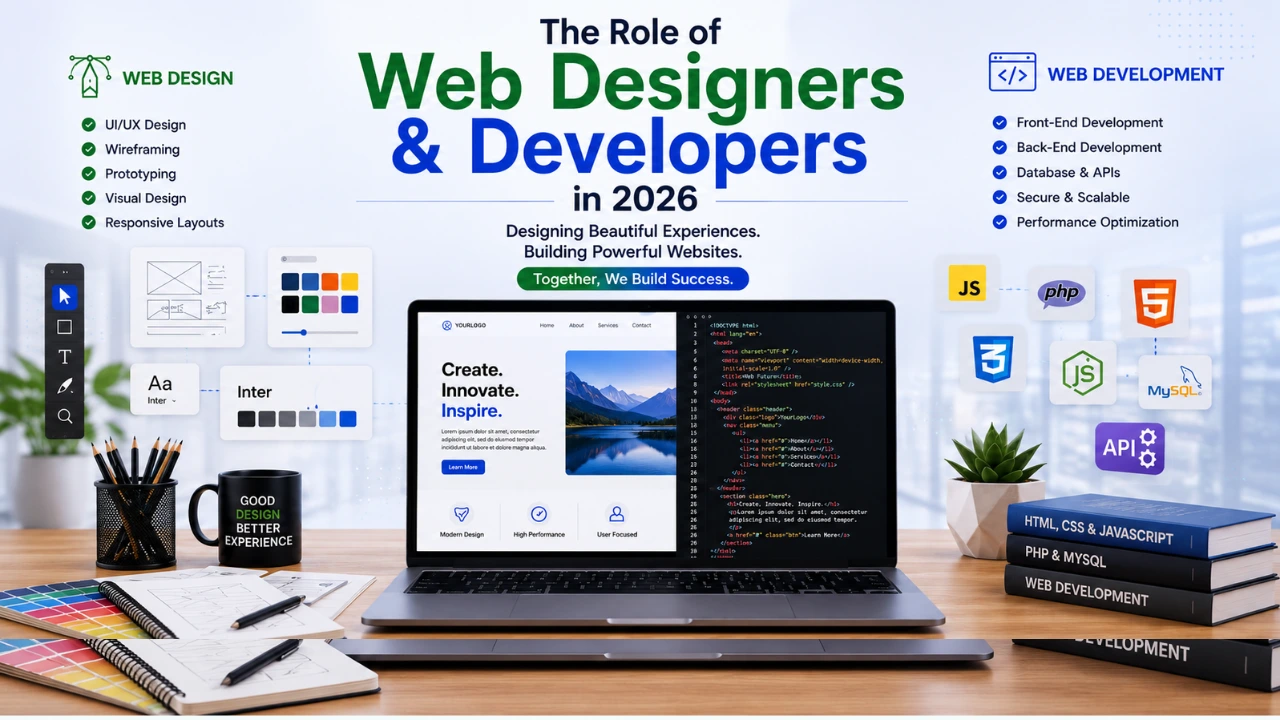
This is why both web designers and web developers have an important role in website development. A designer focuses on how the website looks and how users move through it, while a developer builds the technical functionality that makes those designs and features work.
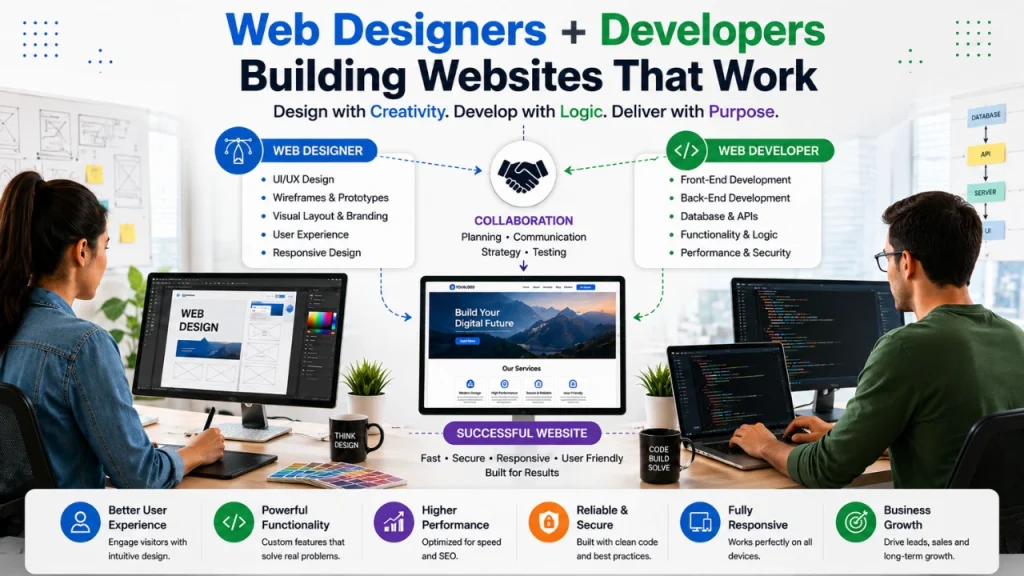
The two roles are different, but they work toward the same goal. A website needs a clear visual structure, simple navigation, responsive layouts, useful content, and reliable functionality to provide a good experience for visitors.
If you are planning a new business website, it is important to understand what web designers and developers actually do and why both skill sets may be required for a successful website project.
What Does a Web Designer Do in Website Development?
A web designer plans the visual and user-facing parts of a website. This includes page layouts, typography, colors, images, navigation, buttons, forms, spacing, and other interface elements.
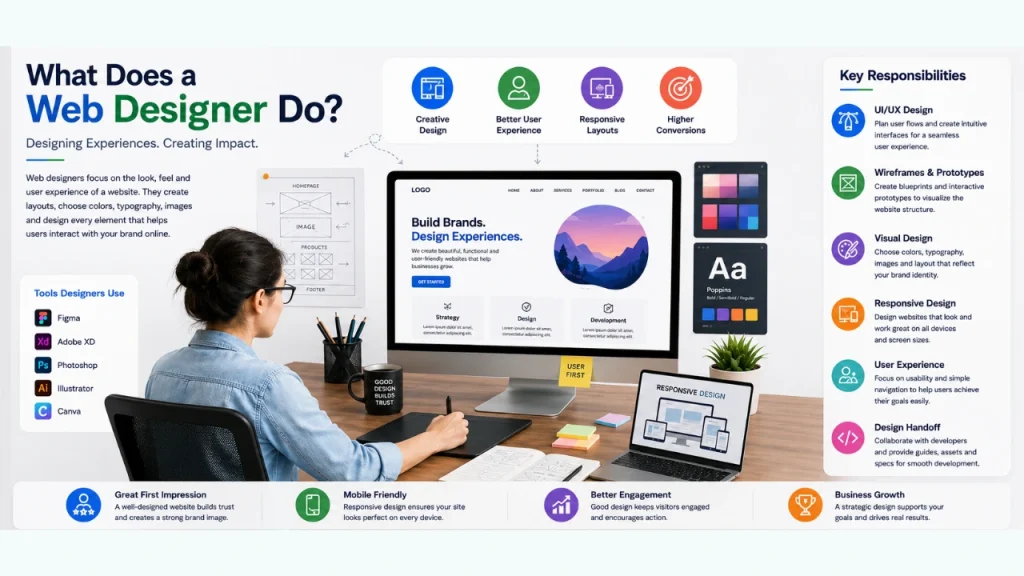
Modern web design is not only about making a website look attractive. Designers also consider how users interact with pages and whether important information can be found quickly. They may create wireframes, prototypes, design systems, and responsive layouts before development begins.
A professional web designer also considers different screen sizes. A website should work properly on smartphones, tablets, laptops, and desktop computers instead of being designed only for one screen size.
Accessibility is another important part of modern web design. Text should be readable, navigation should be understandable, color contrast should be appropriate, and interactive elements should be usable by people with different needs.
A good design therefore combines visual consistency with usability. The goal is to create a website that supports the user’s journey instead of adding unnecessary visual elements.
For businesses that need a professional interface, PPC Services in India can help create page structures, responsive layouts, and user-focused designs based on the website’s goals.
What Is the Role of a Web Developer?
A web developer turns designs and business requirements into a working website. Depending on the project, development may involve front-end development, back-end development, database management, APIs, integrations, security, and server-side processes.
Front-end developers work on the parts visitors interact with directly. This can include navigation menus, forms, buttons, animations, page layouts, interactive sections, and other browser-based features.
Back-end developers handle processes that happen behind the website. These can include databases, user authentication, business rules, APIs, payment processing, data handling, and connections with other systems.
For example, a website may allow a customer to create an account, submit an inquiry, book an appointment, pay online, check an order, or access a private dashboard. These functions require development work beyond the visual design of the page.
Modern web development can use technologies such as HTML, CSS, JavaScript, PHP, Python, databases, APIs, content management systems, and different front-end or back-end frameworks. The right technology depends on the website’s requirements, expected traffic, integrations, security needs, and future maintenance.
For businesses that require technical website functionality, Digital Marketing Services can help build websites with the features, integrations, and technical structure required for specific business processes.
Why Are Web Designers and Developers Both Important?
Web design and web development solve different problems, but both are important for creating a complete website.
A website can have an attractive design but still perform poorly if its forms do not work, pages load slowly, integrations fail, or important features are difficult to use. Similarly, a technically strong website may not provide good results if visitors cannot understand the navigation or find important information.
Design helps visitors understand and interact with the website, while development makes the required functions work.
A successful website may require:
- UI and UX design
- Responsive website design
- Front-end development
- Back-end development
- Database integration
- API development and integration
- CMS development
- eCommerce functionality
- Website security
- Performance optimization
- Accessibility improvements
- SEO-friendly technical structure
- Analytics and conversion tracking
When designers and developers work together from the planning stage, they can identify technical limitations early and create a more consistent website experience.
This is especially important for business websites that need more than basic informational pages. A website with lead forms, customer accounts, payment systems, booking functionality, or third-party integrations needs both a clear interface and reliable technical implementation.
How Has Website Development Changed in 2026?
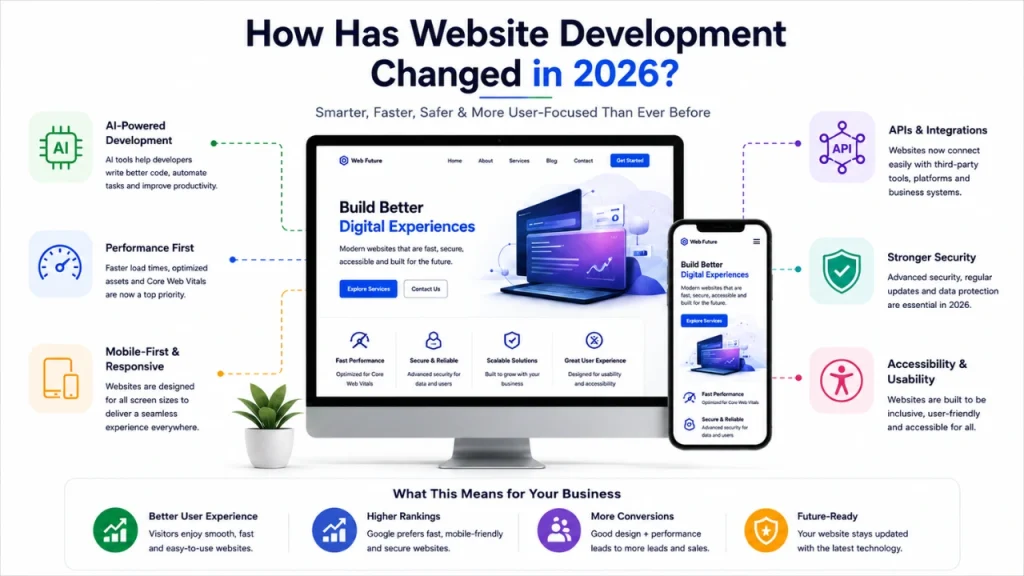
Website development in 2026 is more focused on performance, accessibility, security, responsive experiences, and maintainable technology than simply creating static pages.
Modern websites are expected to work across different browsers and devices while providing fast interactions and clear navigation. Developers also need to consider how websites connect with external services, how data is handled, and how new functionality can be added without creating unnecessary technical problems.
Accessibility has also become a more important part of web development. Modern web standards and browser capabilities increasingly support accessible interfaces without requiring developers to recreate basic browser behavior with unnecessary custom code.
Performance is another major consideration. Developers need to pay attention to loading behavior, JavaScript execution, image sizes, caching, server performance, and Core Web Vitals. Interaction to Next Paint (INP) is now one of Google’s Core Web Vitals used to evaluate page responsiveness.
Security also needs to be considered throughout development. Websites that handle customer information, accounts, payments, or business data need appropriate authentication, secure connections, access controls, updates, backups, and monitoring.
The result is a development process where design, code, performance, accessibility, security, and SEO need to work together rather than being treated as separate tasks.
What Is the Difference Between Front-End and Back-End Development?
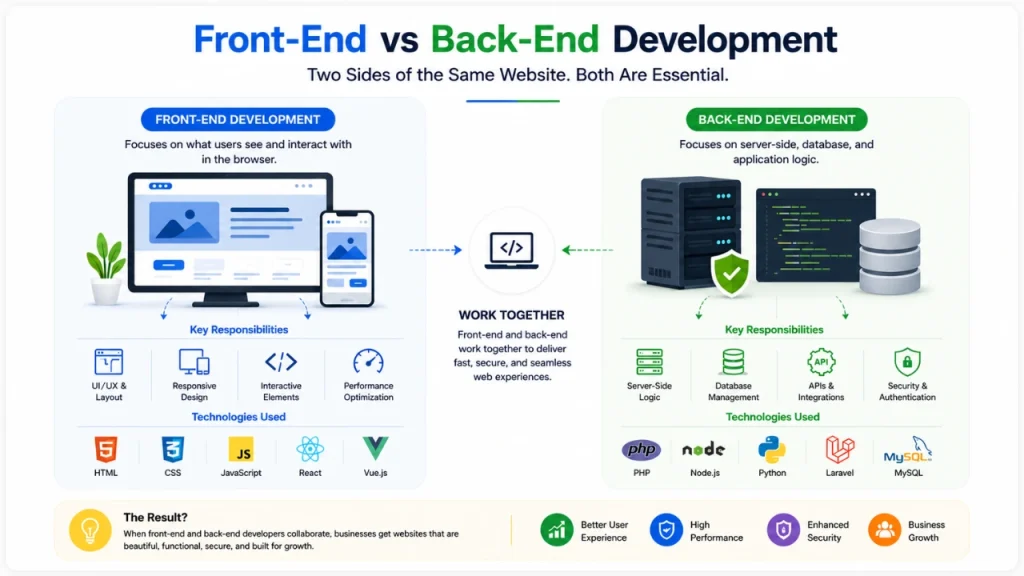
Front-end and back-end development are two major areas of website development.
Front-End Development
Front-end development focuses on the website interface that visitors see and interact with. It includes page structure, responsive layouts, menus, forms, buttons, animations, and interactive components.
Common front-end technologies include HTML, CSS, and JavaScript, along with modern frameworks and libraries where they are appropriate.
Back-End Development
Back-end development manages the systems that operate behind the visible website. It can include databases, authentication, APIs, server-side logic, payments, user accounts, and data processing.
For example, when a customer submits an online form, the front end collects the information while the back end may validate, store, and send that information to a CRM or another business system.
Both areas need to work together. A website cannot provide a reliable user experience if the front end and back end are not properly connected.
Can Web Designers Build a Website Without Programmers?
Some websites can be created with website builders, CMS platforms, themes, and pre-built components without extensive programming. This can work for simple websites that need standard pages and basic functionality.
However, businesses often need features that require custom development. These may include unique forms, API integrations, customer portals, custom dashboards, advanced search, payment workflows, business automation, or connections with internal systems.
In such cases, professional development can provide more control over functionality, performance, security, and long-term maintenance.
The choice depends on the website’s requirements. A simple website does not always need complex custom coding, while a website with advanced business functionality may require experienced developers.
How Do Web Designers and Developers Improve Business Websites?
A business website should support a clear purpose. Depending on the company, that purpose may be generating leads, selling products, receiving bookings, providing information, supporting customers, or creating a platform for users.
Web designers can improve the way visitors experience the website by creating clear page layouts, simple navigation, readable content, consistent branding, and responsive interfaces.
Developers can improve the technical side by building reliable functionality, connecting business tools, improving performance, managing databases, implementing security controls, and making the website easier to maintain.
Together, these areas can help create a website that is:
- Easy to navigate
- Responsive on different devices
- Accessible to more users
- Fast and stable
- Secure
- SEO-friendly
- Easy to maintain
- Ready for integrations
- Scalable as business requirements grow
For businesses planning a complete website project, Social Media Marketing Services can combine design and development requirements into a website structure built around specific business goals.
How Does Website Development Support SEO?
Web development has an important technical role in search engine optimization. Good content alone may not be enough if search engines or users have difficulty accessing and understanding the website.
Developers can support SEO through:
- Mobile-responsive layouts
- Fast page loading
- Clean website architecture
- Search-friendly URLs
- Proper heading structures
- Crawlable navigation
- Internal linking
- Structured data where appropriate
- Image optimization
- Secure HTTPS connections
- Canonical URL implementation
- XML sitemaps
- Technical error management
Design also affects SEO indirectly because poor navigation, difficult-to-read content, intrusive elements, or weak mobile usability can make the website harder for visitors to use.
A strong website development process therefore considers SEO requirements before launch instead of trying to fix every technical issue after the website is already published.
iBirds Digital’s SEO Services can support the technical and content requirements needed to improve search visibility while the website is developed and maintained.
Why Is Website Security Important During Development?
Website security should not be added only after a website is completed. It needs to be considered during development, especially when a website stores customer information, processes payments, provides user accounts, or connects with other business systems.
Developers may need to consider:
- Secure authentication
- User permissions
- Data validation
- HTTPS
- Secure API connections
- Protection against common web vulnerabilities
- Regular software updates
- Secure database practices
- Backups
- Monitoring and maintenance
CMS-based websites also need regular updates for the core platform, themes, and plugins. For example, WordPress 7.0.2 was released on July 17, 2026 as a security release addressing critical and high-severity issues, showing why keeping website software current remains important.
Security is an ongoing responsibility rather than a one-time development task.
For businesses that need ongoing technical protection, Content Writing Services can help with updates, monitoring, performance checks, backups, and regular website maintenance.
Why Should Businesses Work With a Professional Website Development Company?
A professional website development company can bring design, development, SEO, performance, security, and business requirements together during the same project.
This can be especially useful when a website requires custom functionality or connections with other business systems. Instead of selecting separate solutions without considering how they work together, the project can be planned around the complete customer journey and technical requirements.
A professional development team can help with:
- Website planning
- UI and UX design
- Responsive website development
- Custom functionality
- CMS development
- eCommerce development
- API integrations
- Database development
- Website migrations
- Performance optimization
- Technical SEO
- Security
- Website maintenance
The right approach depends on the size and requirements of the business. A small company website may need a simple and manageable setup, while an enterprise website may require custom architecture, integrations, multiple user roles, and ongoing technical support.
iBirds Digital provides Professional Website Development Services for businesses that need websites designed around their goals, customers, functionality, performance, and future requirements.
Frequently Asked Questions
1. What does a web designer do in website development?
A web designer focuses on the visual structure and user experience of a website. Their work can include layouts, typography, colors, navigation, responsive design, page structure, and interface elements.
2. What is the role of a web developer?
A web developer builds the technical functionality of a website. Depending on the project, this can include front-end interfaces, back-end systems, databases, APIs, forms, authentication, integrations, and other website features.
3. What is the difference between a web designer and a web developer?
A web designer mainly focuses on how a website looks and how users interact with it, while a web developer focuses on how the website works technically. Larger projects often need both roles.
4. Can a business website be created without a web developer?
Simple websites can sometimes be created using website builders or CMS platforms with pre-built features. Custom functionality, integrations, databases, advanced forms, and complex business processes usually require professional development.
5. Why are responsive web design and development important?
Responsive design allows a website to adjust to different screen sizes and devices. It helps visitors use the website more easily on smartphones, tablets, laptops, and desktops.
6. What technologies are used for modern website development?
Modern website development can use HTML, CSS, JavaScript, PHP, Python, databases, APIs, CMS platforms, and different frameworks or libraries. The technology depends on the project’s functionality, performance, security, and maintenance requirements.
7. How do web designers and developers work together?
Designers create the visual and user-experience direction, while developers turn that direction into a working website. Collaboration between both roles helps ensure that the final website is attractive, functional, responsive, and technically reliable.
8. Can web development improve SEO?
Yes. Developers can create an SEO-friendly technical foundation through mobile responsiveness, site structure, performance optimization, crawlable navigation, clean URLs, structured data, internal linking, and other technical practices.
9. How much does professional website development cost?
The cost depends on the number of pages, design requirements, custom functionality, integrations, eCommerce features, content, hosting, and ongoing maintenance. A custom project assessment is usually more useful than applying one fixed price to every website.
10. How long does it take to develop a business website?
The timeline depends on the website’s size, design, content, functionality, integrations, testing requirements, and approval process. A simple business website may require less time than a custom platform with advanced functionality.
11. Should businesses choose custom website development?
Custom development can be useful when a business needs functionality that standard themes, plugins, or website builders cannot provide efficiently. It gives developers greater control over features, integrations, performance, and future changes.
12. How can a business start a website development project?
The process normally starts by defining business goals, target users, required pages, design preferences, functionality, integrations, content, and technical requirements. These requirements can then be converted into a website plan and development process.