Which On-Page Element Carries the Most Weight for SEO? If you’re looking for a quick answer, the title tag carries the strongest direct SEO weight among individual HTML elements because it tells search engines what your page is about. However, ranking on Google isn’t determined by the title tag alone. Helpful content that matches search intent, logical page structure, internal linking, and a great user experience all work together to improve your rankings. In this guide, we’ll explain what really matters in modern on-page SEO and how you can optimize every important element to achieve better organic visibility.
Whether you’re a business owner, blogger, or digital marketer, understanding these ranking signals will help you focus on the changes that actually make a difference instead of wasting time on outdated SEO myths.
What Is On-Page SEO?
On-page SEO is the process of optimizing everything within a webpage so search engines can understand its topic and users can easily find the information they’re looking for.
Unlike off-page SEO, which focuses on backlinks and brand authority, on-page SEO gives you complete control over how your content is presented.
Some of the most important on-page SEO elements include:
- Title tags
- High-quality content
- Heading structure (H1, H2, H3)
- URL structure
- Internal linking
- Image optimization
- Meta descriptions
- Page speed and mobile usability
Each of these elements contributes to your page’s performance, but not all of them have the same impact. Knowing where to focus your efforts can save time and deliver better SEO results.
If you’re building a long-term organic growth strategy, it’s important to combine on-page optimization with technical improvements and quality backlinks. At iBirds Digital, Our SEO Services follow this holistic approach to help businesses improve rankings and generate sustainable organic traffic.
Which On-Page Element Carries the Most Weight for SEO?
This question has sparked debates for years, but the answer becomes much clearer when you separate HTML elements from overall ranking factors.
The strongest individual HTML element:
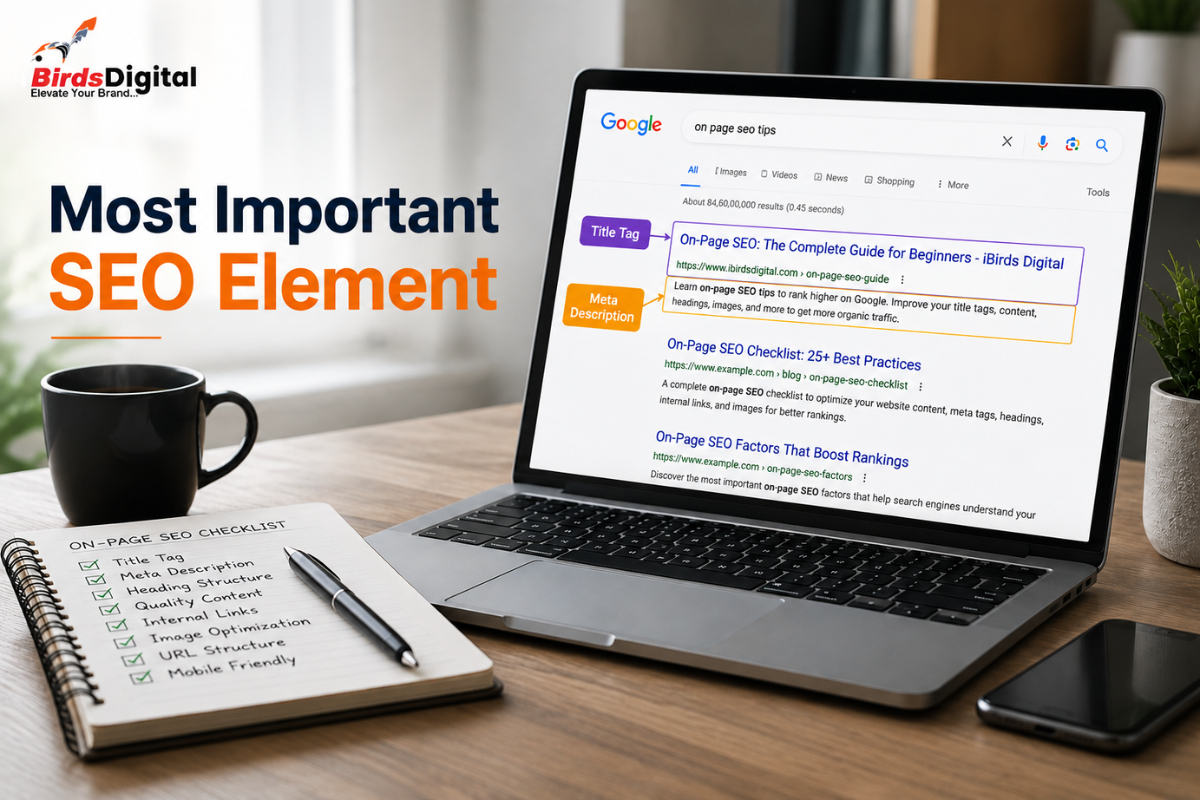
Title Tag
The strongest overall on-page ranking factor:
Helpful, search intent-focused content
Many articles stop after saying “the title tag is the most important.” While technically true for HTML elements, it doesn’t tell the whole story.
Imagine you write an excellent title like:
Which On-Page Element Carries the Most Weight for SEO? A Practical Guide
Now imagine the page contains only 400 words of generic information copied from other websites.
Will that title alone help you rank?
Probably not.
Google’s ranking systems are designed to reward pages that genuinely answer a user’s question. If your content is incomplete, outdated, or fails to satisfy search intent, a perfectly optimized title tag won’t be enough.
That’s why successful SEO is never about optimizing a single element. It’s about making every important part of your page work together.
Why the Title Tag Carries So Much SEO Weight
Even with hundreds of ranking signals, the title tag remains one of the most influential on-page SEO elements because it serves multiple purposes.
It Helps Google Understand Your Page
The title tag is one of the first pieces of information search engines evaluate when crawling a page.
A clear, descriptive title immediately communicates the topic.
For example:
Which On-Page Element Carries the Most Weight for SEO?
is far more informative than:
SEO Guide
The first title tells both Google and users exactly what the page covers, making it easier to match with relevant search queries.
It Improves Click-Through Rate (CTR)
Your title tag is usually the first thing people notice in search results.
Even if your page ranks well, users won’t click if the title is vague or uninteresting.
A good title should:
- Include the primary keyword naturally.
- Explain what readers will learn.
- Encourage curiosity without being misleading.
- Stay within Google’s recommended display length.
A higher click-through rate doesn’t automatically improve rankings, but it often leads to more qualified traffic and stronger engagement.
It Builds Consistency Across Platforms
Your title tag doesn’t only appear in Google Search.
It can also be displayed in:
- Browser tabs
- Social media previews
- Messaging apps
- Bookmarks
- AI-powered search experiences
This makes it one of the most visible elements of your webpage.
Why Helpful Content Matters Even More
If the title tag attracts visitors, your content is what convinces Google that your page deserves to rank.
Modern search engines no longer reward pages simply because they contain the right keywords. Instead, they evaluate whether the content provides genuine value.
Helpful content should:
- Answer the user’s question clearly.
- Cover important related topics.
- Include original insights or practical examples.
- Be easy to read and navigate.
- Stay updated as industry trends change.
For example, someone searching for:
“Which On-Page Element Carries the Most Weight for SEO?”
doesn’t just want to know that the title tag is important.
They also want answers to questions like:
- Why does it matter?
- Is content more important than title tags?
- Do headings affect rankings?
- How important are internal links?
- What mistakes should I avoid?
Pages that answer these follow-up questions naturally are far more likely to perform well because they satisfy search intent completely.
This is exactly why businesses invest in professional Content Marketing Services. High-quality content not only improves rankings but also builds trust, increases engagement, and supports long-term lead generation.
Title Tag vs. Content: Which Should You Prioritize?
Instead of treating them as competing factors, think of them as partners.
| On-Page Element | Why It Matters | SEO Impact |
|---|---|---|
| Title Tag | Defines the page topic and improves click-through rate | ⭐⭐⭐⭐⭐ |
| Content Quality | Satisfies search intent and demonstrates expertise | ⭐⭐⭐⭐⭐ |
| H1 Heading | Reinforces page relevance | ⭐⭐⭐⭐☆ |
| Internal Linking | Helps Google understand your website structure | ⭐⭐⭐⭐☆ |
| URL Structure | Improves clarity and usability | ⭐⭐⭐☆☆ |
| Meta Description | Encourages clicks from search results | ⭐⭐☆☆☆ |
| Image Optimization | Supports accessibility and image search | ⭐⭐⭐☆☆ |
The key takeaway is simple:
A great title gets users to click. Great content gives them a reason to stay.
When these two elements work together, your chances of ranking—and keeping those rankings—improve significantly.
A Real-World Example
Let’s say two companies publish articles targeting the same keyword.
Website A
- Optimized title tag
- 500-word article
- No internal links
- Generic information
- No examples or visuals
Website B
- Keyword-focused title tag
- Comprehensive, well-structured guide
- Helpful comparison tables
- Practical examples
- Relevant internal links to Link Building Services and Web Development Services
- Optimized images and headings
Even though both websites optimized their title tags, Website B has a much stronger chance of ranking because it provides a better overall experience for readers.
This reflects how modern SEO works. Search engines don’t reward individual elements in isolation—they reward pages that solve problems better than competing results.
What Google Really Wants
One of the biggest misconceptions in SEO is that there is a single ranking factor that guarantees success.
In reality, Google’s goal is much simpler: show users the most helpful and relevant page for their search.
That means your page should:
- Clearly answer the main question.
- Provide trustworthy and accurate information.
- Be easy to read on all devices.
- Help users discover related information through meaningful internal links.
- Offer enough depth that readers don’t need to return to Google for another answer.
If you focus on creating genuinely useful pages instead of chasing shortcuts, you’ll build stronger rankings that last through future algorithm updatesHow Heading Tags (H1, H2, and H3) Strengthen Your SEO
Once you’ve written a compelling title and high-quality content, the next step is organizing that content effectively. This is where heading tags play an important role.
Heading tags help break your content into logical sections, making it easier for both users and search engines to understand the page.
Here’s how they should be used:
- H1: The main title of your page (use only one).
- H2: Main sections of your content.
- H3: Supporting points within each H2.
For example, this guide uses H2 headings to explain major topics like title tags, internal linking, and image optimization. Under each H2, H3 headings provide more detailed explanations.
A clear heading structure offers several benefits:
- Improves readability.
- Makes long articles easier to scan.
- Helps search engines understand the relationship between topics.
- Increases the chances of appearing in Featured Snippets for question-based searches.
While headings alone won’t improve rankings, they strengthen the overall relevance and usability of your content.
Internal Linking: The Secret Behind Strong Website Authority
Internal linking is often overlooked, yet it’s one of the easiest ways to improve your website’s SEO.
An internal link connects one page on your website to another relevant page. These links help Google discover content, understand your site’s structure, and distribute authority across important pages.
For example, if someone is reading about on-page SEO, they may also be interested in learning about:
- SEO Services
- Content Marketing Services
- Link Building Services
- Web Development Services
Connecting related pages naturally creates a better user experience and encourages visitors to spend more time on your website.
Best Practices for Internal Linking
- Link only to relevant pages.
- Use descriptive anchor text instead of “Click Here.”
- Avoid adding too many links in a single paragraph.
- Update older blog posts with links to newly published content.
A strong internal linking strategy doesn’t just help search engines—it also helps your visitors discover more valuable content.
URL Structure: Keep It Short, Clear, and Descriptive
URLs are a small ranking signal, but they contribute to a better user experience.
Compare these examples:
❌ yourwebsite.com/blog/post?id=456
✅ yourwebsite.com/blog/most-important-on-page-seo-element
A clean URL immediately tells users what the page is about.
URL Best Practices
- Keep URLs short.
- Include your primary keyword naturally.
- Use hyphens between words.
- Avoid unnecessary dates or numbers.
If your page is already live, avoid changing the URL unless absolutely necessary. If you do change it, always set up a 301 redirect to preserve your existing SEO value.
Meta Descriptions: Small Detail, Big Impact
Meta descriptions don’t directly improve rankings, but they can influence how many people click on your page.
Think of your meta description as a short advertisement for your content.
A good meta description should:
- Explain what the page is about.
- Include the primary keyword naturally.
- Encourage users to click.
- Stay under 155 characters.
Example
Weak Meta Description
Learn about on-page SEO.
Better Meta Description
Discover which on-page element carries the most weight for SEO and learn practical strategies to improve your Google rankings.
A compelling description can improve your click-through rate, helping you attract more visitors from search results.
Image Optimization: An Easy SEO Win
Images make your content more engaging, but they also provide additional SEO opportunities.
Before uploading an image, make sure to:
- Rename the file descriptively.
- Compress it for faster loading.
- Add relevant alt text.
- Use high-quality images.
For example:
File Name
title-tag-on-page-seo-guide.jpg
Alt Text
“Which On-Page Element Carries the Most Weight for SEO”
This helps search engines understand the image while improving accessibility for users with screen readers.
Adding diagrams, comparison charts, screenshots, or infographics also makes your content more engaging and shareable.
Which On-Page Element Carries the Most Weight for SEO? Understanding this helps you prioritize the right optimization tasks instead of focusing on outdated SEO techniques.
Common On-Page SEO Mistakes to Avoid
Even well-written content can struggle if basic SEO mistakes are overlooked.
Here are some of the most common issues:
1. Writing for Search Engines Instead of People
If your content feels repetitive or unnatural because you’re forcing keywords everywhere, readers will quickly lose interest.
Always write for people first.
2. Ignoring Search Intent
If users are looking for a practical guide, don’t give them a short definition.
Study the current search results and understand what users actually expect before creating content.
3. Publishing Thin Content
A page that briefly answers a question without providing useful insights rarely performs well against comprehensive resources.
Depth matters—but only when it’s relevant.
4. Skipping Internal Links
Publishing blogs without connecting them to other pages weakens your website’s overall authority.
Every new article should strengthen your existing content.
5. Forgetting Mobile Optimization
Most searches now happen on mobile devices.
Always ensure your pages load quickly and display correctly across different screen sizes.
On-Page SEO Checklist
Before publishing any webpage, go through this checklist:
✅ Write a unique title tag.
✅ Include your primary keyword naturally.
✅ Create helpful, original content.
✅ Use one H1 heading.
✅ Organize content with H2 and H3 headings.
✅ Add internal links to related pages.
✅ Optimize images and alt text.
✅ Write an engaging meta description.
✅ Keep your URL clean and readable.
✅ Check mobile responsiveness.
✅ Improve page speed.
✅ Proofread your content before publishing.
Following this process consistently will help improve both user experience and search performance.
Final Thoughts
So, which on-page element carries the most weight for SEO?
If we’re talking about a single HTML element, the answer is the title tag. It plays a critical role in helping search engines understand your page and encouraging users to click on your result.
However, modern SEO is about much more than one element.
The websites that consistently rank well combine optimized title tags, high-quality content, clear headings, smart internal linking, image optimization, and a positive user experience. These elements work together to create pages that genuinely help users—and that’s exactly what Google aims to reward.
Instead of chasing shortcuts or relying on outdated SEO tactics, focus on creating valuable content supported by strong on-page optimization. That’s the strategy that delivers sustainable rankings over time.
If you’re looking to improve your website’s visibility, generate more qualified traffic, and grow your business online, iBirds Digital can help. Our team specializes in SEO, content marketing, technical optimization, and link-building strategies designed to deliver long-term results. Get in touch with us today to discuss how we can help your business rank higher on Google.
Frequently Asked Questions
1. Which on-page element carries the most weight for SEO?
The title tag is the strongest individual HTML element for on-page SEO. However, helpful content that satisfies search intent has the greatest overall impact on rankings.
2. Is content more important than the title tag?
Both are essential. The title tag helps search engines understand your page, while high-quality content determines whether your page meets user expectations and deserves to rank.
3. Do H1 headings affect SEO?
Yes. H1 headings reinforce your page topic and improve content structure, making it easier for both users and search engines to understand your content.
4. Are meta descriptions a ranking factor?
No. Meta descriptions don’t directly influence rankings, but they can improve click-through rates by making your search listing more appealing.
5. Which On-Page Element Carries the Most Weight for SEO?
A. The title tag is the strongest individual HTML element, but helpful content, internal linking, and search intent are equally important for long-term rankings.
6. Can I rank with good on-page SEO alone?
For low-competition keywords, strong on-page SEO may be enough. For highly competitive topics, combining on-page optimization with quality backlinks and technical SEO usually delivers the best results.